Jurassic Dinos editorial · Updated · Source-based review
What is Acrocanthosaurus?
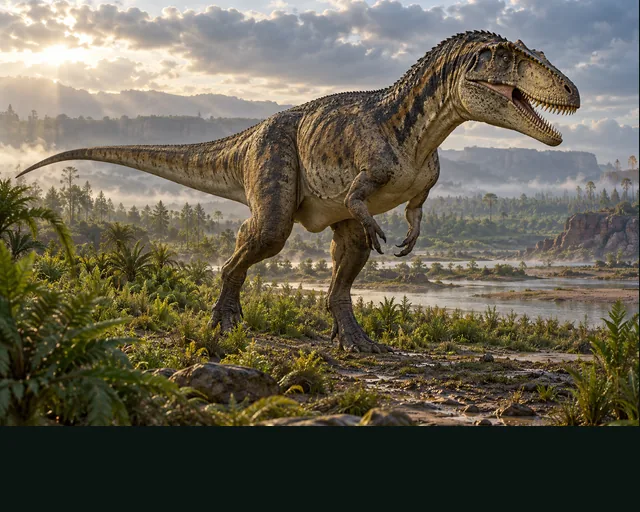
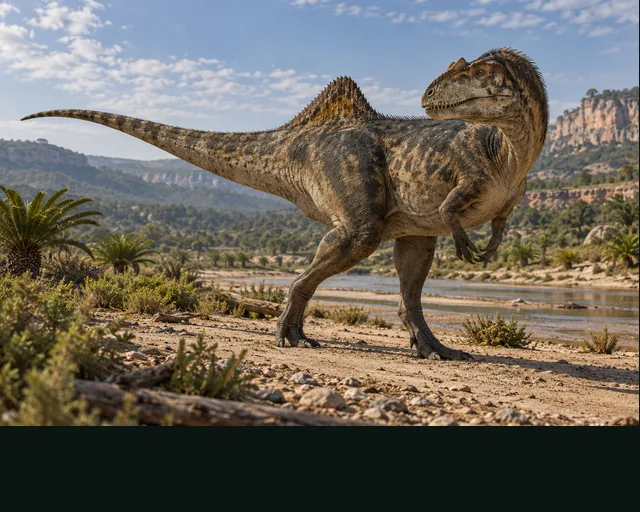
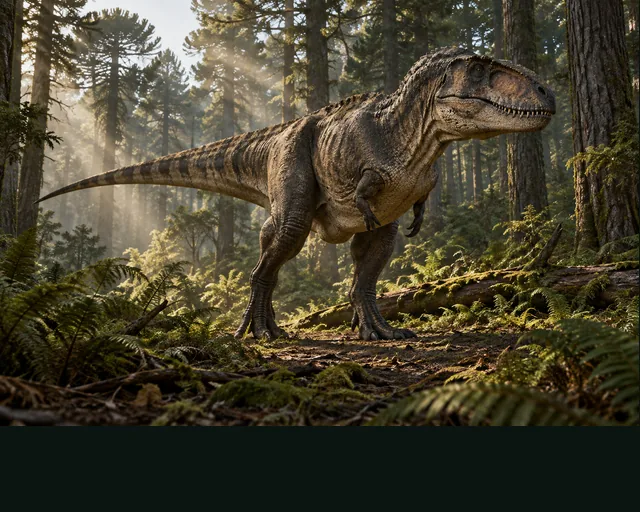
Acrocanthosaurus was a large North American theropod distinguished by tall spines along its neck, back and hips.
Distinctive features and evidence
The elevated vertebral spines are the basis for its name. They should not automatically be drawn as the same kind of sail seen in Spinosaurus, and widely referred fragmentary fossils may not all represent the same species.
Genus overview and research references.
Acrocanthosaurus fossil discoveries
The first bones, found in Atoka County, Oklahoma, in the early 1940s, were two partial skeletons and some skull pieces. J. Willis Stovall and Wann Langston Jr. named the genus in 1950. Much better skeletons appeared in the 1990s, including a partial skeleton from Texas and a specimen nicknamed “Fran”, now in the North Carolina Museum of Natural Sciences, which includes the only known complete skull and forelimb.
In 2012 a juvenile from Wyoming was added, and in 2024 an incomplete skeleton from the Arundel Formation in Maryland was identified as a young Acrocanthosaurus, the first firm record from eastern North America. Many other teeth and bones have been linked to the genus, though some of those identifications are doubtful.
How big was Acrocanthosaurus?
The largest specimen, “Fran”, had a skull of about 1.2 to 1.3 metres and a body length estimated at 11 to 12 metres. Its weight has been estimated by several methods, giving a wide range of about 4.4 to 8.4 tonnes. That puts it among the largest known theropods.
A row of tall bony spines ran along its neck, back, hips and upper tail, in places more than two and a half times the height of the vertebrae they grew from. They probably supported a thick ridge of muscle. Researchers have suggested that the spines might also have helped with display, fat storage or temperature control, but the function is not known.
Is Acrocanthosaurus a carcharodontosaurid?
Most studies say yes. The genus is usually placed in Carcharodontosauridae, near the base of the family, with the later giants Carcharodontosaurus and Giganotosaurus. It was once grouped with Allosaurus in the family Allosauridae, and for a time its tall spines even led some authors to link it with Spinosaurus.
A CT scan of the braincase made in 2005 found a brain most like those of Carcharodontosaurus and Giganotosaurus, which supports the carcharodontosaurid placement. The later description of another carcharodontosaurid, Tameryraptor, listed differences between the best specimen and the type material, suggesting that North American carcharodontosaurids may be more varied than once thought.
How did Acrocanthosaurus hunt?
Its arms were short and strong, and a study of the best forelimb found they could not swing far forward. The authors concluded that Acrocanthosaurus probably led with its jaws and may have used its arms to hold prey after biting. This is an interpretation based on joint movement, not observed behaviour.
Large three-toed tracks in the Glen Rose Formation of Texas may belong to Acrocanthosaurus, since it is the only large theropod known from rocks of that age and place, but no bones are linked to them. One famous trackway has been used to suggest a small group stalking sauropods, yet other explanations, such as separate animals passing at different times, fit the evidence as well.
When and where did Acrocanthosaurus live?
Acrocanthosaurus lived in North America in the Early Cretaceous, with fossils from Oklahoma, Texas, Wyoming, Utah, Arizona and Maryland. The rock units have not been dated radiometrically, so the age comes from fossils in them, and the estimate is roughly 125 to 100 million years ago. Databases give slightly different ranges.
The Texas and Oklahoma deposits record a broad floodplain draining into a shallow sea. Possible prey include sauropods and the large ornithopod Tenontosaurus, and the smaller Deinonychus lived in the same region.
Classification and fossil record
The Paleobiology Database taxonomic record catalogues Acrocanthosaurus under Carcharodontosauridae. This is the immediate parent in that catalogue, rather than a complete list of evolutionary relationships.
The corroborated occurrence sample includes United States; those are modern discovery locations, not a complete ancient geographic range.
The sourced length estimate for Acrocanthosaurus is 11–12 metres. This is an estimate for the reconstructed animal, not a measurement shared by every individual. See the body-size discussion and linked evidence for context.
Research starting point
The catalogue links Acrocanthosaurus to Stovall and Langston, Jr., 1950, published in American Midland Naturalist. This identifies a research starting point; the catalogue’s citation alone does not verify every later reconstruction or species assignment.
For the meaning of taxonomic terms and how evidence is checked, see the glossary and editorial policy.
Quick answers
- Is Acrocanthosaurus a dinosaur?
- Yes. Acrocanthosaurus was a large meat-eating theropod dinosaur, a carcharodontosaurid that lived in North America during the Early Cretaceous.
- How big was Acrocanthosaurus?
- The largest specimen is estimated at 11 to 12 metres long, and weight estimates run from about 4.4 to 8.4 tonnes, depending on the method used.
- When did Acrocanthosaurus live?
- Roughly 125 to 100 million years ago, in the Early Cretaceous. The age is inferred from fossils in the rock units, since they have not been radiometrically dated.
- Is Acrocanthosaurus a carcharodontosaurid?
- Most studies place it in Carcharodontosauridae, near the base of the family, though it was once classed with Allosaurus. Its brain shape resembles that of Giganotosaurus.
- What does Acrocanthosaurus mean?
- High-spined lizard. The name refers to the tall spines on its neck, back and hip vertebrae that probably anchored a ridge of muscle.