Jurassic Dinos editorial · Updated · Source-based review
What is Mapusaurus?
Mapusaurus was a large Argentine carcharodontosaurid known from a multi-individual Huincul Formation bonebed.
Distinctive features and evidence
A bonebed establishes that several animals were preserved together; it does not directly demonstrate cooperative hunting. The cached overview’s stage assignment requires primary-source checking before an exact numerical age is published.
Genus overview and research references.
Mapusaurus fossil discoveries
The first Mapusaurus bones were found in 1997 by the Argentinian-Canadian Dinosaur Project, at a site called Cañadón del Gato in Neuquén Province, Argentina. The site lies roughly 20 kilometres from the town of Plaza Huincul. The team first believed they had a single large skeleton. During preparation it became clear that the bones belonged to several animals of different sizes and ages.
Excavation continued until 2001 and produced hundreds of bones from at least seven to nine individuals. Rodolfo Coria and Philip Currie described the genus in 2006, choosing a right nasal bone (from the snout) as the name-bearing specimen. The species name roseae honours both the rose-coloured rock and Rose Letwin, who sponsored the fieldwork. The bonebed is unusual because the Huincul Formation normally gives only isolated or fragmentary remains.
How big was Mapusaurus?
The animals in the bonebed ranged from about 5.5 to 10.2 metres long, judging from the smallest jaw and the largest thigh bone. Later authors suggested maximum lengths of roughly 10.2 to 12.6 metres and weights of 6 to 8 tonnes, so published numbers are estimates that differ between studies; the Natural History Museum’s Dino Directory lists a single figure of 13 metres.
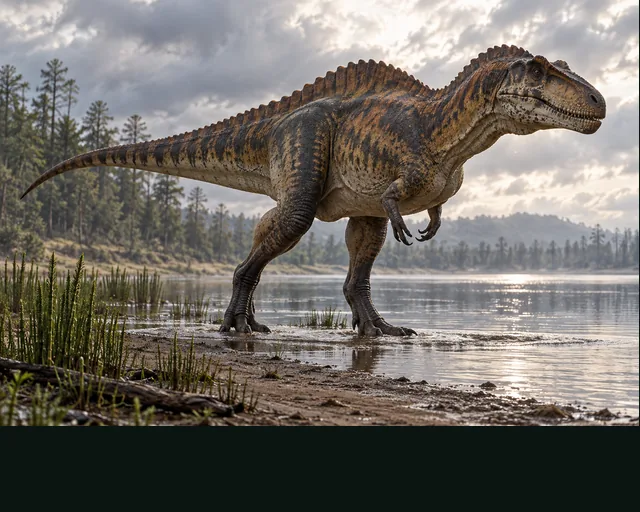
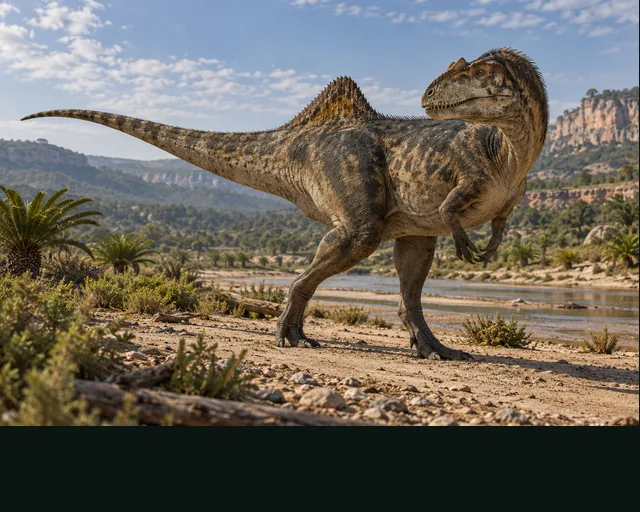
Mapusaurus looked much like Giganotosaurus but had a deeper, narrower skull, with a rougher surface on the snout bones. Its arms were very short: the upper arm bone was only about a quarter of the length of the thigh bone.
Did Mapusaurus hunt in packs?
This is the most common question about the genus, and the evidence is weaker than the headlines suggest. Coria and Currie suggested in 2006 that the bonebed might be a long-term, possibly coincidental, collection of carcasses, perhaps a kind of trap. In 2016 Coria said the pile of bones might also indicate group hunting of giant prey such as the titanosaur Argentinosaurus. A bonebed shows that several animals died and were buried in one place, and by itself it does not show that they lived or hunted together.
The bones do show some signs of hard lives. A few carry healed rib fractures and one neck vertebra seems to have been infected, but only about 2.8% of the bones were affected, and none of the injuries were the cause of death.
Is Mapusaurus a carcharodontosaurid?
Yes. Mapusaurus belongs to Carcharodontosauridae, the family named for Carcharodontosaurus. Within it, studies group Mapusaurus with Giganotosaurus, Meraxes and Tyrannotitan in a South American group of giant predators, separate from the African Carcharodontosaurus.
Another Huincul carcharodontosaurid, Taurovenator, was once suggested to be a synonym of Mapusaurus, but a 2024 study of a more complete specimen found it a separate animal, from lower rock layers than Mapusaurus.
Where and when Mapusaurus lived
Mapusaurus is known only from the Huincul Formation in the Neuquén Basin, Patagonia, where river sands were laid down by a braided river system. Fossil pollen shows a rich plant community of ferns, conifers and flowering plants. Neighbours included the huge titanosaurs Argentinosaurus and Choconsaurus, other carcharodontosaurids and many smaller theropods.
The age is reported differently. The Paleobiology Database and recent descriptions place it in the Albian stage of the Early Cretaceous, about 110 to 106 million years ago, while the Natural History Museum lists the Late Cretaceous and earlier studies suggested a Cenomanian to Turonian age. Treat any single date as approximate.
Classification and fossil record
The Paleobiology Database taxonomic record catalogues Mapusaurus under Carcharodontosauridae. This is the immediate parent in that catalogue, rather than a complete list of evolutionary relationships.
The corroborated occurrence sample includes Argentina; those are modern discovery locations, not a complete ancient geographic range.
Research starting point
The catalogue links Mapusaurus to Coria and Currie, 2006, published in Geodiversitas. This identifies a research starting point; the catalogue’s citation alone does not verify every later reconstruction or species assignment.
For the meaning of taxonomic terms and how evidence is checked, see the glossary and editorial policy.
Geological age clarification
The original Mapusaurus description identifies Upper Cretaceous material. The conflicting Albian label in older overview and catalogue records is not used as a precise age.
Quick answers
- Is Mapusaurus a dinosaur?
- Yes. Mapusaurus was a giant theropod dinosaur of the family Carcharodontosauridae, found in Argentina.
- How big was Mapusaurus?
- Estimates for the largest individuals range from roughly 10 to 12.6 metres in length and 6 to 8 tonnes, based on a thigh bone and other parts. The numbers are estimates.
- Did Mapusaurus hunt in packs?
- It is not known. Its fossils come from a bonebed of at least seven to nine animals, but a bonebed alone does not prove cooperative hunting, and the animals may have died at different times.
- Is Mapusaurus related to Giganotosaurus?
- Yes. Both belong to Carcharodontosauridae and are grouped together with Meraxes and Tyrannotitan in a South American tribe of giant predators.
- Where was Mapusaurus found?
- All known fossils come from the Huincul Formation near Plaza Huincul, Neuquén Province, Patagonia, Argentina.