Jurassic Dinos editorial · Updated · Source-based review
What is Concavenator?
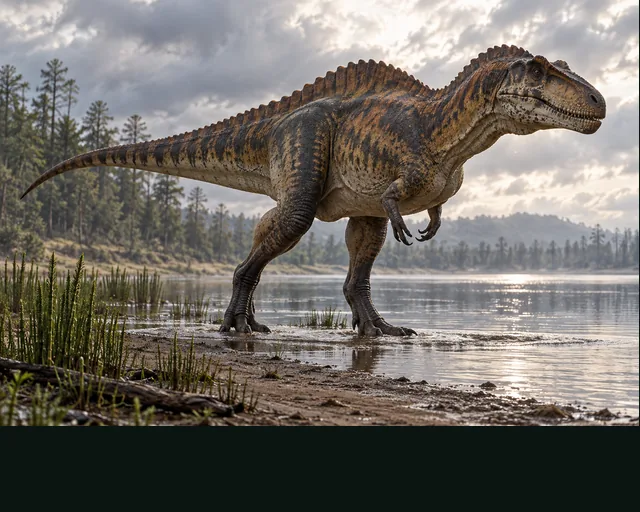
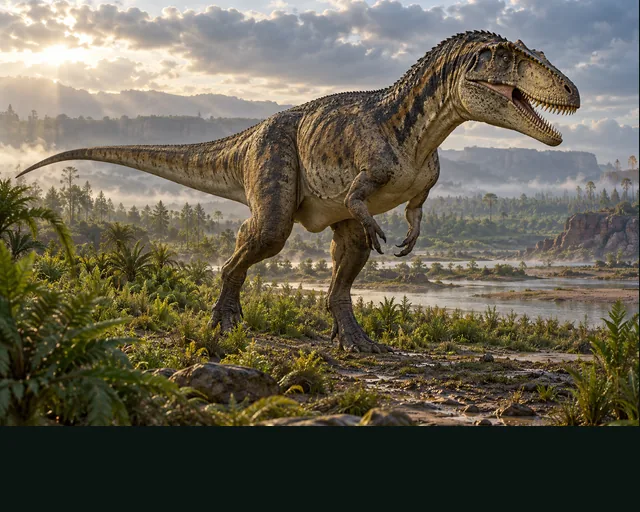
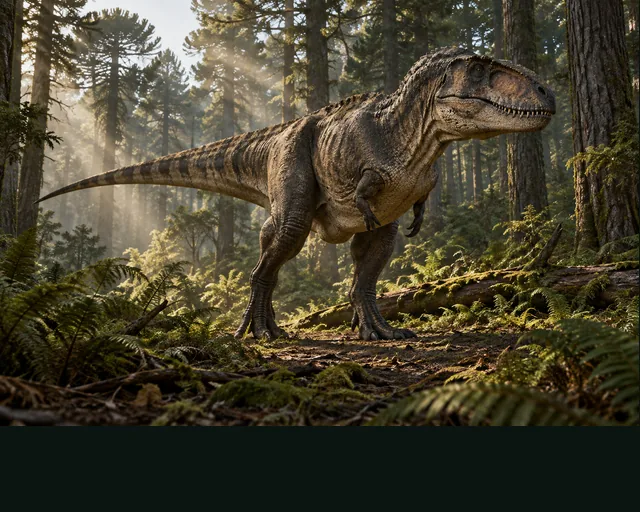
Concavenator was an Early Cretaceous Spanish theropod with elevated spines over the rear part of its back.
Distinctive features and evidence
A nearly complete Las Hoyas skeleton anchors its unusual profile. Its localized raised structure differs from the extensive ridge of Acrocanthosaurus; the exact soft-tissue covering and function remain reconstruction questions.
Genus overview and research references.
Concavenator fossil discoveries
Concavenator is known from one remarkable skeleton. It was found in limestone slabs at Las Hoyas in Cuenca Province, Spain, a site noted for the exceptional quality of its fossils. The skeleton was found articulated, meaning the bones were still joined in their natural positions, and nearly complete: it includes the skull, ten neck vertebrae, thirteen back vertebrae, five hip vertebrae, thirty tail vertebrae, part of an arm and shoulder, the pelvis and parts of the legs.
In 2010, Francisco Ortega, Fernando Escaso and José Luis Sanz described it, and it is kept at the Science Museum of Castilla-La Mancha. Some parts were deliberately left inside the rock because the skin traces were so delicate. More studies followed, including an examination of the foot skin in 2015 and detailed redescriptions of the skeleton in 2018.
How big was Concavenator?
Concavenator was a medium-sized meat-eater. Estimates give a length of about 5 to 6 metres, and the Natural History Museum lists 6 metres. One published estimate puts its weight at roughly 320 to 400 kilograms. The skull is about 63 centimetres long. Because only one skeleton is known, these figures come from a single animal.
Why did Concavenator have a hump?
The most unusual feature of Concavenator is on its back. Two of the vertebrae just in front of the hips are extremely tall, forming a narrow, pointed crest. In most related dinosaurs these spines are much lower. Scientists cannot say what the crest held up in life, whether a fleshy hump or a thin skin sail.
Its purpose is just as uncertain. One suggestion is that it was a display signal, for example to help members of the species recognise each other; the Spanish describers also suggested it could have helped regulate body temperature. None of these ideas has been tested, and the bone shape alone cannot settle them.
Did Concavenator have feathers?
Scientists disagree. The ulna, one of the forearm bones, has a row of small bumps that the describing team interpreted as quill knobs, the marks left where feather-like structures anchor to a bone. If correct, Concavenator might have had simple quill-like structures on its arm.
Other researchers think the bumps are muscle or ligament scars. The ulna is also somewhat distorted, which makes the argument harder to settle. What is directly preserved is scale impressions on the tail and feet, including broad scales on the underside of the tail, and pads on the soles. No skin impressions were found beside the arm, so the arm covering is unknown.
Is Concavenator a spinosaur?
No. The tall back spines may remind people of the sail of Spinosaurus, but Concavenator belongs to the carcharodontosaurids, a different group of large theropods. Its famous relatives, such as Giganotosaurus, reached much greater sizes. A 2022 analysis recovered Concavenator as an early-branching member of the family, in a tangle with Eocarcharia, Lajasvenator and Lusovenator.
Where and when Concavenator lived
Concavenator lived in the Early Cretaceous, around 125 million years ago. The Natural History Museum gives a range of 130 to 125 million years ago, and the Paleobiology Database places it in the Barremian stage, roughly 125.8 to 121.4 million years ago, so the exact age depends on the source.
Las Hoyas was an inland lake at that time, and its fossils include plants, fishes, worms and prehistoric crocodiles. Other European dinosaurs from this age include the spinosaurid Baryonyx, as well as Iguanodon and Hypsilophodon.
Classification and fossil record
The Paleobiology Database taxonomic record catalogues Concavenator under Carcharodontosauridae. This is the immediate parent in that catalogue, rather than a complete list of evolutionary relationships.
Discovery and naming history
Concavenator corcovatus was described in 2010 from a nearly complete Las Hoyas skeleton. The unusually informative body record makes its back profile a preserved anatomical feature, while interpretations of soft tissues require separate evidence. Historical overview.
The corroborated occurrence sample includes Spain; those are modern discovery locations, not a complete ancient geographic range.
The sourced length estimate for Concavenator is 5–6 metres. This is an estimate for the reconstructed animal, not a measurement shared by every individual. See the body-size discussion and linked evidence for context.
Research starting point
The catalogue links Concavenator to Ortega and Escaco, 2010, published in Nature. This identifies a research starting point; the catalogue’s citation alone does not verify every later reconstruction or species assignment.
For the meaning of taxonomic terms and how evidence is checked, see the glossary and editorial policy.
Quick answers
- Is Concavenator a dinosaur?
- Yes. Concavenator was a medium-sized meat-eating theropod dinosaur in the carcharodontosaurid family, found in Early Cretaceous rocks of Spain.
- When did Concavenator live?
- Around 125 million years ago in the Early Cretaceous. The Natural History Museum gives 130 to 125 million years ago, and the Paleobiology Database places it in the Barremian stage.
- How big was Concavenator?
- About 5 to 6 metres long, with one estimate of 320 to 400 kilograms. Only one skeleton is known, so the figures come from a single animal.
- Is Concavenator a spinosaur?
- No. Its tall back spines resemble a sail, but it is a carcharodontosaurid, in the group of Giganotosaurus and Carcharodontosaurus.
- Did Concavenator have feathers?
- Unknown. Bumps on the forearm may be quill knobs, but other researchers think they are muscle scars. Scale impressions were found on the tail and feet.
- Where was Concavenator found?
- At the Las Hoyas fossil site in Cuenca Province, Spain, in the La Huérguina Formation, and it was described in 2010.