Jurassic Dinos editorial · Updated · Source-based review
What is Spinosaurus?
Spinosaurus was a Late Cretaceous North African spinosaurid with elongated vertebral spines.
Distinctive features and evidence
The original Egyptian remains were destroyed during World War II, and later discoveries changed its reconstruction. Proposed aquatic abilities and alternative species assignments require specific evidence; a game swimming mechanic cannot settle those debates.
Genus overview and research references.
Spinosaurus fossil discoveries
Spinosaurus was first described from Egypt. In 1912 the fossil collector Richard Markgraf, working for the German palaeontologist Ernst Stromer, found a partial skeleton in the Bahariya Formation in the Egyptian desert, and Stromer named it Spinosaurus aegyptiacus in 1915. It included pieces of the jaws, vertebrae with very tall spines, ribs and teeth. A second, poorer skeleton collected in 1914 was described later, in 1934. Stromer’s specimens were kept in Munich, and they were destroyed when the museum was bombed on the night of 24 to 25 April 1944. His drawings and photographs survived, and for decades were all that scientists had.
New material came from Morocco and elsewhere in the 1980s and 1990s, but mostly as isolated teeth and fragments. A major step came in 2008, when a fossil collector showed Italian palaeontologist Nizar Ibrahim fragmentary bones he suspected were Spinosaurus. Ibrahim’s team later traced the source to the Kem Kem beds of Morocco and excavated a partial skeleton of a subadult, now in Casablanca. The team proposed it as a replacement type specimen in 2014, though other scientists have disputed this because it was not found in the same place or in direct association with Stromer’s bones. More tail bones were added from 2015 to 2019. Spinosaurus remains have also been reported from Algeria, Tunisia and Niger.
How big was Spinosaurus?
Spinosaurus is among the largest meat-eating dinosaurs known, but no complete skeleton exists, so every size is an estimate. In 2022 Paul Sereno and colleagues built a 3D model from CT scans of the fossils and put the maximum at about 14 metres long and about 7.4 tonnes. The Natural History Museum uses the same figures, and the museum adds a useful comparison: Spinosaurus was likely longer than any other known meat-eating dinosaur, but its short hind legs meant that Tyrannosaurus stood taller at the hips.
Earlier estimates differed a lot. Some older surveys gave 15 metres or more, and one study scaling from the snout of the related Suchomimus suggested 16 to 18 metres. Researchers have also warned that scaling a whole body from a skull is unreliable in this family. The 2022 team argued that a competing reconstruction had overstated parts of the body, which in turn shifted the estimated centre of mass.
What did Spinosaurus look like?
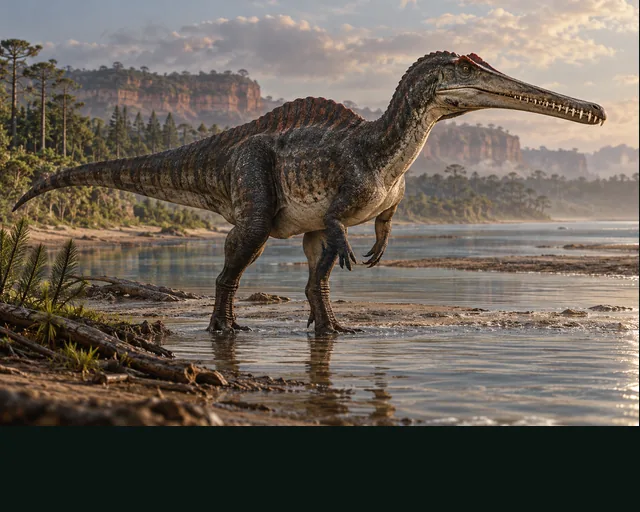
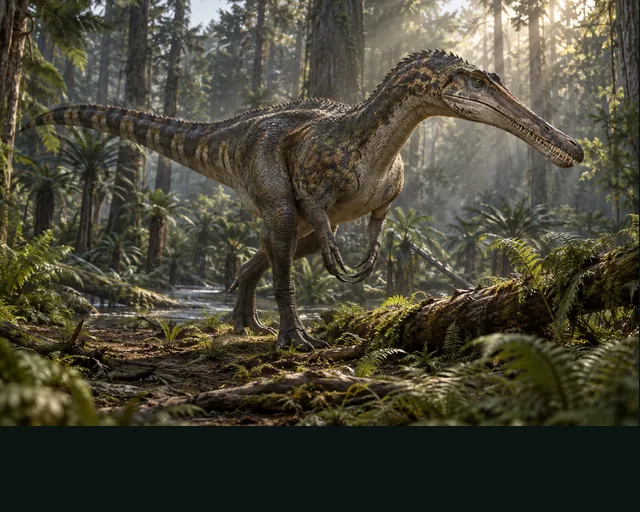
The head was long, low and narrow, with a snout shaped a little like a crocodile’s and straight cone-shaped teeth that had few or no serrations. The very tip of the snout was widened, and the jaws had a notch near the front that suits catching slippery prey. Strong arms ended in hands with three fingers, the first with a large claw.
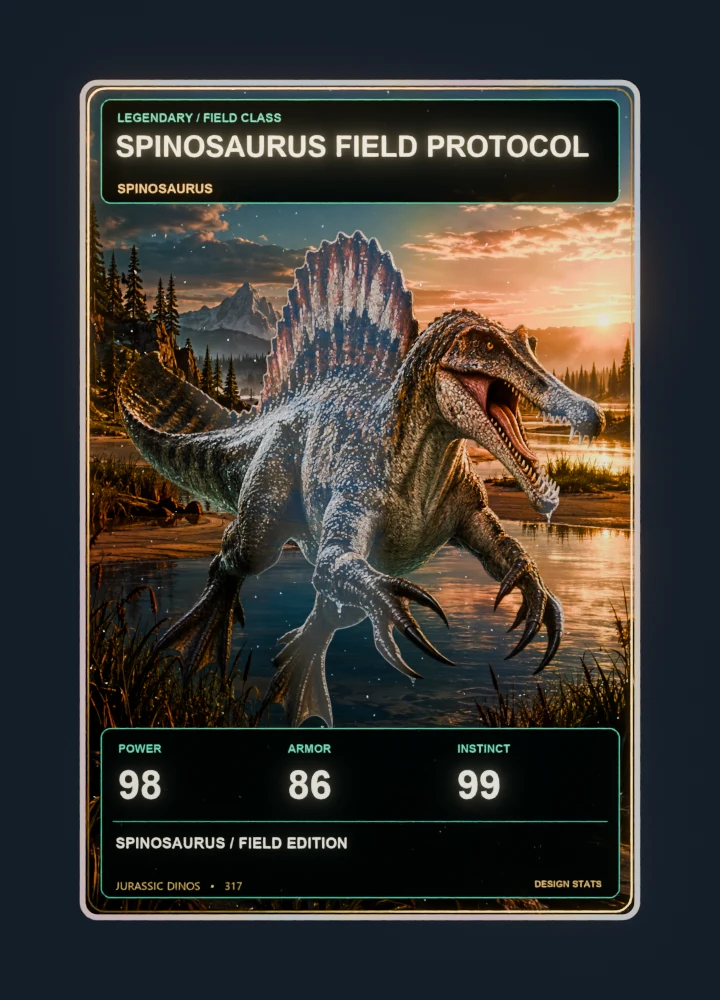
The best-known feature is the tall “sail” made of the elongated spines on the back vertebrae, which reached at least 1.65 metres, with skin most likely stretched between them. The Natural History Museum notes that a thin sail is now favoured over a fatty hump. The legs were short compared with the body, the hip bones were small, and the tail was deep and narrow, with tall spines above and long chevron bones below, forming a paddle-like shape.
Scientists have proposed that the sail helped with temperature control, display to rivals or mates, or even something in the water, but there is no consensus.
Was Spinosaurus aquatic?
This is the main debate, and it has swung back and forth. In 2014 Ibrahim and colleagues presented Spinosaurus as a short-legged, semi-aquatic animal that may have walked on four legs on land. A 2018 study by Donald Henderson argued that it floated too high to dive and was probably more at home on land or in shallow water. In 2020 a more complete tail was described, a deep paddle that gave far more forward thrust in experiments than the tails of land theropods, which was read as evidence for a swimming predator.
Then opinion moved again. In 2021 David Hone and Thomas Holtz argued that it was a shoreline generalist, because its nostrils and body shape would have been awkward for pursuing fish underwater. In 2022 Fabbri and colleagues reported dense bones like those of diving animals, while Sereno’s team, using a flesh model, concluded that Spinosaurus was a bipedal walker on land and an unstable, slow swimmer at the surface, best described as a semi-aquatic ambush hunter of fish at the edges of rivers and coasts. A 2024 study compared its hunting style with that of wading birds such as herons.
The Natural History Museum sums up the uncertainty by saying that nobody yet knows whether Spinosaurus was a regular swimmer or mainly a shoreline animal.
What did Spinosaurus eat?
Fish were probably the main food. The long, narrow jaws and conical teeth fit that diet, and large fish lived in the same waters. The best direct evidence comes from relatives rather than Spinosaurus itself. A Baryonyx skeleton had fish scales and bones from a young Iguanodon in its stomach region, and a tooth lodged in a South American pterosaur bone suggests spinosaurs occasionally took pterosaurs.
A 2013 jaw-mechanics study concluded that Spinosaurus was not an obligate fish eater, though it seems to have fed on fish more than on land animals. A 2024 paper added that it likely also took small to medium-sized land animals and had a relatively weak bite compared with other big theropods. Many researchers therefore picture a mostly fish-eating, opportunistic predator that also scavenged. Isotope studies of teeth from several North African sites found that Spinosaurus differed from other large theropods in ways that fit time spent in or near water.
Is Spinosaurus one species, and what are its relatives?
Spinosaurus belongs to the family Spinosauridae, the group that includes Baryonyx, Irritator and Suchomimus. Oxalaia from Brazil is a close relative, although one proposal treats it as a possible synonym of Spinosaurus.
How many Spinosaurus species there were is unsettled. The type species S. aegyptiacus is known from Egypt and Morocco. A second species, S. mirabilis, was named from Niger. Some researchers treat Sigilmassasaurus and S. maroccanus from the Kem Kem beds as the same animal as Spinosaurus, and others keep them separate. Whether Oxalaia is a separate genus is likewise debated. Because so much of the material is fragmentary, these questions will probably remain open until more complete skeletons turn up.
Where and when Spinosaurus lived
Spinosaurus lived in North Africa during the Cenomanian stage of the Late Cretaceous, roughly 100 to 94 million years ago. The region bordered the Tethys Sea, and the Bahariya fossils come from tidal flats with mangrove vegetation. The Kem Kem beds of Morocco show a freshwater river system with channels, sandbars and a monsoon-like wet season. The museum adds that the hottest part of the year brought droughts, which may have pushed Spinosaurus onto land at times.
The neighbours were remarkable. Large fish such as the sawskate Onchopristis, crocodile relatives, pterosaurs, and big meat-eaters including Carcharodontosaurus shared the area, together with sauropods such as Rebbachisaurus. North African sites have an unusually high ratio of meat-eaters to plant-eaters, which researchers call “Stromer’s riddle”. One proposed explanation is that the different predator groups specialised in different food, with spinosaurids taking fish while others hunted plant-eating dinosaurs.
Spinosaurus in the game
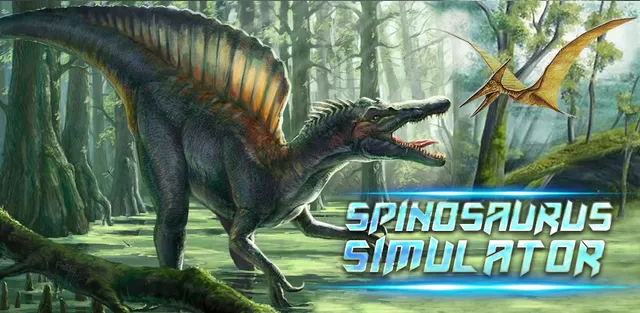
Spinosaurus Dinosaur Simulator is an Android game that lets you control a Spinosaurus with a joystick and fight other dinosaurs. According to its store listing you maintain health and energy by eating and drinking, explore a large world with a day-night cycle and weather, find a partner and raise young, and unlock skills with upgrades. Spinosaurus also appears as an opponent in many other simulators from the same studio, including Stegosaurus: Plate Dino Sim.
The listing says Spinosaurus was as powerful as T. rex. The game places it on an island among dinosaurs from many periods, which does not reflect its Cretaceous age or the debate about its lifestyle described above. Treat game abilities and fights as entertainment, not scientific evidence.
Classification and fossil record
The Paleobiology Database taxonomic record catalogues Spinosaurus under Spinosaurini. This is the immediate parent in that catalogue, rather than a complete list of evolutionary relationships.
Discovery and naming history
Egyptian material discovered in 1912 was described by Ernst Stromer in 1915. Later finds and reinterpretations substantially changed the reconstruction, so a familiar historical silhouette is not the final word on its anatomy or aquatic behavior. Historical overview.
The corroborated occurrence sample includes Egypt, Morocco, Niger; those are modern discovery locations, not a complete ancient geographic range.
The sourced length estimate for Spinosaurus is about 14 metres. This is an estimate for the reconstructed animal, not a measurement shared by every individual. See the body-size discussion and linked evidence for context.
Research starting point
The catalogue links Spinosaurus to Stromer, 1915, published in Abhandlungen der Königlich Bayerischen Akademie der Wissenschaften Mathematisch-physikalische Klasse Abhandlung. This identifies a research starting point; the catalogue’s citation alone does not verify every later reconstruction or species assignment.
For the meaning of taxonomic terms and how evidence is checked, see the glossary and editorial policy.
Quick answers
- Is Spinosaurus a dinosaur?
- Yes. Spinosaurus was a large theropod dinosaur in the family Spinosauridae, known from Cretaceous rocks in North Africa.
- When did Spinosaurus live?
- Spinosaurus lived in the Cenomanian stage of the Late Cretaceous, roughly 100 to 94 million years ago, according to museum and published dating.
- How big was Spinosaurus?
- A 2022 study estimated a maximum of about 14 metres and 7.4 tonnes. Older estimates reached 15 metres or more, and no complete skeleton has been found.
- Was Spinosaurus bigger than T. rex?
- Spinosaurus was probably longer than T. rex, but T. rex stood taller at the hips because Spinosaurus had short hind legs, according to the Natural History Museum.
- What did Spinosaurus eat?
- Mostly fish, judging by its narrow jaws and cone-shaped teeth, though it may also have eaten other animals and scavenged. No preserved Spinosaurus stomach contents have been reported.
- Was Spinosaurus aquatic?
- Scientists disagree. It was semi-aquatic, but studies range from a swimming hunter to a shoreline wader, so how much it swam is still debated.