Jurassic Dinos editorial · Updated · Source-based review
What is Oxalaia?
Oxalaia was a Late Cretaceous Brazilian spinosaurid name based on fragmentary Alcantara Formation material.
Distinctive features and evidence
Its incomplete remains make a full skull or body reconstruction heavily dependent on comparison. The fossil locality and formally described material provide firmer evidence than an exact body-length claim.
Genus overview and research references.
Oxalaia fossil discoveries
Oxalaia is known from a very small amount of bone. The fossils were collected in 1999 on Cajual Island in northeastern Brazil, in rock layers called the Alcântara Formation. The main specimen is the fused front of the upper jaw, the premaxillae, and a second fragment of the upper jaw bone, the maxilla, was later assigned to the same animal. Hundreds of loose teeth and bone pieces come from the same fossil bed, because tides break up and carry away most remains there, so a jaw fragment in good condition was an unusual find.
The specimens were kept at the National Museum in Rio de Janeiro, which was badly damaged by fire in 2018. Researchers have since reported that damaged remains of Oxalaia were recovered, and a new study of them has been described as in preparation. Until that work appears, the original 2011 description remains the main published record.
How big was Oxalaia?
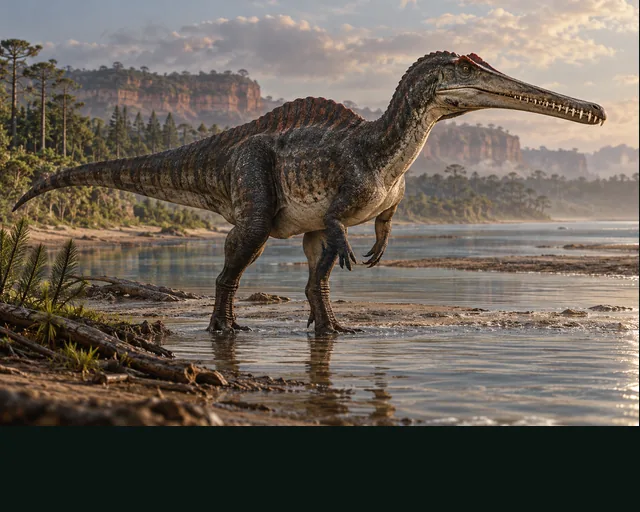
The snout bones themselves are only about 20 centimetres long, so any whole-body size is an estimate made by scaling up from better-known spinosaurids. The describing team compared the snout with a skull of Spinosaurus and suggested a total length of roughly 12 to 14 metres. That would make it the largest meat-eating dinosaur reported from Brazil, but it is a single scaled estimate from a fragmentary jaw tip, not a measured skeleton.
Because our knowledge of Spinosaurus body shape has also changed in recent years, treat the number as a rough guide rather than a record.
Is Oxalaia a spinosaurid?
Yes. Oxalaia is placed in the family Spinosauridae, usually in the subfamily Spinosaurinae with Spinosaurus. The key clues are an enlarged, rounded snout tip, conical teeth with an oval cross-section and no fine serrations. Baryonyx is a more distant spinosaurid relative, from the other main branch of the family.
The name itself has been debated. A 2020 study argued that the features used to define Oxalaia could fall within the natural variation of Spinosaurus, which would make Oxalaia a duplicate name. Later studies pointed to differences in the palate and in the position of the nostril and kept Oxalaia as a separate genus. This is why many accounts, including this one, describe it as a valid but fragmentary spinosaurid.
Where and when Oxalaia lived
Oxalaia lived in the Cenomanian, early in the Late Cretaceous, roughly 100.5 to 93.9 million years ago. At that time South America and Africa were only just separating, which explains why the animals and plants of the Alcântara Formation resemble those of Morocco and Egypt. The region has been reconstructed as humid forest of conifers, ferns and horsetails, surrounded by drier land, with fish, crocodile relatives, pterosaurs and other dinosaurs nearby.
Classification and fossil record
The Paleobiology Database taxonomic record catalogues Oxalaia under Spinosaurinae. This is the immediate parent in that catalogue, rather than a complete list of evolutionary relationships.
Discovery and naming history
Cajual Island fossils found in 1999 were described by Alexander Kellner and colleagues in 2011. The material is fragmentary, so the name-bearing skull evidence should be distinguished from a complete spinosaur body reconstruction. Historical overview.
The corroborated occurrence sample includes Brazil; those are modern discovery locations, not a complete ancient geographic range.
Research starting point
The catalogue links Oxalaia to Kellner and Azevedo, 2011, published in Anais da Academia Brasileira de Ciências. This identifies a research starting point; the catalogue’s citation alone does not verify every later reconstruction or species assignment.
For the meaning of taxonomic terms and how evidence is checked, see the glossary and editorial policy.
Quick answers
- Is Oxalaia a dinosaur?
- Yes. Oxalaia was a theropod dinosaur, a member of the spinosaurid family that lived in what is now northeastern Brazil.
- When did Oxalaia live?
- Oxalaia lived during the Cenomanian stage of the Late Cretaceous, roughly 100.5 to 93.9 million years ago.
- How big was Oxalaia?
- The describing team estimated roughly 12 to 14 metres by scaling from a Spinosaurus skull, but the real fossil is only a snout fragment, so the figure is uncertain.
- Is Oxalaia a spinosaurid?
- Yes. Its enlarged snout tip and unserrated conical teeth place it in Spinosauridae, most often in the subfamily Spinosaurinae.
- What was found of Oxalaia?
- Only parts of the upper jaw: the fused front of the snout and a separate maxilla fragment, found in 1999 on Cajual Island, Brazil.