Jurassic Dinos editorial · Updated · Source-based review
What is Carcharodontosaurus?
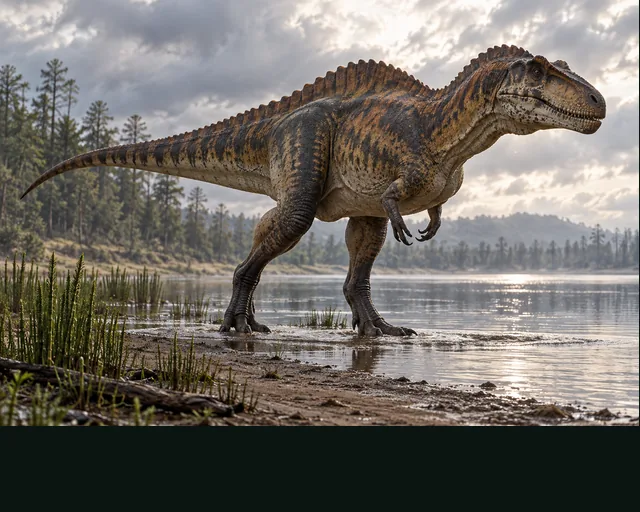
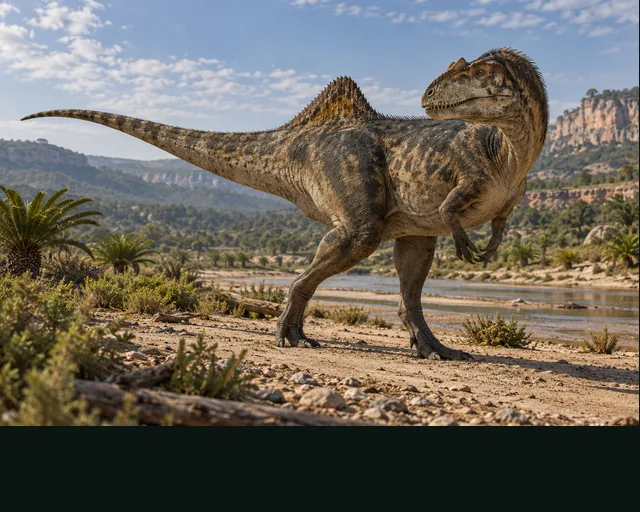
Carcharodontosaurus was a large Cretaceous North African theropod named for its blade-like, shark-resembling teeth.
Distinctive features and evidence
Its naming history involves lost teeth, a destroyed Egyptian skeleton and Moroccan skull material. The reassignment of the Egyptian animal to Tameryraptor illustrates why older reconstructions and fossil assignments need to be distinguished from current genus boundaries.
Genus overview and research references.
Carcharodontosaurus fossil discoveries
The reference skull of Carcharodontosaurus did not turn up until 1995, when Paul Sereno’s University of Chicago expedition found an incomplete skull in the Kem Kem Beds of southeastern Morocco. It was described in 1996 and was officially proposed in 2007 as the neotype, a replacement name-bearing specimen, because the original teeth were lost.
Even so, the skeleton is poorly known. No skull of the genus preserves the front of the upper jaw, the back of the skull or the lower jaw in full. For decades, scattered teeth and bones from across North Africa were attributed to Carcharodontosaurus. A 2012 study by Carrano and colleagues concluded that isolated teeth from the region can only safely be called teeth of an unspecified carcharodontosaurid.
How big was Carcharodontosaurus?
The Moroccan neotype has been estimated at 12 to 12.5 metres long and about 5 to 7 tonnes in weight, which puts C. saharicus among the largest known meat-eating dinosaurs. Other researchers have produced larger figures. In 2007, Therrien and Henderson estimated about 13.3 metres and 15.1 tonnes. Estimates differ because the skeleton is incomplete and the methods vary.
The skull is the best-known part, and it was probably around 1.4 to 1.6 metres long. Sereno’s team gave 1.6 metres in 1996, Carrano and colleagues gave 1.42 metres in 2012, and Canale and colleagues gave 1.4 to 1.6 metres in 2022. Stromer’s original Egyptian skeleton suggested a smaller animal, about 8 to 9 metres, but that specimen is now treated as a different genus, Tameryraptor.
What did Carcharodontosaurus eat?
Carcharodontosaurus was a meat-eater. Its teeth were blade-like, finely serrated and unusually thin, with an estimated 60 or so in the whole mouth, and the biggest known tooth was about 6.5 centimetres tall. Thin teeth could probably bend or snap on bone, but they were replaced often.
A 2022 study estimated bite forces well below those of Tyrannosaurus, which suggests Carcharodontosaurus did not routinely crush bone. Its large, light skull, full of air spaces, also points to slicing softer flesh instead. Tooth chemistry suggests it lived mostly on land, unlike the contemporary Spinosaurus, which seems to have spent more time in water.
Stevens (2006) modelled the field of view of the skull and suggested limited binocular vision, comparable to crocodiles, so Carcharodontosaurus may have relied on ambush.
Is Carcharodontosaurus related to Tyrannosaurus?
No, they are only distant relatives. Carcharodontosaurus belongs to the family Carcharodontosauridae within the allosauroid theropods, the group that includes Allosaurus, and not to the tyrannosaurs. Close relatives include Giganotosaurus and Mapusaurus from South America, and Acrocanthosaurus from North America.
Giganotosaurus was merged into Carcharodontosaurus in 1998 and again in 2010, but later authors have not followed that view. A second species from Niger, C. iguidensis, named in 2007, is now thought by several studies to belong to a different genus, so even the species list is unsettled.
Where and when Carcharodontosaurus lived
Carcharodontosaurus lived in North Africa during the Cenomanian, early in the Late Cretaceous, about 100 to 94 million years ago. The Kem Kem Beds were a coastal region of mangrove forest, tidal flats and waterways beside the Tethys Sea, with a seasonal monsoon. Rivers held large fish, and the area had crocodile relatives and pterosaurs.
Carcharodontosaurus shared this world with other giant theropods, including Spinosaurus, and with the sauropod Rebbachisaurus. Isotope studies suggest that carcharodontosaurids ate large land animals, while spinosaurids targeted fish.
Classification and fossil record
The Paleobiology Database taxonomic record catalogues Carcharodontosaurus under Carcharodontosauridae. This is the immediate parent in that catalogue, rather than a complete list of evolutionary relationships.
Discovery and naming history
Its history includes Algerian teeth first assigned to Megalosaurus in 1925 and later reassessment under Carcharodontosaurus. Egyptian material long associated with the genus was reassigned to Tameryraptor in 2025, so historical restorations may combine different animals. Historical overview.
The corroborated occurrence sample includes Niger, Egypt, Morocco; those are modern discovery locations, not a complete ancient geographic range.
The sourced length estimate for Carcharodontosaurus is 12–12.5 metres. This is an estimate for the reconstructed animal, not a measurement shared by every individual. See the body-size discussion and linked evidence for context.
Research starting point
The catalogue links Carcharodontosaurus to Stromer, 1931, published in Abhandlungen der Bayerischen Akademie der Wissenschaften Mathematisch-naturwissenschaftliche Abteilung, Neue Folge. This identifies a research starting point; the catalogue’s citation alone does not verify every later reconstruction or species assignment.
For the meaning of taxonomic terms and how evidence is checked, see the glossary and editorial policy.
Quick answers
- Is Carcharodontosaurus a dinosaur?
- Yes. Carcharodontosaurus was a very large theropod dinosaur from North Africa, belonging to the allosauroid family Carcharodontosauridae.
- When did Carcharodontosaurus live?
- It lived in the Cenomanian age of the Late Cretaceous, about 100 to 94 million years ago.
- How big was Carcharodontosaurus?
- The Moroccan neotype is estimated at 12 to 12.5 metres long and about 5 to 7 tonnes, though other studies have produced larger figures from incomplete bones.
- What did Carcharodontosaurus eat?
- It was a meat-eater with thin, serrated, blade-like teeth. Bite-force studies suggest it sliced softer flesh instead of crushing bone.
- Is Carcharodontosaurus related to Tyrannosaurus?
- Only distantly. It belongs to the allosauroid family Carcharodontosauridae, with Giganotosaurus and Acrocanthosaurus, not to the tyrannosaurs.
- Where was Carcharodontosaurus found?
- Its best skull comes from the Kem Kem Beds of Morocco. Other material has been reported across North Africa, but many of these finds are uncertain.