Jurassic Dinos editorial · Updated · Source-based review
What is Nodosaurus?
Nodosaurus was a Late Cretaceous nodosaurid armored dinosaur from Wyoming’s Frontier Formation.
Distinctive features and evidence
It gave Nodosauridae its name, but the type genus should not be used as a stand-in for every better-preserved member. A concise description is preferable to borrowing another armored dinosaur’s body measurements.
Genus overview and research references.
Nodosaurus fossil discoveries
Fossil collector William Harlow Reed found the first bones on 17 July 1881 in Albany County, Wyoming. This was during the Bone Wars, the rivalry between Othniel Charles Marsh and Edward Drinker Cope, and Reed was in the area searching Morrison Formation rocks at Como Bluff. The skeleton came from a single quarry about 2.4 kilometres from Quarry 13 at Como Bluff, but its rock turned out to be much younger than the Morrison Formation: the Frontier Formation, also called the Dakota Sandstone, of Cenomanian age.
The specimen, YPM VP 1815 at the Yale Peabody Museum, includes three back vertebrae and 13 tail vertebrae, three ribs, parts of the forelimbs, a partial pelvis, thigh and shin bones, part of a foot and several pieces of bony armour. Marsh described it in 1889 as Nodosaurus textilis. The species name refers to the cloth-like pattern of the armour. No skull bones are listed among the remains.
What did the armour of Nodosaurus look like?
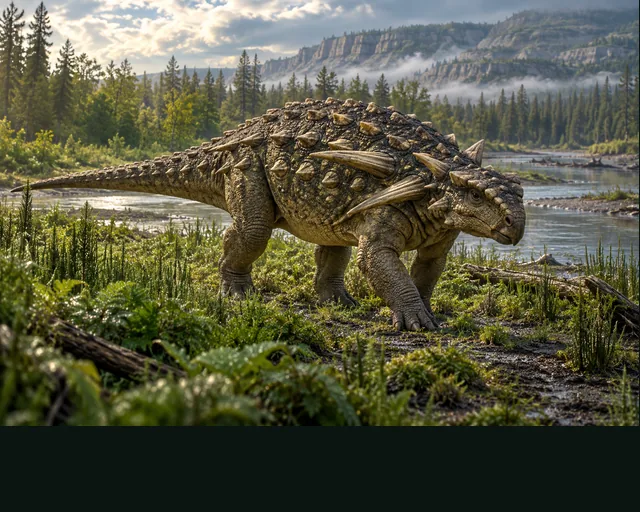
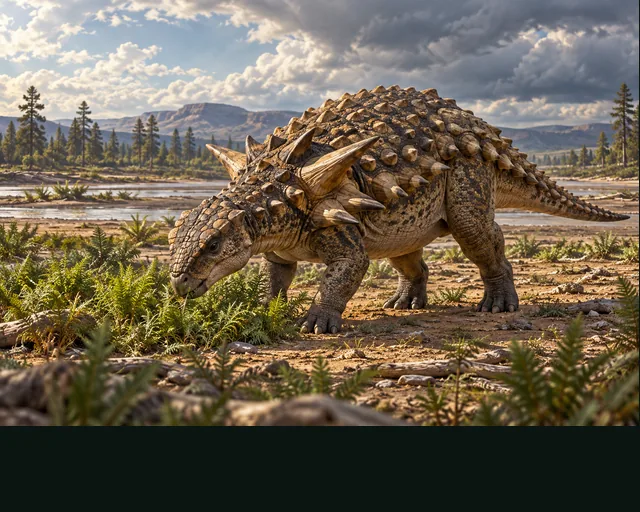
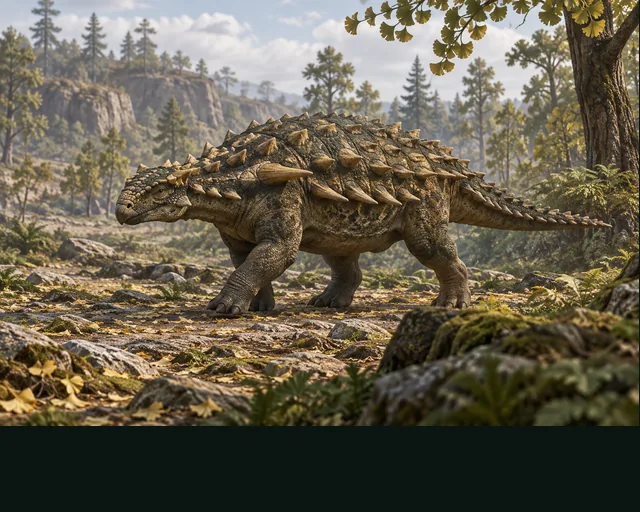
The bony plates, called osteoderms, formed bands across the back. Narrow bands lay over the ribs, alternating with wider plates covered in neat rows of small bony nodules. There may also have been spikes along the sides. It walked on four short legs, with five toes on each foot, and had a short neck and a long, stiff tail that lacked a club.
Most estimates give a length of 4 to 6 metres. In 2010 Gregory Paul estimated about 6 metres and 3.5 tonnes. That is one estimate, from incomplete bones.
What did Nodosaurus eat?
The diet is not known directly. One suggestion is that it ate soft plants, since it perhaps could not chew tough, fibrous ones. Another is that it could have processed such plants using stomach stones (gastroliths) and a very large gut. Both ideas are inferences from the body shape of related armoured dinosaurs.
Why is Nodosaurus important in classification?
Marsh first classified it as a stegosaur, then in 1890 placed it in its own family, Nodosauridae, which he put among the horned dinosaurs. Today Nodosauridae is a family of armoured dinosaurs within Ankylosauria, and Nodosaurus is the genus that gave it its name. Richard Swan Lull published a fuller description in 1921. In 1978 Walter Coombs suggested that Stegopelta and Hierosaurus were synonyms of Nodosaurus, but that idea has not had much support.
Within the family, Nodosaurus falls in the subfamily Nodosaurinae. Better-preserved relatives include Edmontonia, Sauropelta and Polacanthus.
When did Nodosaurus live?
Nodosaurus fossils come only from the Frontier Formation in Wyoming, whose rocks are Cenomanian in age. The Cenomanian is the first stage of the Late Cretaceous and began about 100.5 million years ago, and the Natural History Museum lists the animal at 110 to 100 million years ago in the Early Cretaceous. This is why you may see both periods in different references.
Classification and fossil record
The Paleobiology Database taxonomic record catalogues Nodosaurus under Nodosauridae. This is the immediate parent in that catalogue, rather than a complete list of evolutionary relationships.
The sourced length estimate for Nodosaurus is 4–6 metres. This is an estimate for the reconstructed animal, not a measurement shared by every individual. See the body-size discussion and linked evidence for context.
Research starting point
The catalogue links Nodosaurus to Marsh, 1889, published in American Journal of Science. This identifies a research starting point; the catalogue’s citation alone does not verify every later reconstruction or species assignment.
For the meaning of taxonomic terms and how evidence is checked, see the glossary and editorial policy.
Quick answers
- Is Nodosaurus a dinosaur?
- Yes. Nodosaurus was an armoured, plant-eating ankylosaur from the Late Cretaceous of Wyoming, and the type genus of the family Nodosauridae.
- When did Nodosaurus live?
- It lived in the Cenomanian stage, around the boundary between the Early and Late Cretaceous, roughly 100 million years ago.
- How big was Nodosaurus?
- Estimates are about 4 to 6 metres long. Gregory Paul estimated about 6 metres and 3.5 tonnes in 2010, but the skeleton is incomplete.
- Where was Nodosaurus found?
- The type specimen was found in 1881 in Albany County, Wyoming, in the Frontier Formation. All Nodosaurus fossils described so far come from that formation.
- What does Nodosaurus mean?
- The name means "knobbed lizard", for the nodules on its bony plates.