Jurassic Dinos editorial · Updated · Source-based review
What is Polacanthus?
Polacanthus was an Early Cretaceous English armored dinosaur with plates and spikes.
Distinctive features and evidence
Polacanthus foxii is the accepted species in the overview. Its skull remains poorly known, and disagreement over its wider placement should be kept separate from the clearly preserved body armor.
Genus overview and research references.
Polacanthus fossil discoveries
The Reverend William Fox found the type skeleton on the Isle of Wight, England, in early 1865. The story of its naming is unusual. Fox hoped his friend, the poet Alfred Tennyson, would name it, and Tennyson suggested a name that was rejected. In the end Fox presented the find at a scientific meeting and Richard Owen supplied the name Polacanthus foxii, which may have been a way to avoid naming an animal after himself. Because no matching paper by Owen exists, scholars have credited different authors for the name.
The fossil is incomplete: the head, neck, front armour and forelimbs are missing, but the hips, one hind leg, tail vertebrae, ribs, 22 spikes and many small bony nodules are preserved. The armour had almost fallen apart by 1881, but preparators at the British Museum put it back together with painstaking care after Fox’s collection was acquired. A second partial skeleton, excavated in 1979, was the first to show skull pieces, neck vertebrae and clear front armour.
What did the armour of Polacanthus look like?
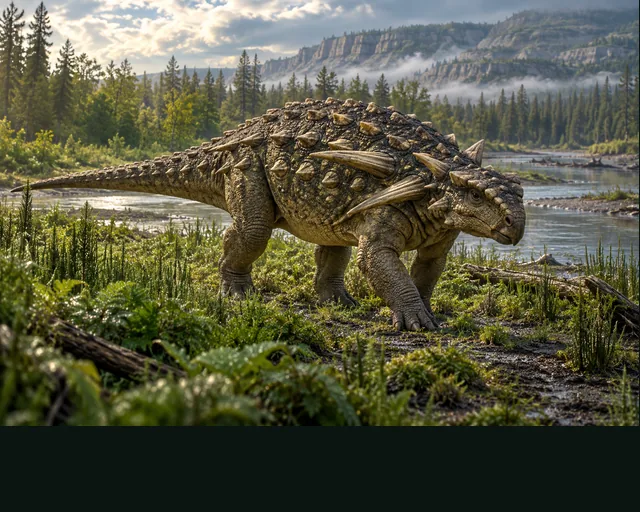
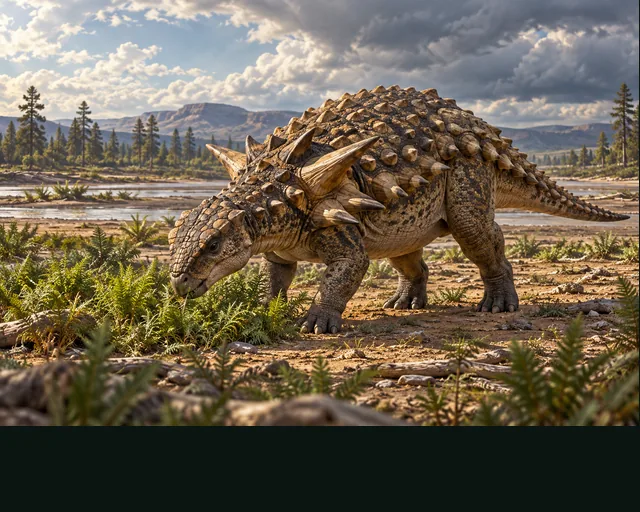
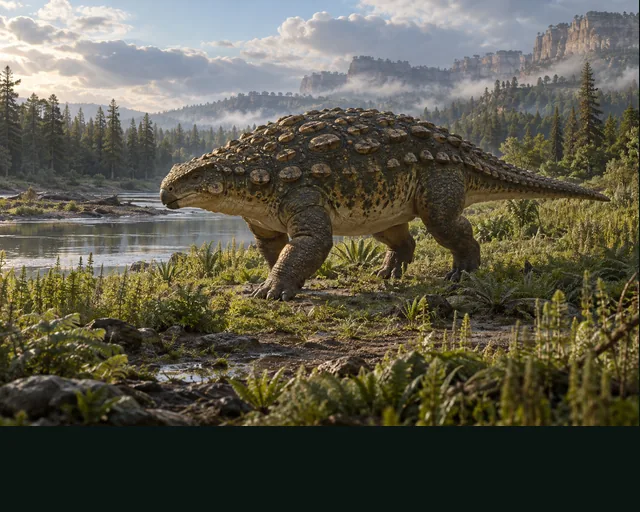
John Hulke recognised in 1881 that Polacanthus had a large shield of fused bone over its hips, probably loosely attached to the skeleton below and covered in bumps. The shield of the type specimen measures just over a metre across. Similar hip shields are found in some other primitive armoured dinosaurs, such as Gastonia.
The placement of the spikes has been argued over for more than a century. Hulke thought spikes lined the sides of the rump and that two rows of keeled plates ran along each side of the tail. In 1905 Franz Nopcsa proposed that two parallel rows of spikes ran along both the front of the body and the tail, and William Blows largely agreed in 1987, recognising three spike types. Without a complete skeleton, every reconstruction is an informed interpretation.
How many species of Polacanthus are there?
Strictly speaking, one. Only P. foxii is considered valid today, and several other names were later removed. P. rudgwickensis, named in 1996, was made a separate genus, Horshamosaurus, in 2015, and was about 30 per cent larger. The American dinosaur Hoplitosaurus was once called Polacanthus marshi, but that idea is generally rejected. Polacanthus has also been suggested to be identical to Hylaeosaurus, but the few overlapping bones make this hard to prove or disprove.
A 2020 review of British ankylosaur fossils concluded that none of the extra specimens, including a partial skeleton from Sussex, can be confidently assigned to Polacanthus. If that is right, the genus is known from its type skeleton alone.
How big was Polacanthus?
Polacanthus was a medium-sized armoured dinosaur. Darren Naish and David Martill estimated 5 metres in 2001, and Gregory Paul supported that length in 2010 and added a mass estimate of 2 tonnes. Thomas Holtz suggested in 2012 that it was only 4 metres long and weighed 227 to 454 kilograms. The wide gap between these weights shows how uncertain the body shape is.
Is Polacanthus a nodosaurid?
Possibly. Fox first placed it simply with the dinosaurs, and Huxley and Hulke put it with the scelidosaurids, before Coombs placed it in the Nodosauridae in 1978. Kenneth Carpenter and colleagues refined this to a subgroup, the Polacanthinae. In 2000 Tracy Ford suggested a separate family, Polacanthidae, that sits below the split between nodosaurids and ankylosaurids. Polacanthus may be a primitive nodosaurid, or part of that separate family, and the question remains open. Edmontonia is a better-known nodosaurid from the Late Cretaceous of North America.
Where and when Polacanthus lived
Polacanthus comes from the Wessex Formation of southern England, which dates from the Barremian stage of the Early Cretaceous; one account gives about 130 to 125 million years ago. The type skeleton came from Barnes High on the Isle of Wight.
Classification and fossil record
The Paleobiology Database taxonomic record catalogues Polacanthus under Nodosauridae. This is the immediate parent in that catalogue, rather than a complete list of evolutionary relationships.
The sourced length estimate for Polacanthus is 4–5 metres. This is an estimate for the reconstructed animal, not a measurement shared by every individual. See the body-size discussion and linked evidence for context.
Research starting point
The catalogue links Polacanthus to Fox, 1866, published in Report of the British Association for the Advancement of Science, Birmingham. This identifies a research starting point; the catalogue’s citation alone does not verify every later reconstruction or species assignment.
For the meaning of taxonomic terms and how evidence is checked, see the glossary and editorial policy.
Quick answers
- Is Polacanthus a dinosaur?
- Yes. Polacanthus was an armoured dinosaur, an ankylosaur, that lived in what is now southern England during the Early Cretaceous.
- How big was Polacanthus?
- Estimates run from about 4 to 5 metres long, with weights from a few hundred kilograms to about 2 tonnes. The skull and front of the body are missing, so the size is uncertain.
- Where was Polacanthus found?
- The type skeleton was found at Barnes High on the Isle of Wight, England, in 1865, in the Wessex Formation.
- Is Polacanthus a nodosaurid?
- It may be a primitive nodosaurid, or it may belong to a separate family, Polacanthidae. Researchers still disagree.
- What was found of Polacanthus?
- An incomplete skeleton with hips, a hind leg, tail, ribs and armour, plus a second partial skeleton found in 1979. A 2020 review doubted that other specimens belong to it.