Jurassic Dinos editorial · Updated · Source-based review
What is Euoplocephalus?
Euoplocephalus was a Late Cretaceous Canadian ankylosaurid whose fossil assignments have been repeatedly revised.
Distinctive features and evidence
A once broad collection of specimens has been divided among several genera. A useful description identifies the material genuinely assigned to Euoplocephalus tutus instead of copying the full range of an older, inclusive classification.
Genus overview and research references.
Euoplocephalus fossil discoveries
The first specimen was found on 18 August 1897 by Canadian palaeontologist Lawrence Lambe in the Red Deer River valley, in what is now Dinosaur Provincial Park, Alberta. It consists of the upper part of a skull and five bony plates from the neck armour. Lambe named it Stereocephalus tutus in 1902, from Greek words for solid head, but the name had already been given to a beetle. In 1910 he replaced it with Euoplocephalus.
The species name tutus is Latin for safely protected. Scientific papers have spelled the genus name incorrectly in over a dozen ways, so older sources may spell it unexpectedly.
Which fossils are really Euoplocephalus?
For decades Euoplocephalus was among the best-known dinosaurs. In 1971 Walter Coombs decided that many Campanian ankylosaurid fossils from Alberta and Montana belonged to a single species, and he merged the genera Anodontosaurus, Dyoplosaurus and Scolosaurus into it. That produced a “species” known from more than forty individuals that spanned nearly the whole Campanian stage.
Researchers at the University of Alberta later questioned this. Studies from 2009 onward revived Dyoplosaurus, Anodontosaurus and Scolosaurus as separate genera, and in 2013 Victoria Arbour limited reliable Euoplocephalus fossils to the lowest 30 metres of the Dinosaur Park Formation, around a dozen specimens. This explains why older descriptions show features, such as the tail, that may belong to relatives.
How big and armoured was Euoplocephalus?
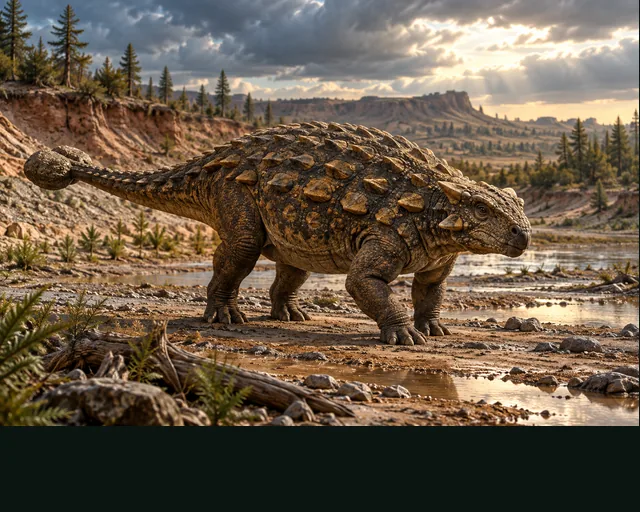
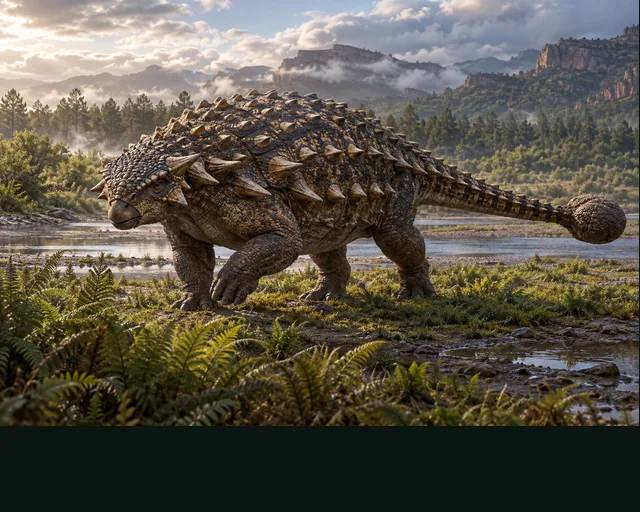
Euoplocephalus was a heavy, low-slung animal on four short legs, with a very broad flat body. Sources give different lengths: about 5.3 metres in one account and about 7 metres at the Natural History Museum, with both putting its weight at roughly 2 tonnes. Among ankylosaurids, it is described as exceeded in size only by Ankylosaurus and possibly a few others. The biggest known skull is about 41 centimetres long.
The head and body were covered with bony plates and hundreds of small round ossicles. The neck had two half-rings of armour, the eyes may have had bony eyelids, and the back of the skull bore two pyramid-shaped horns. Details of the body armour are uncertain because much of the best-known armour description was based on Scolosaurus.
Did Euoplocephalus really have a tail club?
Yes, the tail ended in a bony club, but old pictures often get it wrong. Many restorations show a club with two large upright spikes, an error traced to a restoration of Scolosaurus by Franz Nopcsa, who used an incomplete tail. Those spikes actually sat halfway along the tail.
Only the outer half of the tail was stiffened by bundles of ossified tendons, so the inner half could still swing sideways. A 2009 study found that large ankylosaur clubs could break bone, while average and small ones could not. It is unknown whether the club was used against predators, rivals of its own kind, or both.
Where and when Euoplocephalus lived
Euoplocephalus lived in what is now Alberta, Canada. All specimens that can be reliably assigned come from the Dinosaur Park Formation and date to roughly 76.4 to 75.6 million years ago, late in the Campanian stage. Before the splitting of Coombs’s species, the same name was applied to fossils spanning 76.5 to 67 million years ago. The Natural History Museum gives 76 to 70 million years ago.
It shared its habitat with tyrannosaurs such as Gorgosaurus, against which the tail club is thought to have been a defence. Armoured relatives in the nodosaurid family, such as Edmontonia, had narrower snouts and different armour, and no tail club is known for them.
Classification and fossil record
The Paleobiology Database taxonomic record catalogues Euoplocephalus under Euoplocephalini. This is the immediate parent in that catalogue, rather than a complete list of evolutionary relationships.
The corroborated occurrence sample includes United States, Canada; those are modern discovery locations, not a complete ancient geographic range.
Research starting point
The catalogue links Euoplocephalus to Lambe, 1910, published in The Ottawa Naturalist. This identifies a research starting point; the catalogue’s citation alone does not verify every later reconstruction or species assignment.
For the meaning of taxonomic terms and how evidence is checked, see the glossary and editorial policy.
Quick answers
- Is Euoplocephalus a dinosaur?
- Yes. Euoplocephalus was a heavily armoured, plant-eating ankylosaurid dinosaur from the Late Cretaceous of Canada.
- How big was Euoplocephalus?
- Sources differ on length, from about 5.3 to 7 metres, but agree on a weight of roughly 2 tonnes. It was low, broad and four-legged.
- Did Euoplocephalus have a tail club?
- Yes. Like other ankylosaurids, it had a bony tail club. Old reconstructions with two upright spikes on the club are inaccurate.
- When did Euoplocephalus live?
- Specimens reliably assigned to it date to about 76.4 to 75.6 million years ago, toward the end of the Campanian stage of the Late Cretaceous.
- What does Euoplocephalus mean?
- It means "well-armoured head", from Greek words for good, armed and head. The name refers to the heavy armour that covered the skull.