Jurassic Dinos editorial · Updated · Source-based review
What was Zuul?
Zuul was a Late Cretaceous armoured dinosaur from Montana. Its fossil connects an exceptionally informative skull with a preserved tail club and much of the body armour. Instead of imagining armour from scattered plates, researchers can investigate how several defensive structures belonged to the same animal.
What makes the fossil distinctive?
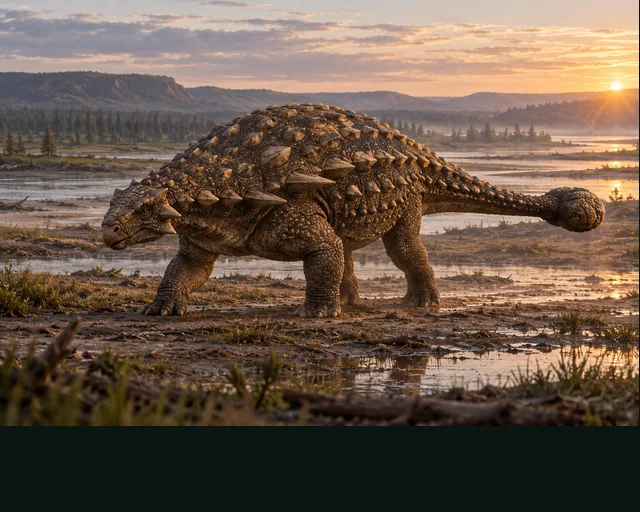
The head carries patterned bony tiles and prominent horns toward its rear corners. Far behind it, the end of the tail forms a heavy club. The club is part of a larger mechanical system: stiffened tail bones support the terminal mass, while muscles nearer the body would have powered movement. A reconstruction should therefore show a long tail leading to the club, not a ball attached directly to the hips.
Where was it found and how was it named?
The specimen was discovered in 2014 during work at a fossil site near Havre. It was found largely connected and was later acquired by the Royal Ontario Museum. Preparation, scanning and anatomical comparison allowed researchers to distinguish it from other ankylosaurs. The genus name refers to the creature Zuul in Ghostbusters; the species name crurivastator alludes to the potential damage a tail club could cause.
What can we infer, and what remains uncertain?
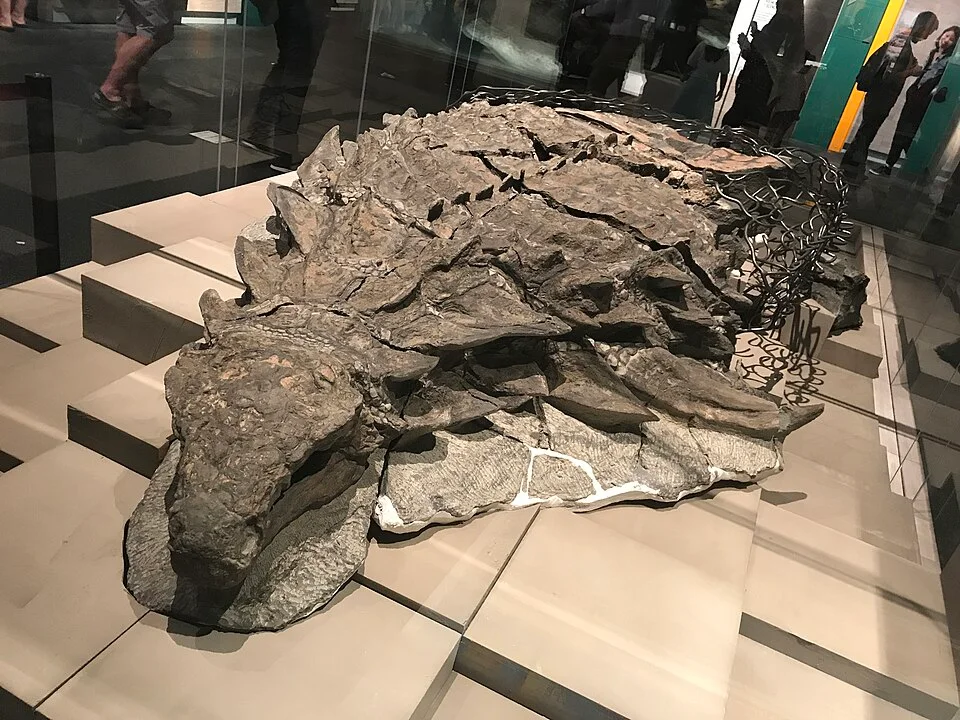
A dramatic name is not a recording of behaviour. Tail clubs could have mattered in defence, competition or more than one setting, and each proposal needs evidence beyond the name. Likewise, the preserved covering tells us about surface structure without showing every movement or sound of a living Zuul. Compare its club-bearing anatomy with Borealopelta, a different kind of armoured dinosaur, to see why “armoured” does not describe one identical body plan.
Was Zuul a predator?
No. It was a plant-eating ankylosaur. Its formidable armour and tail club should not be confused with adaptations for hunting prey.
How can you check the evidence?
The Paleobiology Database record catalogues Zuul under Ankylosaurinae. Its linked bibliography identifies this research starting point: V. M. Arbour and D. C. Evans. 2017. A new ankylosaurine dinosaur from the Judith River Formation of Montana, USA, based on an exceptional skeleton with soft tissue preservation. Royal Society Open Science 4(161086). Open the bibliographic record. A catalogue entry establishes the source trail; it does not independently verify every later illustration or behavioural claim.
Use the dated genus overview to follow the references behind the discovery and anatomy discussed above. When sources disagree, compare which specimen and rock layer each author studied. A reconstructed whole animal can combine original bones with comparisons to relatives; those two kinds of evidence should not be confused. The account above explains the particular limits that matter for Zuul, rather than supplying unsupported size, speed or lifespan figures.
Read the image and keep exploring
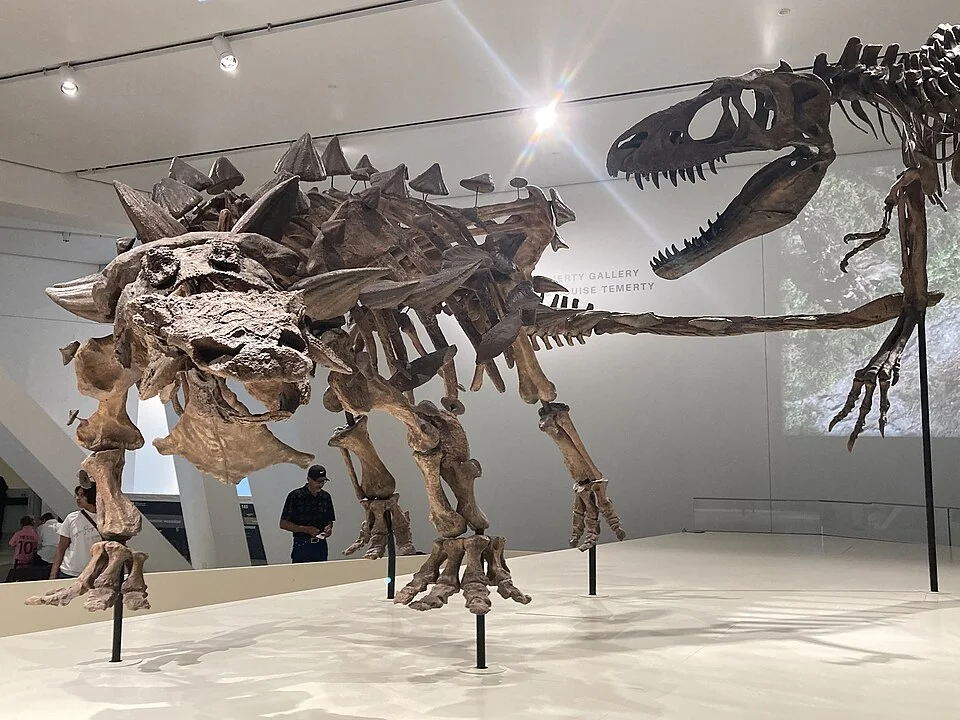
A museum mount presents Zuul with its low armoured body and clubbed tail; the display includes reconstructed anatomy. A displayed specimen or skeletal mount can include restored parts. Its appearance should be read alongside the original specimen description.
Compare Ankylosaurus, Euoplocephalus, Borealopelta. Find more names in the Z index and explore ornithischian field notes. The glossary explains unfamiliar fossil terms.
Quick answers
- Where have Zuul fossils been found?
- The discoveries discussed here come from United States. Modern place names describe discovery locations, not a complete ancient geographic range.
- When did Zuul live?
- It is placed in the Cretaceous period. See the discovery discussion for qualifications about the particular rock layers and dating.
- Where can I compare Zuul with related dinosaurs?
- Follow the related field notes below. Comparisons explain shared anatomy; they do not imply that all the animals lived together.