Jurassic Dinos editorial · Updated · Source-based review
What was Borealopelta?
Borealopelta was an armoured plant-eating dinosaur from Early Cretaceous Alberta. Its most important fossil preserves far more than a skeleton: armour, skin and even material from its last meal survived. This makes it a particularly useful animal for learning how palaeontologists separate an observation from a reconstruction.
What makes the fossil distinctive?
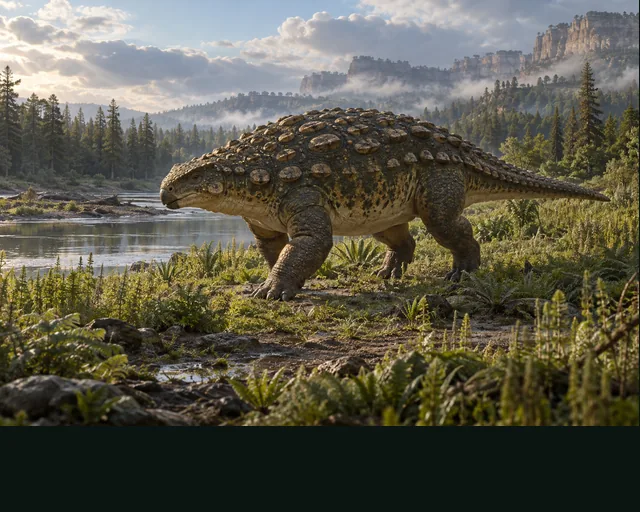
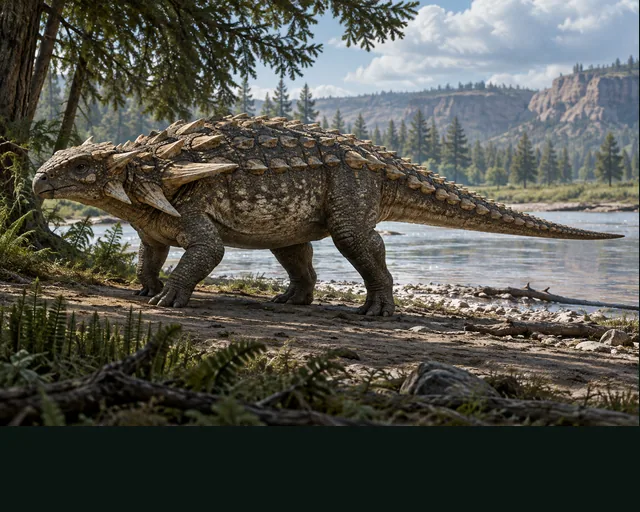
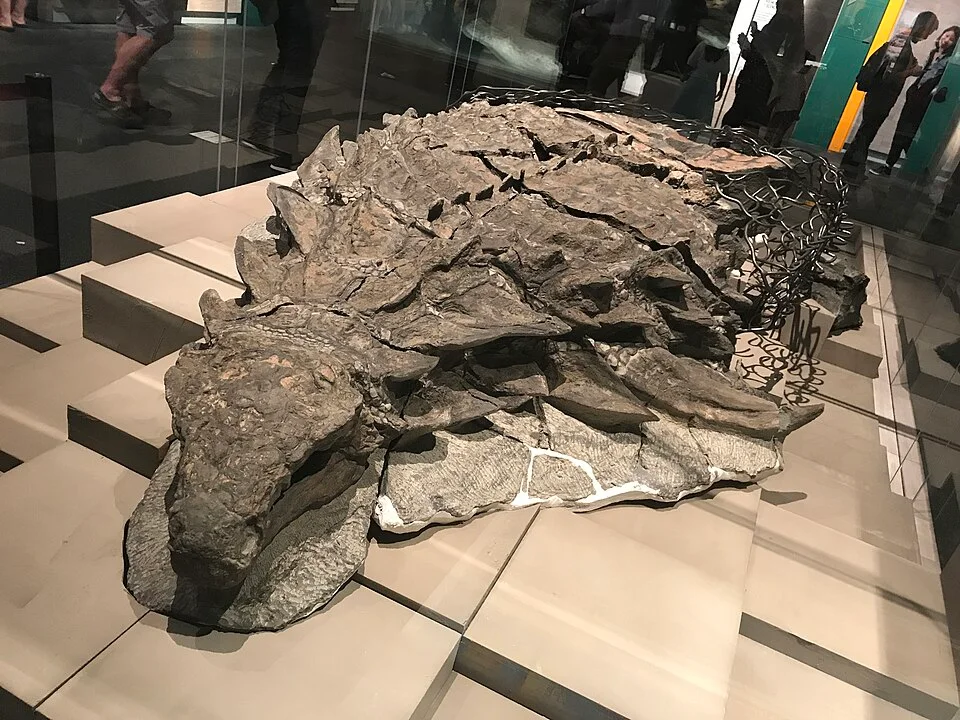
Look at the shoulder spikes and the rows of armour across the back. These bony plates are called osteoderms: bones that formed within the skin. On this specimen many remain close to their original positions, with traces of the outer keratin covering. Keratin is the material that also forms human fingernails. Preserving both layers helps researchers reconstruct an armour surface that bare bones alone would underestimate.
Where was it found and how was it named?
The fossil was uncovered by mining equipment in Alberta in 2011. Preparing it was a long, careful process rather than simply brushing dust from a complete animal. Technician Mark Mitchell spent years freeing the specimen from its surrounding rock; the species name markmitchelli honours that work. Its burial in marine sediments does not make it a swimming reptile. A land animal can be carried into the sea after death.
What can we infer, and what remains uncertain?
Preserved stomach material provides unusually direct evidence of food, including ferns. That is stronger evidence for this individual’s meal than a guess based only on tooth shape. Chemical evidence has also been used to investigate reddish coloration and camouflage, but the complete living colour pattern remains an interpretation. Compare Borealopelta with a club-tailed ankylosaur: both carried armour, yet a tail club was not a feature of every armoured dinosaur.
Why is this fossil sometimes called a dinosaur mummy?
Because parts of its outer covering survive alongside the bones. It was fossilised, however, rather than deliberately preserved like a human mummy.
How can you check the evidence?
The Paleobiology Database record catalogues Borealopelta under Nodosauridae. Its linked bibliography identifies this research starting point: C. M. Brown, D. M. Henderson, and J. Vinther, I. F., A. Sistiaga, J. Herrera, R. E. Summons. 2017. An exceptionally preserved three-dimensional armored dinosaur reveals insights into coloration and Cretaceous predator-prey dynamics. Current Biology 27:2514-2521. Open the bibliographic record. A catalogue entry establishes the source trail; it does not independently verify every later illustration or behavioural claim.
Use the dated genus overview to follow the references behind the discovery and anatomy discussed above. When sources disagree, compare which specimen and rock layer each author studied. A reconstructed whole animal can combine original bones with comparisons to relatives; those two kinds of evidence should not be confused. The account above explains the particular limits that matter for Borealopelta, rather than supplying unsupported size, speed or lifespan figures.
Read the image and keep exploring
The preserved head and body armour of Borealopelta show why this specimen is valuable beyond its internal skeleton. A displayed specimen or skeletal mount can include restored parts. Its appearance should be read alongside the original specimen description.
Compare Nodosaurus, Sauropelta, Ankylosaurus. Find more names in the B index and explore ornithischian field notes. The glossary explains unfamiliar fossil terms.
Quick answers
- Where have Borealopelta fossils been found?
- The discoveries discussed here come from Canada. Modern place names describe discovery locations, not a complete ancient geographic range.
- When did Borealopelta live?
- It is placed in the Cretaceous period. See the discovery discussion for qualifications about the particular rock layers and dating.
- Where can I compare Borealopelta with related dinosaurs?
- Follow the related field notes below. Comparisons explain shared anatomy; they do not imply that all the animals lived together.