Jurassic Dinos editorial · Updated · Source-based review
What is Saurolophus?
Saurolophus was a Late Cretaceous hadrosaur with a spike-like crest, represented in North America and Asia.
Distinctive features and evidence
The Canadian Saurolophus osborni and Mongolian Saurolophus angustirostris should be separated in comparisons. Its solid projecting crest differs from the elongated hollow crest of Parasaurolophus despite the similar names.
Genus overview and research references.
Saurolophus fossil discoveries
Barnum Brown collected the first Saurolophus in 1911 beside the Red Deer River in Alberta, Canada. The nearly complete skeleton, now displayed in New York, was the earliest almost-complete dinosaur skeleton found in Canada. Brown named it Saurolophus osborni in 1912. Little more has been described from Canada since.
Better material came from Mongolia. Russian-Mongolian expeditions in the late 1940s recovered large skeletons that became the second species, Saurolophus angustirostris, named by Anatoly Rozhdestvensky in 1952. It is known from at least 15 specimens at many growth stages and is now the most common hadrosaurid from Asia.
How big was Saurolophus?
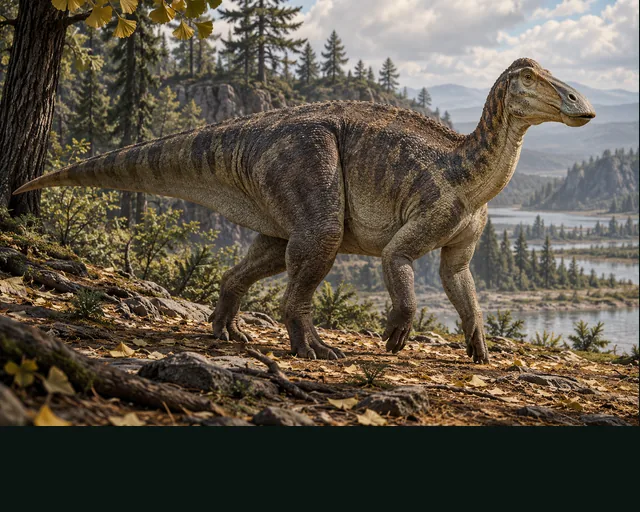
The two species differed in size. The Canadian S. osborni was around 8.2 to 8.5 metres long with a skull about a metre long, and an estimated weight near 3 tonnes. The Mongolian S. angustirostris was estimated at 12 to 13 metres and up to 11 tonnes, with the largest known skull about 1.22 metres long. The Natural History Museum lists about 9 metres for the genus, so treat all figures as rough guides.
The Mongolian species also had a skull about 20 percent longer, with a more upturned snout.
What was the Saurolophus crest for?
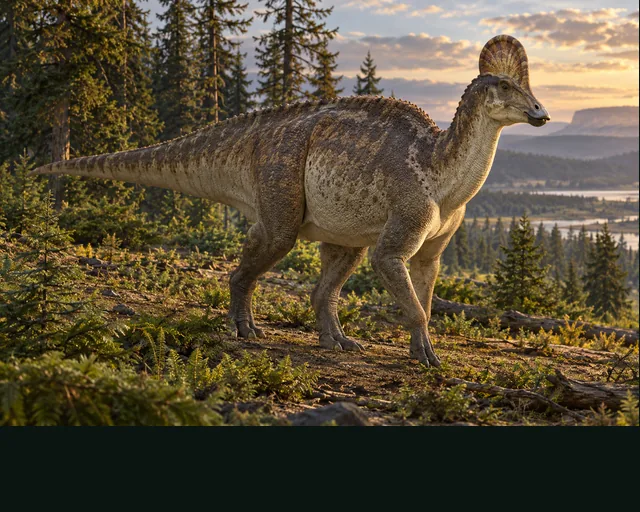
The crest is a spike that rises up and backwards from above the eyes at about 45 degrees. It is formed almost entirely by the nasal bones, and was present but smaller in young animals. It is often called solid, but in the Canadian species it seems to be solid only at the tip, with internal chambers lower down. That is different from the hollow, tubular crest of Parasaurolophus, despite the similar names.
Scientists have offered several ideas: visual display, a way to recognise others of the same species, a larger respiratory surface for breathing and heat control, and even an anchor for inflatable skin flaps over the nostrils. None has been proven, and the crest may have served more than one purpose.
Saurolophus behaviour: the Dragon’s Tomb bonebed
In the Nemegt Formation of Mongolia, a site called Dragon’s Tomb holds a large bonebed that is dominated by S. angustirostris of juvenile, sub-adult and adult sizes. At least 21 individuals have been counted, and the bone-bearing area is large enough that over 100 carcasses might have contributed. The describers took this as the first evidence that the species lived in groups, although the cause of the mass death cannot be determined. There is no similar evidence yet for the Canadian species.
A humerus with bite marks attributed to the large tyrannosaurid Tarbosaurus shows damage to one bone only, which suggests a carcass being scavenged, not a kill.
Is Saurolophus a hadrosaur?
Yes. Saurolophus is a hadrosaurid, or duck-billed dinosaur, in the group Saurolophinae, which is named after it. It is the namesake of related genera, since Prosaurolophus means before Saurolophus and Parasaurolophus means near Saurolophus. Other well-known duckbills include Edmontosaurus and Corythosaurus.
Brown first thought its crest was made of the same bones as in lambeosaurines such as Corythosaurus, but the crest of Saurolophus is built from the nasal bones alone. Few dinosaur genera are known from more than one continent, and Saurolophus has fossils in both North America and Asia.
Where and when Saurolophus lived
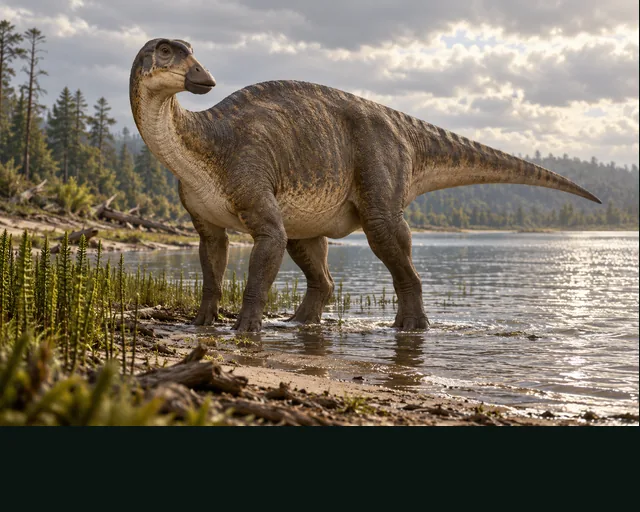
S. osborni lived in the early Maastrichtian near the Western Interior Seaway, in the upper Horseshoe Canyon Formation of Alberta, alongside Albertosaurus. S. angustirostris lived in the well-watered, partly semi-arid Nemegt Formation of Mongolia with river channels and lakes. Ages differ a little between sources, from about 71.5 to 66 million years ago in one account to a start near 74 million years ago in the museum’s listing, so a Late Cretaceous, late-Campanian-to-Maastrichtian window is the safest summary.
Classification and fossil record
The Paleobiology Database taxonomic record catalogues Saurolophus under Saurolophini. This is the immediate parent in that catalogue, rather than a complete list of evolutionary relationships.
Discovery and naming history
Barnum Brown described the Canadian species Saurolophus osborni in 1912. The later Mongolian species supplied a separate geographic and anatomical comparison, so a genus-wide range should not be assigned unchanged to every species. Historical overview.
The corroborated occurrence sample includes Mongolia, United States, Canada; those are modern discovery locations, not a complete ancient geographic range.
Research starting point
The catalogue links Saurolophus to Brown, 1912, published in Bulletin of the American Museum of Natural History. This identifies a research starting point; the catalogue’s citation alone does not verify every later reconstruction or species assignment.
For the meaning of taxonomic terms and how evidence is checked, see the glossary and editorial policy.
Quick answers
- Is Saurolophus a dinosaur?
- Yes. Saurolophus was a hadrosaurid, or duck-billed dinosaur, a plant eater known from Canada and Mongolia, with a long spike on its skull.
- When did Saurolophus live?
- It lived in the Late Cretaceous, roughly 74 to 66 million years ago depending on the source, with the best-dated fossils in the Maastrichtian age.
- How big was Saurolophus?
- The Canadian species was about 8.2 to 8.5 metres long and the Mongolian species was estimated at 12 to 13 metres, though the sizes are estimates.
- Is Saurolophus a hadrosaur?
- Yes. Saurolophus is a duck-billed hadrosaurid belonging to the Saurolophinae, the subfamily that carries its name, along with relatives such as Edmontosaurus.
- What did Saurolophus eat?
- Saurolophus ate plants. Its broad beak cropped vegetation and its dental batteries of hundreds of teeth could grind it, which is an inference from skull anatomy.
- Where was Saurolophus found?
- It was found in Alberta, Canada, in the Horseshoe Canyon Formation, and in Mongolia, in the Nemegt Formation.