
Jurassic Dinos editorial · Updated · Source-based review
What is Olorotitan?
Olorotitan was a latest Cretaceous lambeosaurine hadrosaur from eastern Russia’s Udurchukan Formation.
Distinctive features and evidence
The species Olorotitan arharensis extends the crested duck-billed dinosaur story into the Amur region. Its Asian provenance offers a useful comparison with North American Corythosaurus and Lambeosaurus without assuming identical habitats.
Genus overview and research references.
Olorotitan fossil discoveries
Olorotitan is known from one remarkable skeleton and a set of smaller, more fragmentary remains. The site is Kundur, in the Amur region of far-eastern Russia, close to the Chinese border. The locality was first found in 1990 by a researcher from a mineral-resources institute, who collected bones beside a highway, and large-scale digging began in 1999. The main specimen, catalogued AEHM 2/845, was discovered in 1999 and fully excavated in 2001. Pascal Godefroit, Yuri Bolotsky and Vladimir Alifanov named the animal in 2003, and Godefroit and two colleagues gave a full bone-by-bone description in 2012.
That skeleton is described as the most complete dinosaur ever found in Russia, and the most complete lambeosaurine outside western North America. It is still incomplete: the hands and feet are missing, as are parts of the ribs, the back vertebrae and the right hind limb, and some of the more fragile skull bones are absent. The bonebed itself extends over at least 1,000 square metres and contains a jumble of bones from many animals of different sizes, mostly duck-billed dinosaurs.
How big was Olorotitan and what made it distinctive?
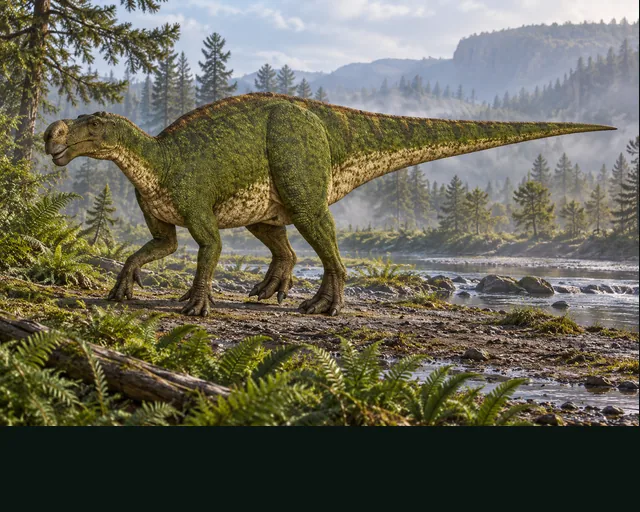
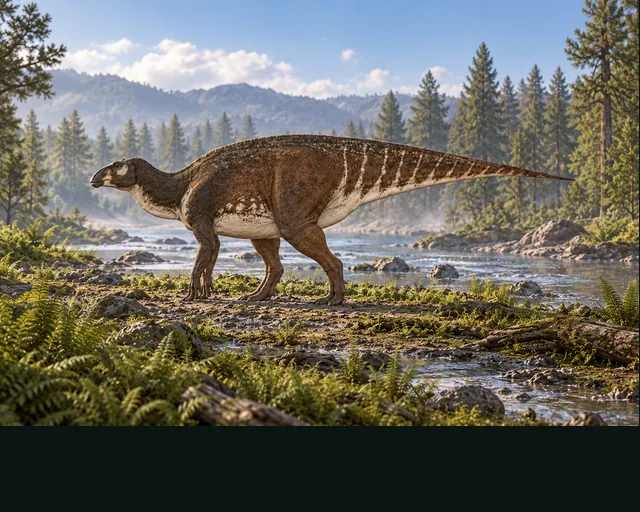
When mounted on all fours, the main skeleton is about 8 metres long and about 3.5 metres tall at the hips. Its thigh bone is 1.1 metres long, which is typical for an adult duck-billed dinosaur from North America, so it was a large but not extraordinary animal. A published mass range, from Gregory Paul, is about 2.6 to 3.4 tonnes. This is one estimate rather than a measurement.
The skull carried a tall, helmet-shaped hollow crest that rose higher than the rest of the skull and reached back beyond the rear of the head, making the crest very different from those of its American relatives. The neck had 18 vertebrae, more than the 15 previously known in any hadrosaurid, which is the origin of the name “titanic swan”. The sacrum, the fused vertebrae over the hips, includes 15 or 16 vertebrae, and in the front part of the tail the tips of the neural spines were linked together, which would have made that section stiff. Another unusual detail is that the shin bone is as long as the thigh bone, whereas it is normally a little shorter in large hadrosaurs.
The internal shape of the crest is not known, because the nasal bones are broken and the front of the crest was crushed. For that reason, sound-production ideas for other crested hadrosaurs, such as Parasaurolophus, cannot be tested directly on Olorotitan.
What happened to the Olorotitan holotype?
The way the skeleton was buried is a story in itself. It lay on its side, with the skull, backbone and shoulder girdle mostly joined, but with the limbs partly scattered. Researchers concluded that it was covered rapidly, within a few days of death, probably by a sediment flow, and was not left lying on the surface for long.
The skull has a four-sided hole through one frontal bone, and some parallel grooves on the other side. Large tyrannosaurid-type teeth were found in the same layer, so the authors raised the possibility that the animal was killed by a large predator, or was partly eaten before burial. They also noted that no definite tooth marks could be recognised on the surviving limb bones, and they offered other explanations. This is therefore a suggestion, not a confirmed attack.
Is Olorotitan related to Corythosaurus?
Yes, probably. Olorotitan is a lambeosaurine, a hadrosaurid with a hollow crest. The 2012 analysis placed it in a group called Corythosaurini and as the sister of Corythosaurus and Hypacrosaurus, the helmet-crested hadrosaurs of North America. Lambeosaurus is another lambeosaurine from there with a very large crest. The authors warn that the links within that small group are weakly supported, so the exact position may change with more fossils.
Other lambeosaurines lived beside it in the same region, including Amurosaurus, and Charonosaurus, which resembles Parasaurolophus. Researchers think the group first appeared in Asia and later spread to North America. The presence of different branches in the Amur-Heilongjiang area at the end of the Cretaceous suggests that lineages moved readily between western North America and eastern Asia. Compare this with western North America, where lambeosaurines are rare in the youngest Cretaceous rocks, while in Asia they are diverse.
Where and when Olorotitan lived
Olorotitan lived in the latest Cretaceous, near the end of the age of dinosaurs. The exact date is uncertain. Palynologists, who date rocks by their pollen, have argued over whether the Udurchukan Formation is early, middle or late Maastrichtian, and the authors of the 2012 paper prefer a late Maastrichtian age but say that independent evidence such as radiometric dates is still needed. This page therefore gives the age only as Maastrichtian.
The Kundur fauna is not very diverse. Besides duck-bills, it includes turtle fragments, crocodile teeth, remains of theropods and nodosaurid dinosaurs and a multituberculate mammal. Another duck-billed dinosaur from the same rocks is Kundurosaurus, a hadrosaurine.
Olorotitan in the game
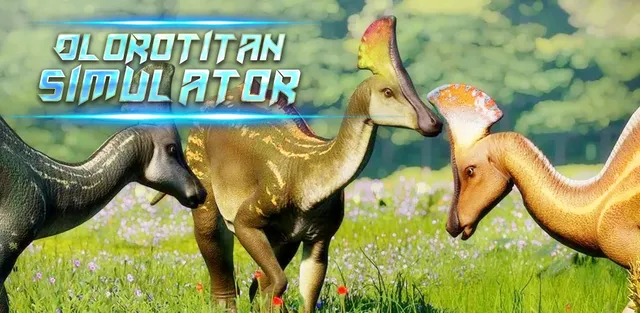
Olorotitan: Giant Dino Family lets you play a duck-billed dinosaur. The store listing describes finding food and water for your family, meeting a mate, raising up to five babies, protecting a herd, and exploring a large 3D world with changing weather.
Those family mechanics are game design. Nothing is known about how Olorotitan reared young, since only one good skeleton and a few fragments exist. The listing also calls the setting “Jurassic”, while Olorotitan lived at the very end of the Cretaceous.
Classification and fossil record
The Paleobiology Database taxonomic record catalogues Olorotitan under Lambeosaurinae. This is the immediate parent in that catalogue, rather than a complete list of evolutionary relationships.
The corroborated occurrence sample includes Russia; those are modern discovery locations, not a complete ancient geographic range.
The sourced length estimate for Olorotitan is about 8 metres. This is an estimate for the reconstructed animal, not a measurement shared by every individual. See the body-size discussion and linked evidence for context.
Research starting point
The catalogue links Olorotitan to Godefroit and Bolotsky, 2003, published in Comptes Rendus Palevol. This identifies a research starting point; the catalogue’s citation alone does not verify every later reconstruction or species assignment.
For the meaning of taxonomic terms and how evidence is checked, see the glossary and editorial policy.
Quick answers
- Is Olorotitan a dinosaur?
- Yes. Olorotitan was a crested, duck-billed dinosaur, a lambeosaurine hadrosaurid, from the latest Cretaceous of far-eastern Russia.
- When did Olorotitan live?
- It lived in the Maastrichtian, the last age of the Cretaceous. The exact age of its rock unit is debated, so no narrower date is certain.
- How big was Olorotitan?
- The mounted holotype is about 8 metres long and 3.5 metres high at the hips. One published estimate gives a mass of roughly 2.6 to 3.4 tonnes.
- Is Olorotitan related to Corythosaurus?
- Probably. A 2012 analysis placed Olorotitan as the sister of Corythosaurus and Hypacrosaurus, though the authors noted the support within that small group is weak.
- Why is it called titanic swan?
- The name refers to its unusually long neck. Olorotitan has 18 neck vertebrae, more than the 15 previously known in any hadrosaurid.
- Where was Olorotitan found?
- It was found at Kundur in the Amur region of far-eastern Russia, in the Udurchukan Formation, between 1999 and 2001.