Jurassic Dinos editorial · Updated · Source-based review
What was Aralosaurus?
Aralosaurus was a duck-billed dinosaur from Late Cretaceous Kazakhstan. Its best-known fossil is part of a skull, so its face tells us much more than its legs or tail. It belonged to the herbivorous hadrosaurs, whose closely packed teeth helped process plants.
What makes the fossil distinctive?
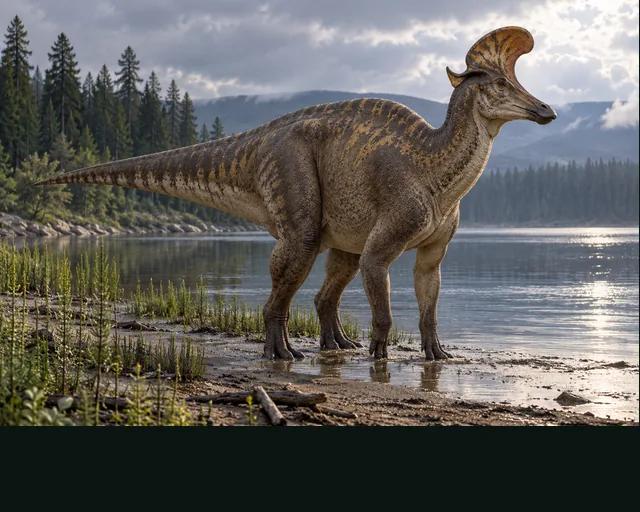
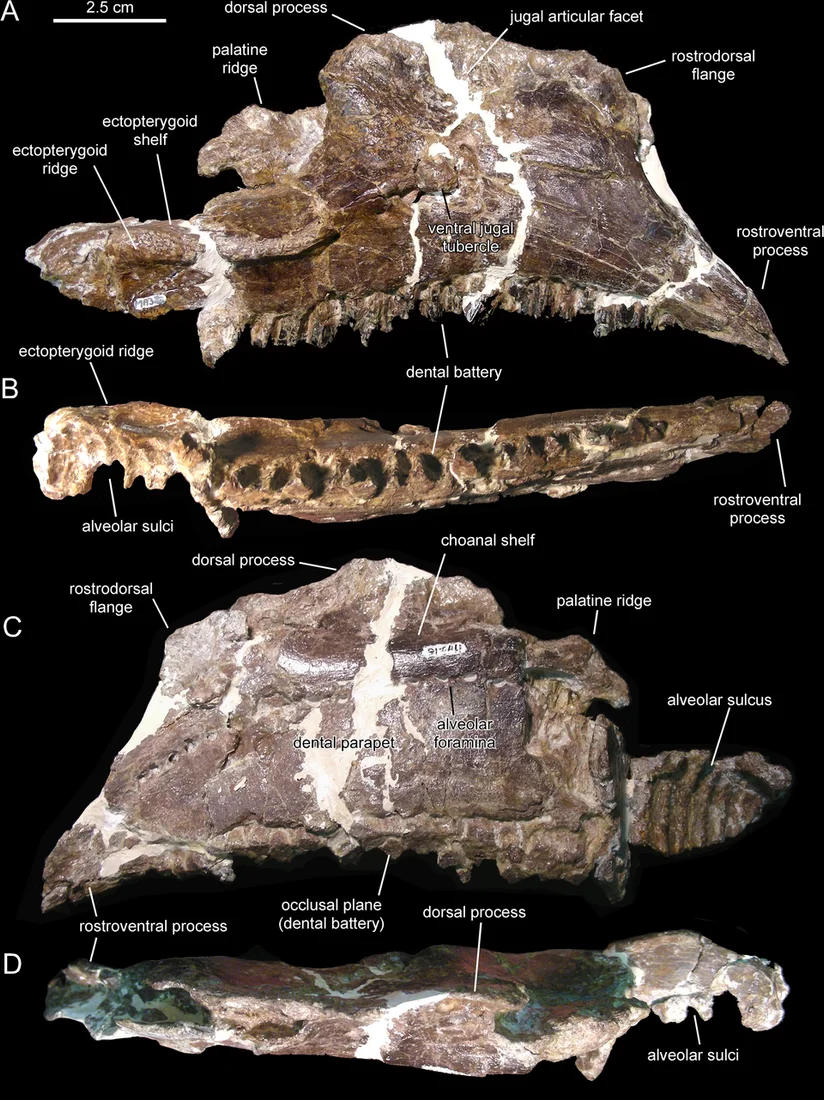
The important feature is a raised, hollow structure associated with the nasal region. Only its base is preserved. That is enough to investigate relationships, but not enough to draw the complete crest confidently. A spectacular crest in an illustration should therefore be treated as an interpretation.
Where was it found and how was it named?
The fossil comes from the Bostobe Formation and was named in 1968. Early reconstructions compared its nose with the solid arch of Gryposaurus. Later examination instead supported a relationship with hollow-crested lambeosaurines. This changed the interpretation of the same fossil rather than revealing a newly discovered complete head.
What can we infer, and what remains uncertain?
Compare Aralosaurus with Canardia to explore skull anatomy, and with Parasaurolophus to see a much better-known crest. The three are useful comparisons, but their crests should not be copied onto one another. A gap in a fossil is a gap in our knowledge, not an invitation to choose the most dramatic shape.
Do we know the complete crest?
No. The preserved nasal region supports a hollow structure, but the complete outline is not known.
How can you check the evidence?
The Paleobiology Database record catalogues Aralosaurus under Lambeosaurinae. Its linked bibliography identifies this research starting point: A. K. Rozhdestvensky. 1968. Gadrozavry Kazakhstana [Hadrosaurs of Kazakhstan]. [Upper Paleozoic and Mesozoic Amphibians and Reptiles]. Akademia Naul SSSR, Moscow. Open the bibliographic record. A catalogue entry establishes the source trail; it does not independently verify every later illustration or behavioural claim.
Use the dated genus overview to follow the references behind the discovery and anatomy discussed above. When sources disagree, compare which specimen and rock layer each author studied. A reconstructed whole animal can combine original bones with comparisons to relatives; those two kinds of evidence should not be confused. The account above explains the particular limits that matter for Aralosaurus, rather than supplying unsupported size, speed or lifespan figures.
Read the image and keep exploring
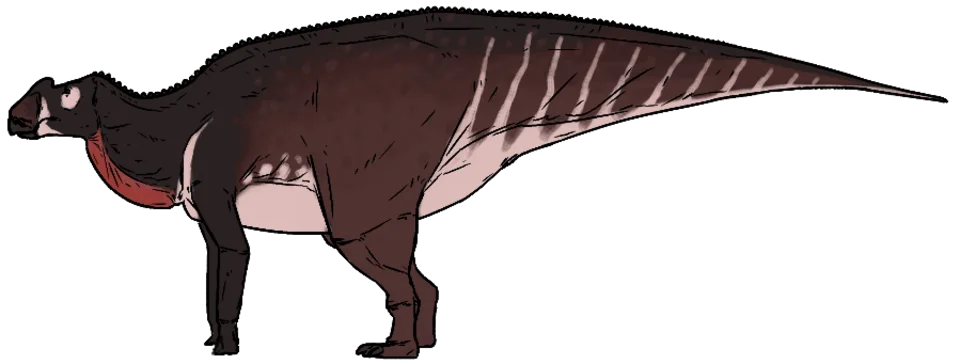
This Aralosaurus restoration supplies a whole body and colour pattern. The complete crest outline is not established by the known skull material. This is an artistic reconstruction: colours, soft tissues and missing anatomy include interpretation, not a photograph of a living dinosaur.
Compare Canardia, Lambeosaurus, Parasaurolophus. Find more names in the A index and explore ornithischian field notes. The glossary explains unfamiliar fossil terms.
Quick answers
- Where have Aralosaurus fossils been found?
- The discoveries discussed here come from Kazakhstan. Modern place names describe discovery locations, not a complete ancient geographic range.
- When did Aralosaurus live?
- It is placed in the Cretaceous period. See the discovery discussion for qualifications about the particular rock layers and dating.
- Where can I compare Aralosaurus with related dinosaurs?
- Follow the related field notes below. Comparisons explain shared anatomy; they do not imply that all the animals lived together.