Jurassic Dinos editorial · Updated · Source-based review
What was Canardia?
Canardia was a duck-billed dinosaur from near the end of the Cretaceous in southern France. It belongs to the lambeosaurines, a branch of hadrosaurs associated with hollow head crests. Its fossils help document the dinosaurs that inhabited the European islands of that time.
What makes the fossil distinctive?
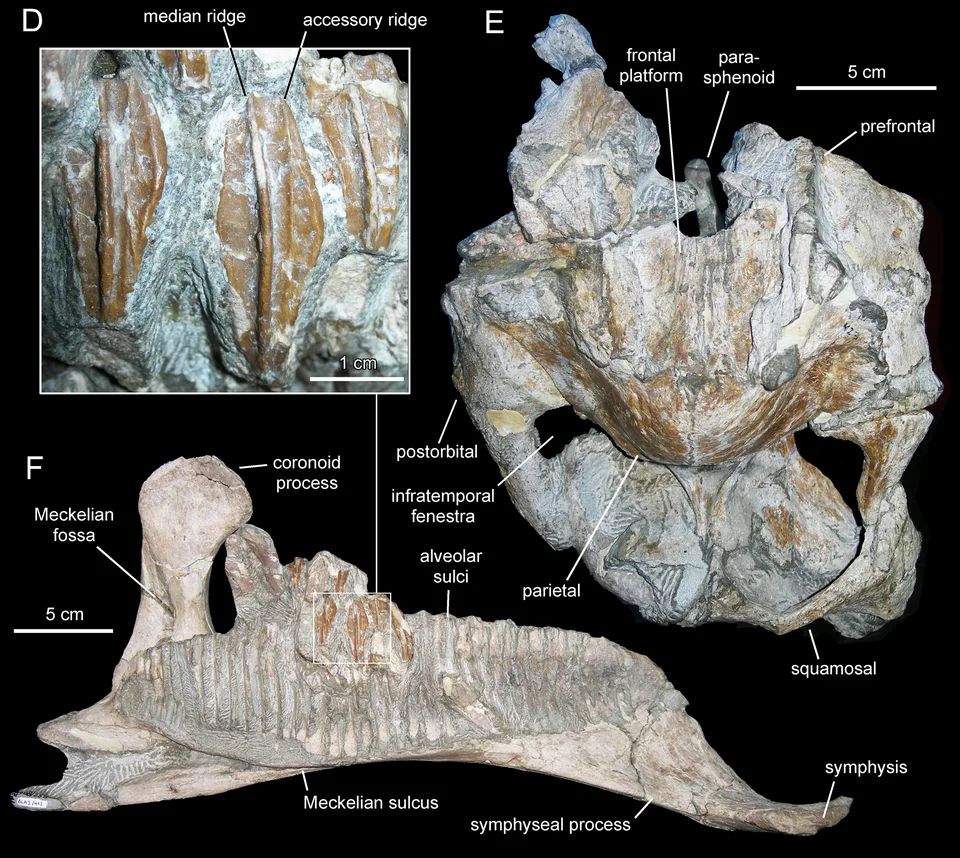
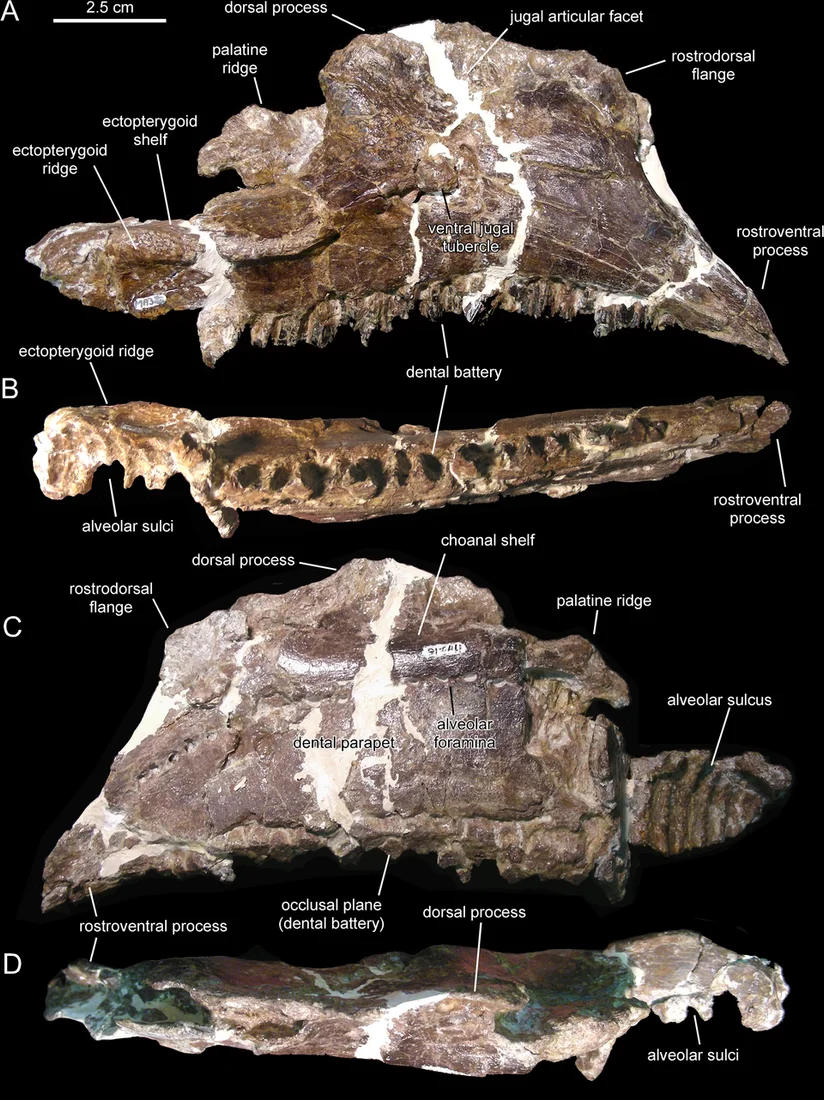
One particularly informative bone is the maxilla, the tooth-bearing part of the upper jaw. Its shape provides characters that can be compared with other hadrosaurs. Teeth and jaw bones also support a plant-processing feeding system, but do not reveal every plant species consumed.
Where was it found and how was it named?
Canardia was named in 2013 from the Marnes d’Auzas Formation. Much of the material represents young individuals. Growing skulls can differ from adult skulls, so age has to be considered when identifying distinctive features and making comparisons.
What can we infer, and what remains uncertain?
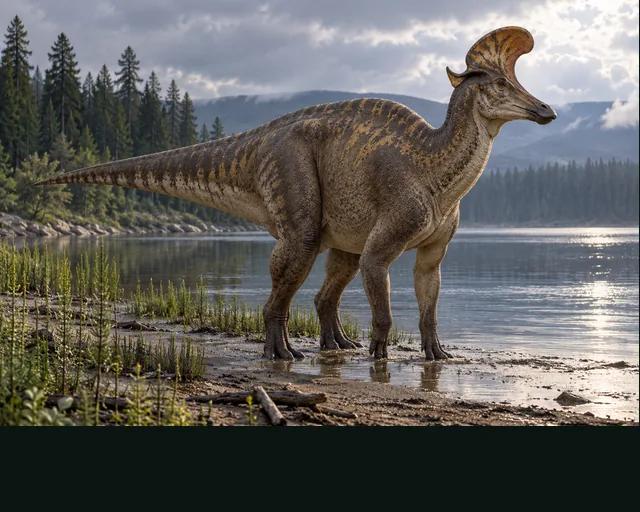
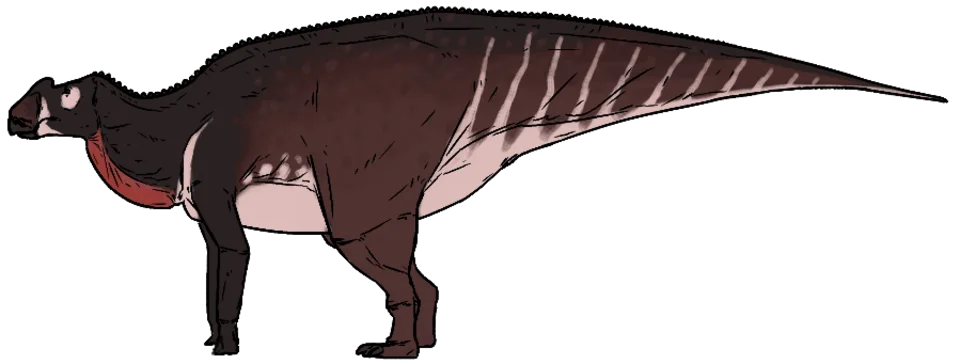
Its detailed placement among lambeosaurines has been discussed alongside Aralosaurus and other European forms. Different analyses do not always recover exactly the same arrangement. That uncertainty does not erase the observed jaw anatomy. When viewing a whole-animal illustration, remember that a reconstructed crest or adult silhouette may be less secure than the preserved bones on which the genus was named.
Why does the upper jaw matter so much?
Its preserved shape contains diagnostic features that can be compared directly with other hadrosaurs, even when much of the rest of the animal is missing.
How can you check the evidence?
The Paleobiology Database record catalogues Canardia under Arenysaurini. Its linked bibliography identifies this research starting point: A. Prieto-Marquez, F. M. D. Vecchia, and R. Gaete, A. Galobart. 2013. Diversity, relationships, and biogeography of the lambeosaurine dinosaurs from the European archipelago, with description of the new aralosaurin Canardia garonnensis. PLoS One 8(7):e69835:1-44. Open the bibliographic record. A catalogue entry establishes the source trail; it does not independently verify every later illustration or behavioural claim.
Use the dated genus overview to follow the references behind the discovery and anatomy discussed above. When sources disagree, compare which specimen and rock layer each author studied. A reconstructed whole animal can combine original bones with comparisons to relatives; those two kinds of evidence should not be confused. The account above explains the particular limits that matter for Canardia, rather than supplying unsupported size, speed or lifespan figures.
Read the image and keep exploring
Annotated Canardia jaw views show the tooth-bearing upper-jaw bone and the features used in anatomical comparisons. A displayed specimen or skeletal mount can include restored parts. Its appearance should be read alongside the original specimen description.
Compare Aralosaurus, Arenysaurus, Lambeosaurus. Find more names in the C index and explore ornithischian field notes. The glossary explains unfamiliar fossil terms.
Quick answers
- Where have Canardia fossils been found?
- The discoveries discussed here come from France. Modern place names describe discovery locations, not a complete ancient geographic range.
- When did Canardia live?
- It is placed in the Cretaceous period. See the discovery discussion for qualifications about the particular rock layers and dating.
- Where can I compare Canardia with related dinosaurs?
- Follow the related field notes below. Comparisons explain shared anatomy; they do not imply that all the animals lived together.