Jurassic Dinos editorial · Updated · Source-based review
What was Altirhinus?
Altirhinus was an Early Cretaceous plant-eating dinosaur from Mongolia. Its name means high nose, referring to the raised nasal region. It belongs to the broader evolutionary story connecting iguanodontian dinosaurs with the more specialised duck-billed hadrosaurs.
What makes the fossil distinctive?
The skull and jaws provide clues to feeding, while hands, feet and limb bones inform posture. A raised nasal profile does not automatically mean the same hollow crest system seen in Parasaurolophus. Similar-looking bumps can involve different bones and internal structures, so external appearance needs to be checked against anatomy.
Where was it found and how was it named?
Several specimens of different sizes were collected during joint Soviet-Mongolian expeditions in 1981. They were initially associated with Iguanodon orientalis, but later work found that the material required its own genus. David Norman named Altirhinus kurzanovi in 1998. The specimens come from Early Cretaceous deposits in the Dornogovi region.
What can we infer, and what remains uncertain?
Having individuals of different sizes allows scientists to investigate variation, but small size alone does not establish either a separate species or a juvenile. Bone maturity and anatomical details also matter. Altirhinus is useful for learning why taxonomic revisions happen: a new name can reflect a better understanding of old material rather than the discovery of an entirely new skeleton.
Was its high nose a hollow musical crest?
That function is not established. It should not be assigned the specialised crest anatomy or sound-producing claims associated with other hadrosaur relatives without supporting evidence.
How can you check the evidence?
The Paleobiology Database record catalogues Altirhinus under Neoiguanodontia. Its linked bibliography identifies this research starting point: D. B. Norman. 1998. On Asian ornithopods (Dinosauria: Ornithischia). 3. A new species of iguanodontid dinosaur. Zoological Journal of the Linnean Society 122:291-348. Open the bibliographic record. A catalogue entry establishes the source trail; it does not independently verify every later illustration or behavioural claim.
Use the dated genus overview to follow the references behind the discovery and anatomy discussed above. When sources disagree, compare which specimen and rock layer each author studied. A reconstructed whole animal can combine original bones with comparisons to relatives; those two kinds of evidence should not be confused. The account above explains the particular limits that matter for Altirhinus, rather than supplying unsupported size, speed or lifespan figures.
Read the image and keep exploring
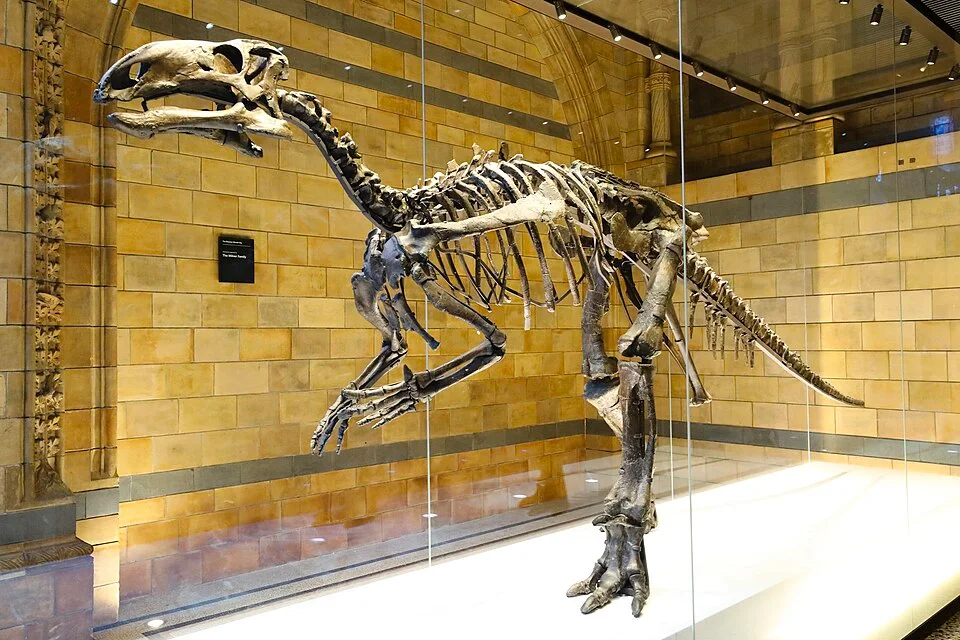
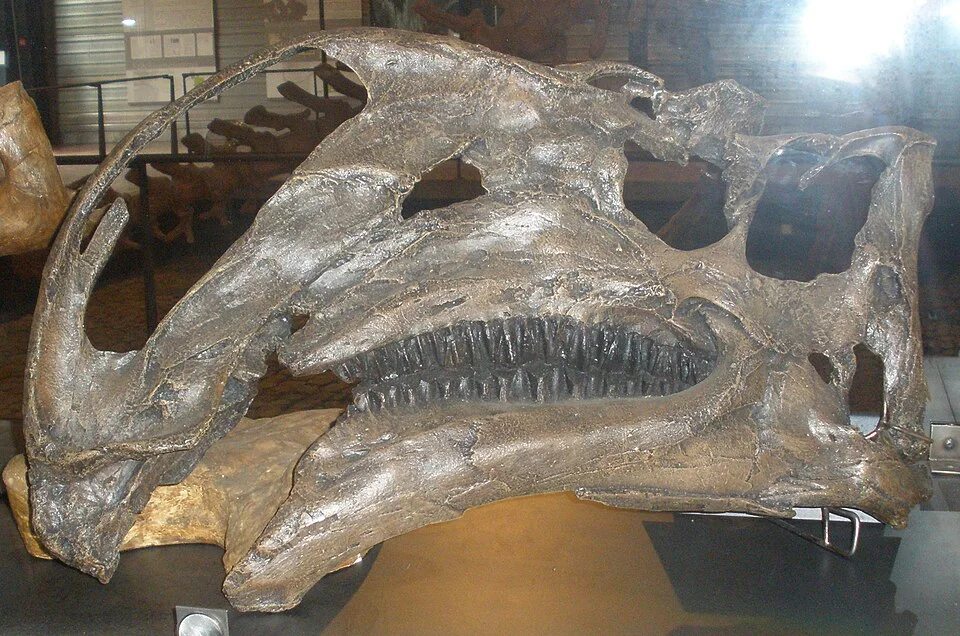
The Altirhinus skull display highlights its arched nasal region and plant-processing jaw. A displayed specimen or skeletal mount can include restored parts. Its appearance should be read alongside the original specimen description.
Compare Iguanodon, Mantellisaurus, Edmontosaurus. Find more names in the A index and explore ornithischian field notes. The glossary explains unfamiliar fossil terms.
Quick answers
- Where have Altirhinus fossils been found?
- The discoveries discussed here come from Mongolia. Modern place names describe discovery locations, not a complete ancient geographic range.
- When did Altirhinus live?
- It is placed in the Cretaceous period. See the discovery discussion for qualifications about the particular rock layers and dating.
- Where can I compare Altirhinus with related dinosaurs?
- Follow the related field notes below. Comparisons explain shared anatomy; they do not imply that all the animals lived together.