Jurassic Dinos editorial · Updated · Source-based review
What is Iguanodon?
Iguanodon was a large Early Cretaceous plant-eating dinosaur best anchored by Iguanodon bernissartensis.
Distinctive features and evidence
The genus was once used for fossils across a much wider span of time and geography. Later revisions narrowed those assignments, making the well-substantiated Belgian material more informative than a composite of every historical Iguanodon species.
Genus overview and research references.
Iguanodon fossil discoveries
Iguanodon was named in 1825 by the English geologist Gideon Mantell from teeth and bones found in the Tilgate Forest of Sussex. Mantell had trouble persuading others. Experts first suggested the teeth belonged to a fish or a rhinoceros, until Georges Cuvier changed his mind in 1824 and a curator at the Royal College of Surgeons noted that the teeth resembled those of an iguana, only far bigger. After Megalosaurus, Iguanodon was the second dinosaur to receive a formal name. A popular story says Mantell’s wife found the first tooth, but there is no firm evidence for it.
The discovery that changed everything came on 28 February 1878, when two miners at Bernissart in Belgium hit a skeleton about 322 metres underground. Excavators eventually recovered at least 38 Iguanodon individuals, and Louis Dollo reconstructed them, so that some of the first mounted dinosaur skeletons went on display in the 1880s. The bones began to crumble from pyrite disease, and the conservation problems have continued through several restoration rounds up to 2007. Some of the skeletons are still displayed in Brussels.
How big was Iguanodon?
Mantell guessed from scaling that the animal might reach 18 metres. Modern estimates are much smaller: I. bernissartensis is estimated at about 9 metres on average, with large individuals up to about 11 metres, while one older figure of 13 metres is thought to be an overestimate. The Natural History Museum gives about 10 metres and 4 tonnes. Different methods give body masses from about 3.1 to 4.5 tonnes.
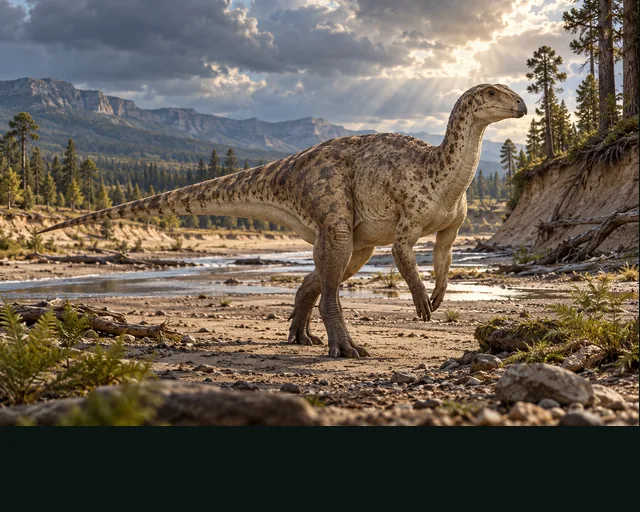
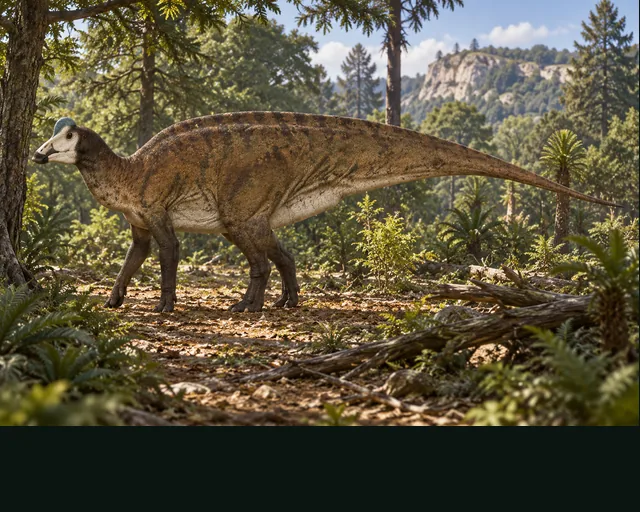
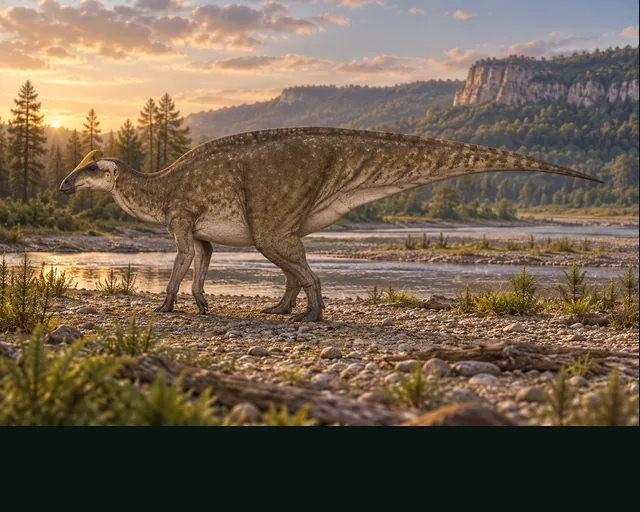
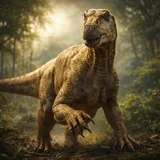
The animal was bulky, with a tall, narrow skull, a toothless beak and cheek teeth. The arms were long and sturdy, up to about three-quarters the length of the legs, and the three central fingers were bound together so that they could carry weight. The little finger was long and flexible. The legs were strong but not built for running, and the backbone and tail were stiffened by tendons that had turned to bone.
What was the Iguanodon thumb spike for?
The conical thumb spike is the best-known feature of Iguanodon, yet Mantell first placed it on the nose of his reconstruction, as a horn. The complete Bernissart skeletons let Dollo put it correctly on the hand. Its purpose is still debated. Many scientists think it was a stabbing weapon for close-range defence against predators, though it might also have been used to open seeds and fruits, or in contests between Iguanodon. A suggestion that it carried a venom gland has been rejected, since the spike was solid and had no grooves for venom.
The Maidstone skeleton, found in 1834 and used for the earliest reconstructions, is now generally treated as a different iguanodont, Mantellisaurus, so the horn error came from an incomplete specimen of a relative.
How did Iguanodon move and live?
Iguanodon has been drawn in several ways. Victorian sculptors at the Crystal Palace made it an elephant-like four-legged beast. After Bernissart, Dollo mounted it upright on two legs with a bent tail, like a kangaroo. David Norman later showed that this was wrong, because the tail was held straight by bony tendons, so the body was carried roughly horizontally. The arm and hand anatomy suggests the animal spent time on all fours, and young animals had relatively shorter arms than adults, which implies that it became more four-legged as it grew heavier. A maximum speed of about 24 kilometres per hour has been estimated, for a biped.
The Bernissart bone beds were once seen as a single herd killed in one disaster, but they are now read as at least three separate events, and the shortage of juveniles argues against a herd. A German site at Nehden, where animals of many ages died, may record moving herds caught by floods, though most of its bones belong to a close relative. Isotope data suggest it did not make long migrations.
What did Iguanodon eat?
The teeth show that Iguanodon ate plants, although exactly which ones is unknown. The upper teeth ground against the lower ones as the skull closed, which worked like a form of chewing, and new teeth replaced old ones one at a time so that the animal could handle tough food through life. The front of the jaws was toothless and tipped with a horny beak for cropping twigs and shoots, and it probably had cheek-like structures to keep food in the mouth.
A large adult could browse from ground level up to foliage about 4 to 5 metres high. Norman suggested horsetails, cycads and conifers. Mantell’s idea that Iguanodon had a long grasping tongue like a giraffe was not supported, because the bones that held the tongue were heavy, which points to a muscular tongue for moving food about.
Which fossils are really Iguanodon?
The genus was once a catch-all. Because it was one of the first dinosaurs named, fossils from many ages and places, from the Late Jurassic to the Early Cretaceous, were assigned to it, and by the early 2000s researchers recognised that the English bones included several unrelated animals. These were split off into genera such as Mantellisaurus, Barilium and Hypselospinus. In 2000 the official type species was changed from a single tooth to I. bernissartensis, so the name now rests on the Belgian skeletons.
A second species, I. galvensis, was named in 2015 from Spain, with 13 young individuals among the material. In 2025 some authors placed it in its own genus, Paulodon, though other palaeontologists have disagreed with their method. Iguanodon gives its name to the larger group Iguanodontia, which includes Dryosaurus, Camptosaurus, Ouranosaurus and the duck-billed hadrosaurs, and it appears in cladograms between Camptosaurus and Ouranosaurus.
Where and when Iguanodon lived
I. bernissartensis lived from the Barremian to the early Aptian ages of the Early Cretaceous, roughly 126 to 122 million years ago, in Belgium, Germany, England and Spain. The Natural History Museum gives a wider 140 to 110 million years for the genus as a whole. The Paleobiology Database catalogue runs far longer, from the Late Jurassic to the end of the Cretaceous, because of old assignments of fossils that were later removed.
In England, the animals living with Iguanodon-type dinosaurs included small and large predators, among them Baryonyx and Neovenator, plus low-feeding plant-eaters and the armoured Polacanthus. Fossils also record injuries: one individual had a fractured hip bone, and two others show arthritis in the ankle bones.
Iguanodon in the game
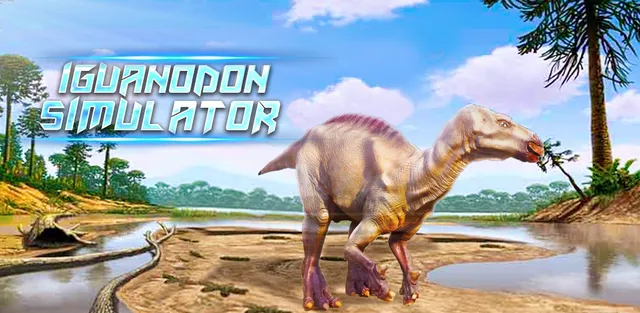
Iguanodon: Dinosaur Survival is an Android open-world dinosaur game. Its store listing describes managing health, hunger and energy, a day-night and weather system, quests, upgrades, building a family and encounters with more than 30 other dinosaurs. It also mentions hunting prey, but Iguanodon was a plant-eater, so that is a game mechanic. A few other Jurassic Dinos games, such as Dimetrodon Simulator, list Iguanodon among the dinosaurs a player may face.
The game’s animations, abilities and fights are entertainment, and they are not scientific evidence about how Iguanodon behaved.
Classification and fossil record
The Paleobiology Database taxonomic record catalogues Iguanodon under Ankylopollexia. This is the immediate parent in that catalogue, rather than a complete list of evolutionary relationships.
The corroborated occurrence sample includes Belgium, Germany, Spain; those are modern discovery locations, not a complete ancient geographic range.
The sourced length estimate for Iguanodon is 9–11 metres. This is an estimate for the reconstructed animal, not a measurement shared by every individual. See the body-size discussion and linked evidence for context.
Research starting point
The catalogue links Iguanodon to Mantell, 1825, published in Philosophical Transactions of the Royal Society of London. This identifies a research starting point; the catalogue’s citation alone does not verify every later reconstruction or species assignment.
For the meaning of taxonomic terms and how evidence is checked, see the glossary and editorial policy.
Quick answers
- Is Iguanodon a dinosaur?
- Yes. Iguanodon was a large plant-eating ornithopod dinosaur and gives its name to the group Iguanodontia, which also includes hadrosaurs.
- When did Iguanodon live?
- I. bernissartensis lived in the Early Cretaceous, about 126 to 122 million years ago, while the Natural History Museum gives a broader 140 to 110 million years for the genus.
- How big was Iguanodon?
- Adults of I. bernissartensis are estimated at about 9 to 11 metres long and roughly 3 to 4.5 tonnes in weight.
- What was the Iguanodon thumb spike for?
- Scientists think it was mainly a close-range defensive weapon, though it may also have opened seeds and fruits. Its exact use is still debated, and a venom gland has been rejected.
- What did Iguanodon eat?
- It was a herbivore with a horny beak and grinding teeth, probably eating low to medium plants such as horsetails, cycads and conifers, although its exact diet is unknown.
- Where was Iguanodon found?
- Fossils come from Belgium, Germany, England and Spain, and the most famous find is the group of at least 38 skeletons discovered in a coal mine at Bernissart, Belgium.