Jurassic Dinos editorial · Updated · Source-based review
What is Ouranosaurus?
Ouranosaurus was an Early Cretaceous African plant-eating hadrosauriform known especially from Niger.
Distinctive features and evidence
Relatively complete Elrhaz Formation specimens provide a stronger basis than isolated fragments. Its raised-back reconstruction should distinguish the vertebral evidence from hypotheses about the soft tissue supported above the spine.
Genus overview and research references.
Ouranosaurus fossil discoveries
Ouranosaurus is known from fairly complete skeletons rather than isolated fragments. Between 1965 and 1972, French expeditions led by Philippe Taquet worked in the Gadoufaoua region of the Sahara in Niger and recovered several iguanodont skeletons. Two of them were nearly complete. One came from the first expedition in 1965 and one from the fourth, in 1970, and in 1976 Taquet named both as Ouranosaurus nigeriensis, with the more complete skeleton as the holotype, the specimen that fixes the name.
The holotype includes a semi-articulated skull, nearly the whole backbone, the forelimbs and most of a hind limb. After its description it was returned to Niger and now stands in the national museum of Niger in Niamey. A second skeleton was mounted in 1975 at the natural history museum in Venice, Italy. A third, indeterminate specimen is known from Cameroon.
One skeleton collected in the same expeditions turned out to belong to a different animal. It became the holotype of Lurdusaurus in 1999.
How big was Ouranosaurus?
Ouranosaurus is usually put at about 7 to 8.3 metres long, with a weight of around 2.2 tonnes, though the tonne figure is a single published estimate. The Natural History Museum lists a length of 7 metres. The Venice skeleton is about 6.5 metres as mounted, with a few tail bones missing, and the holotype was probably about 10 per cent longer.
A 2017 study by Bertozzo and colleagues suggested both main specimens were subadults, meaning they were close to full size but not necessarily fully grown. The bone microstructure of the smaller specimen suggests fast growth.
Was the back of Ouranosaurus a sail or a hump?
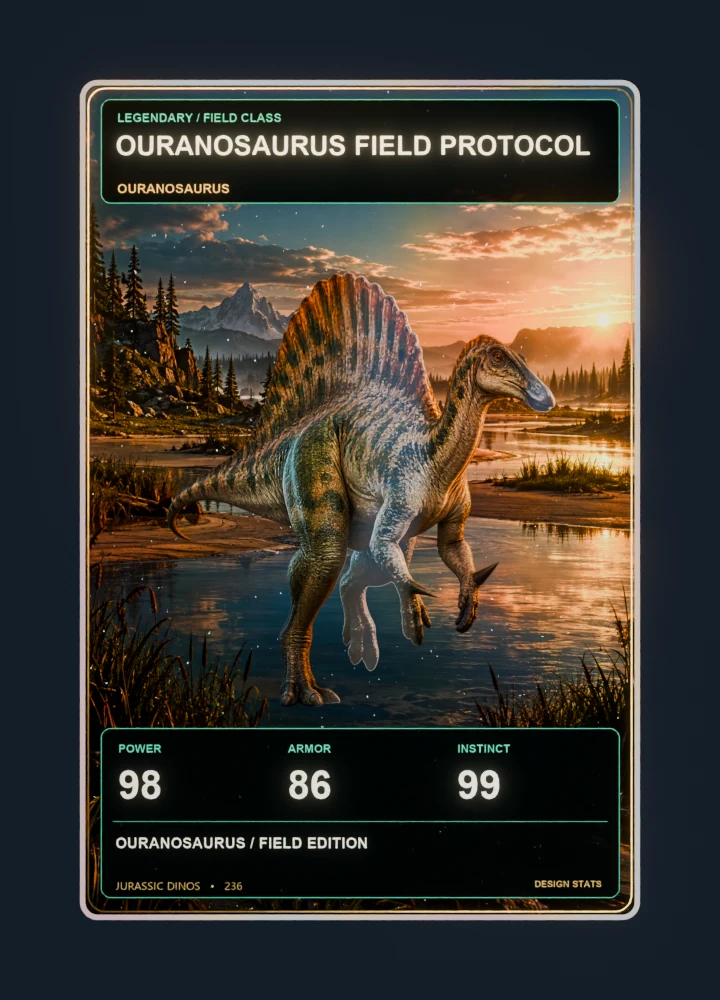
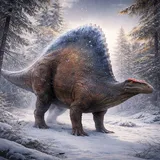
The most striking feature of Ouranosaurus is the row of tall, broad neural spines, the bony blades rising from the top of the vertebrae. They ran over the back, hips and tail base. The longest, about 63 centimetres, rose over the shoulders and front of the back, and the rear spines were bound together by ossified tendons, bands of tendon turned to bone, which stiffened the back.
What covered the spines is not known. Scientists have suggested a skin sail used for temperature control or display, an arrangement that has been compared with the sail of Spinosaurus, a theropod from the Cretaceous of North Africa. Another idea is a fatty or muscular hump like a bison’s or camel’s, which might have stored energy for lean seasons. The bones alone cannot decide between these ideas.
What did Ouranosaurus eat?
Ouranosaurus was a plant eater. The front of the snout had no teeth and wore a horn-covered sheath during life, which made a wide beak. Behind a gap in the jaw were batteries of cheek teeth, with 22 tooth positions in each side of both the upper and lower jaw, where fresh replacement teeth sat between the crowns of those in use. Together they formed a continuous chewing surface.
The jaw muscles seem to have been relatively modest. Some researchers have suggested a diet of leaves, fruit and seeds that were chewed thoroughly, while the wide beak may point to eating large amounts of low-quality plant matter. The skull also had bumps on top of the nasal bones, sometimes described as small horns, but their function is not known.
Is Ouranosaurus an iguanodont or a hadrosaur?
Ouranosaurus is an ornithopod, a plant-eating dinosaur group that includes Iguanodon and the duck-billed hadrosaurs. It was first placed in the family Iguanodontidae in 1976, but that grouping is now regarded as a loose assembly and is rarely used. Today it is usually described as a basal hadrosauriform, an early relative on the line leading to hadrosaurs, rather than a true duck-billed dinosaur.
Its exact position still shifts from study to study. Sereno (1986) treated it as the closest relative of the true hadrosaurs, Norman (2004) placed it on a more basal rung between Iguanodon and Mantellisaurus, and a 2017 analysis using the Venice skeleton recovered it as a basal hadrosauroid. Its hands also differ from Iguanodon. The thumb spike was much smaller, and the broad second and third fingers seem built for bearing weight.
Where and when Ouranosaurus lived
Ouranosaurus comes from the upper Elrhaz Formation, part of the Tégama Group of Niger, which is probably Aptian in age within the Early Cretaceous. The Natural History Museum gives a date range of about 115 to 100 million years ago, whereas the Paleobiology Database lists occurrences of the genus beginning around 121 to 113 million years ago, so published dates differ.
The formation is mostly river-laid sandstone, and Ouranosaurus is thought to have lived on inland floodplains. Its neighbours included the iguanodont Lurdusaurus and the long-necked Nigersaurus, which were the most numerous large plant eaters there, along with theropods such as Suchomimus and Kryptops, and crocodile relatives like Sarcosuchus. Fish, turtles, a hybodont shark and freshwater clams have also been found.
Ouranosaurus in the game
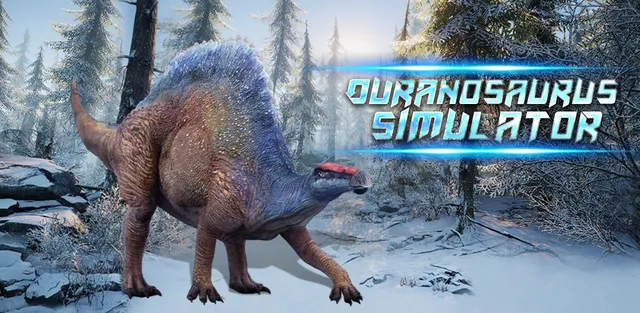
Ouranosaurus: Dino Simulator is an Android game in which you control an Ouranosaurus on a hidden island. According to its store listing, you manage health and energy, find food, drink water, complete quests, level up and customise your dinosaur, with day-and-night cycles and changing weather.
The listing also describes hunting and battling other dinosaurs. That is a game rule. The fossil evidence, with its beak and grinding teeth, indicates Ouranosaurus ate plants, and the listing frames the setting as Jurassic although Ouranosaurus lived in the Early Cretaceous of Africa. Animations, abilities and encounters in the game are entertainment and not scientific evidence.
Classification and fossil record
The Paleobiology Database taxonomic record catalogues Ouranosaurus under Neoiguanodontia. This is the immediate parent in that catalogue, rather than a complete list of evolutionary relationships.
Discovery and naming history
Niger skeletons found in 1965 and 1970 preceded Philippe Taquet’s 1976 naming of Ouranosaurus nigeriensis. Their preservation supports the tall spinal profile; a precise interpretation of the external soft tissue remains a separate question. Historical overview.
The corroborated occurrence sample includes Niger; those are modern discovery locations, not a complete ancient geographic range.
The sourced length estimate for Ouranosaurus is 7–8.3 metres. This is an estimate for the reconstructed animal, not a measurement shared by every individual. See the body-size discussion and linked evidence for context.
Research starting point
The catalogue links Ouranosaurus to Taquet, 1972, published in I Dinosauri del Teneré. This identifies a research starting point; the catalogue’s citation alone does not verify every later reconstruction or species assignment.
For the meaning of taxonomic terms and how evidence is checked, see the glossary and editorial policy.
Quick answers
- Is Ouranosaurus a dinosaur?
- Yes. Ouranosaurus was a plant-eating ornithischian dinosaur, an early relative of the duck-billed hadrosaurs, that lived in Africa during the Early Cretaceous.
- When did Ouranosaurus live?
- It lived in the Early Cretaceous, probably in the Aptian stage. The Natural History Museum gives roughly 115 to 100 million years ago, though other databases give somewhat different ages.
- How big was Ouranosaurus?
- About 7 to 8.3 metres long, with one published weight estimate of around 2.2 tonnes. The best specimens may have been subadults, so fully grown animals could have been slightly larger.
- Is Ouranosaurus a hadrosaur?
- Not a true hadrosaur. It is usually classed as a basal hadrosauriform or hadrosauroid, an earlier relative on the line to the duck-billed dinosaurs, and studies disagree on its exact place.
- What did Ouranosaurus eat?
- Plants. It had a toothless horny beak and batteries of cheek teeth for grinding, though no stomach contents are known. Scientists suggest leaves, fruit, seeds and tough low-quality plant matter.
- Where was Ouranosaurus found?
- Mainly in the Gadoufaoua area of Niger, in the Elrhaz Formation, with an indeterminate third specimen from Cameroon. Skeletons were found in 1965 and 1970.