Jurassic Dinos editorial · Updated · Source-based review
What is Sarcosuchus?
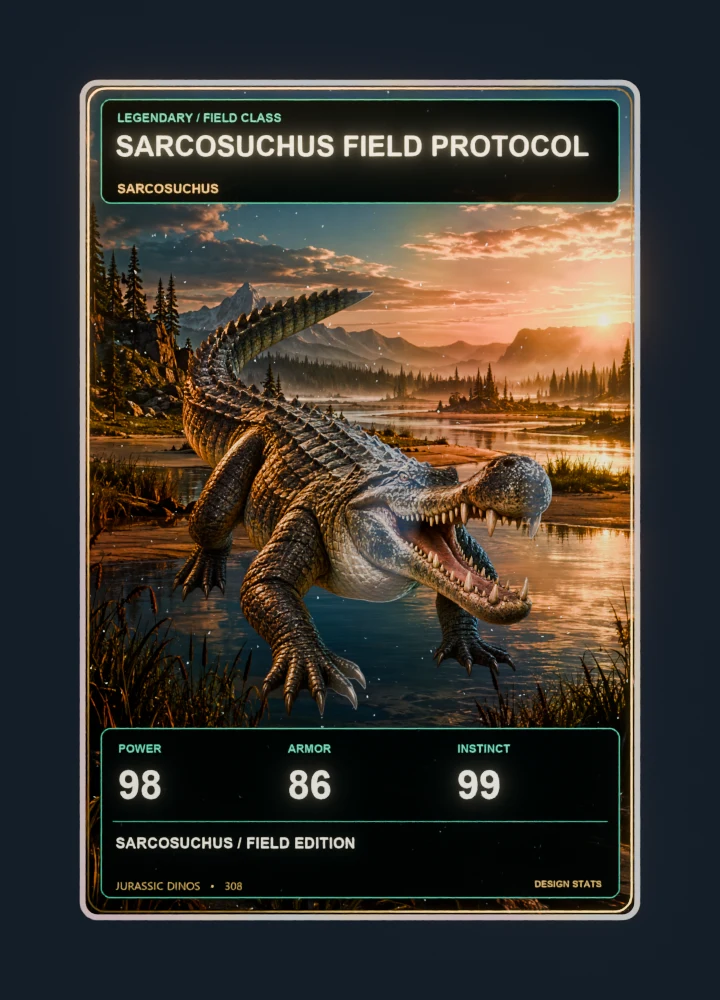
Sarcosuchus was a large Early Cretaceous crocodyliform known from North African and Brazilian records.
Distinctive features and evidence
The Niger skull material anchors Sarcosuchus imperator, while Brazilian fossils have a separate assignment history. It belongs to the crocodile evolutionary story, rather than Dinosauria, and reconstructions should identify which species supplies the evidence.
Genus overview and research references.
Is Sarcosuchus a dinosaur?
No. Sarcosuchus was not a dinosaur. It was a giant crocodyliform, a member of the crocodile branch of reptiles, in an extinct family called Pholidosauridae. It shared its world with dinosaurs, but it belongs to a different line. Crocodyliforms are part of the larger group Crocodylomorpha, which includes living crocodiles, alligators and gharials and their extinct relatives.
It was not a true crocodile either. Pholidosaurids sit outside the group that holds today’s crocodilians and are only distantly related to them. This is why many writers call Sarcosuchus a “crocodile relative” or “supercroc”. See our not-dinosaurs guide for other prehistoric animals that are often mistaken for dinosaurs.
Sarcosuchus fossil discoveries
Fossils of Sarcosuchus turned up in several stages. In the 1850s, British geologist Samuel Allport found crocodile teeth near Salvador in Bahia, Brazil. Years later those teeth were named by Othniel Charles Marsh as Crocodylus hartti. They were moved into Sarcosuchus in 1977, as the species S. hartti, but that species is known only from fragmentary remains and was smaller.
The main species, S. imperator, came from the Sahara. French expeditions between 1946 and 1959 collected teeth, plates of skin armour and skull pieces in Algeria, Mali and Tunisia. In 1964 a team searching for uranium found a nearly complete skull at Gadoufaoua in Niger, and in 1966 Frances de Broin and Philippe Taquet named the genus and species from it.
The best material arrived in 1997 and 2000, when expeditions led by the American palaeontologist Paul Sereno collected six new specimens in the Ténéré Desert of Niger, including skulls and parts of the body. Those finds underpin the detailed 2001 study that gave the animal its modern fame.
How big was Sarcosuchus?
Sarcosuchus imperator was one of the biggest crocodile relatives known, but the numbers have changed. In 2001 Sereno’s team estimated a maximum length of at least 11 to 12 metres and a weight of about 8 tonnes, extrapolating from living crocodilians. Later work using other measurements, such as skull width and a thigh bone, produced lower figures. A 2019 study estimated the largest specimen at nearly 9 metres and about 3.45 tonnes, with upper estimates of 9.5 metres and 4.3 tonnes. Treat the size as a range of about 9 to 12 metres, because no complete skeleton exists.
The biggest confirmed skull is about 1.6 metres long. The snout makes up roughly three quarters of the skull, and each side of the upper jaw held 35 teeth. The jaws did not close evenly, since the upper jaw was longer than the lower. A bump at the snout tip, called a bulla, is found in all described skulls, so it was not a male-only feature as the similar bump of a gharial is. Skin armour plates ran along the neck, back and part of the tail.
Bone sections suggest an animal that took around 50 to 60 years to reach full size, which is a long time for a crocodile relative. Sereno proposed that it grew large by keeping up fast juvenile growth for longer.
What did Sarcosuchus eat?
The skull is the main clue. Adults had a broader snout than a gharial, which is a fish specialist, and smooth, sturdy teeth that did not interlock when the jaws closed. Sereno’s team therefore proposed a generalist diet like that of a Nile crocodile, including fish and large land animals such as dinosaurs. Chemical analysis of its bones is reported to fit a diet of both fish and big dinosaurs.
However, a 2014 computer model of the skull suggested that Sarcosuchus probably could not perform the twisting “death roll” that living crocodiles use to tear prey apart, unlike the giant crocodile relative Deinosuchus. If it did hunt large animals, it likely dealt with them differently. Scientists do not know which dinosaurs, if any, it actually ate, because no fossil shows the act.
Where and when Sarcosuchus lived
Sarcosuchus is known from North Africa and Brazil in the Early Cretaceous. The genus spans roughly 133 to 101 million years ago, but the best-known animals, found in Niger’s Ténéré Desert (the Elrhaz Formation), lived about 120 to 112 million years ago. That was a river-crossed floodplain, and the water-living animals there were all freshwater species.
Its neighbours included large plant-eating dinosaurs such as the plant-eating ornithopod Ouranosaurus and the long-necked Nigersaurus, as well as meat-eating dinosaurs including the spinosaurid Suchomimus. A pterosaur, turtles, fish and a shark-like fish also lived there. Mangrove forests and wetlands covered much of North Africa and Brazil in the Early Cretaceous, supporting a diverse mix of dinosaurs, fish, crocodile relatives and pterosaurs.
Sarcosuchus and its relatives
Sarcosuchus belongs to the Pholidosauridae, a family of mostly aquatic crocodile relatives. Its closest relative is Terminonaris from North America. Most pholidosaurids had long, slim snouts and ate fish, and the earliest members lived in coastal waters, but Sarcosuchus lived in rivers and seems to have been more of a generalist. A 2019 study placed it close to the marine group Dyrosauridae.
Sarcosuchus is often compared with Deinosuchus, another giant crocodile relative, from the Late Cretaceous. One of the largest Deinosuchus skulls is reported as about 1.5 metres long, a little shorter than the biggest confirmed Sarcosuchus skull. For a dinosaur comparison, Spinosaurus belongs to the same family as the Suchomimus that lived alongside Sarcosuchus.
Sarcosuchus in the game
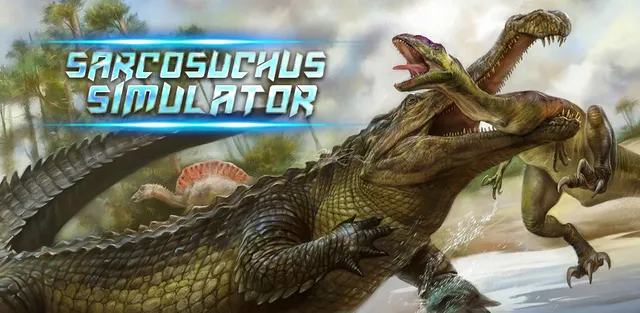
Sarcosuchus Dinosaur Simulator is an Android game where you play as a Sarcosuchus. Its store listing describes hunting, eating and drinking, an open Jurassic island with weather and a day-night cycle, RPG-style levelling, and battles against animals such as T-Rex, Spinosaurus and Velociraptor. Sarcosuchus also appears as a creature to meet in ocean games such as Megalodon Dino Survival Sim and Ichthyosaurus: Ocean Dino Sim.
The listing claims Sarcosuchus was deadlier than a T. rex, and games pit animals from different periods against each other. Those match-ups, abilities and the “Jurassic” setting are entertainment, not evidence: Sarcosuchus lived in the Early Cretaceous, and the sources cited here say nothing about it facing T. rex.
Classification and fossil record
The Paleobiology Database taxonomic record catalogues Sarcosuchus under Pholidosauridae. This is the immediate parent in that catalogue, rather than a complete list of evolutionary relationships.
Discovery and naming history
Frances de Broin and Philippe Taquet introduced Sarcosuchus in 1966 from incomplete Niger skull material. Additional African and Brazilian assignments broadened the historical genus record, requiring species-level context for comparisons. Historical overview.
The corroborated occurrence sample includes Morocco, Niger, Brazil; those are modern discovery locations, not a complete ancient geographic range.
The sourced length estimate for Sarcosuchus is 9–12 metres. This is an estimate for the reconstructed animal, not a measurement shared by every individual. See the body-size discussion and linked evidence for context.
Research starting point
The catalogue links Sarcosuchus to de Broin and Taquet, 1966, published in Comptes Rendus de l’Académie des Sciences à Paris, Série D. This identifies a research starting point; the catalogue’s citation alone does not verify every later reconstruction or species assignment.
For the meaning of taxonomic terms and how evidence is checked, see the glossary and editorial policy.
Quick answers
- Is Sarcosuchus a dinosaur?
- No. Sarcosuchus was a giant crocodyliform, a crocodile relative in the family Pholidosauridae, not a dinosaur and not a true crocodile.
- When did Sarcosuchus live?
- Sarcosuchus lived in the Early Cretaceous, about 133 to 101 million years ago for the genus. The best-known African fossils are about 120 to 112 million years old.
- How big was Sarcosuchus?
- Estimates range from about 9 to 9.5 metres in a 2019 study up to at least 11 to 12 metres in the original 2001 analysis, with weights of roughly 3.5 to 8 tonnes.
- What did Sarcosuchus eat?
- Its broad, unspecialised skull suggests a mixed diet of fish and large land animals, perhaps including dinosaurs, though no fossil directly shows what it ate.
- Where was Sarcosuchus found?
- The best Sarcosuchus fossils come from Niger, with other finds in Mali, Algeria and Tunisia, and from Bahia in Brazil, where the smaller S. hartti was found.