Jurassic Dinos editorial · Updated · Source-based review
What is Camptosaurus?
Camptosaurus was a beaked, plant-eating ornithischian of Late Jurassic western North America.
Distinctive features and evidence
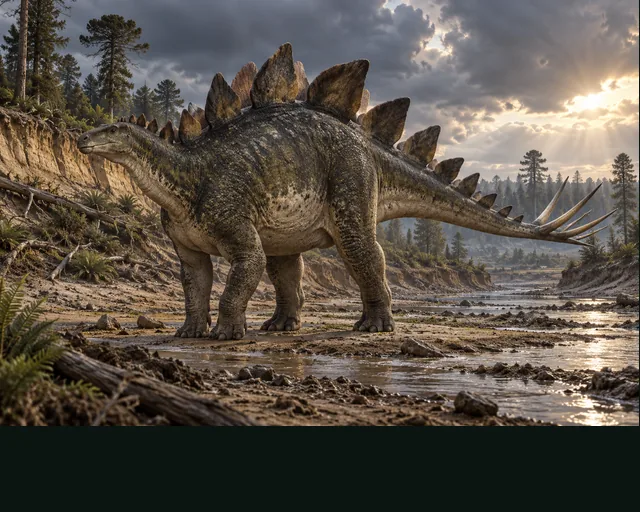
Its body plan provides a contrast with the armored Stegosaurus and long-necked sauropods of Jurassic ecosystems. Possible European assignments require attention to taxonomy rather than an unqualified global distribution claim.
Genus overview and research references.
Camptosaurus fossil discoveries
The first Camptosaurus remains were found on 4 September 1879 by William Harlow Reed in Albany County, Wyoming. Othniel Charles Marsh named the find Camptonotus, meaning “flexible back”, but that name was already used for a cricket, so he changed it to Camptosaurus in 1885. The name-bearing partial skeleton is catalogued as YPM 1877. Marsh also named C. dispar, the type species, from Quarry 13 at Como Bluff in Wyoming.
The record has been revised a lot since. A foot that Marsh gave a separate Camptosaurus species turned out to belong to Allosaurus. A skull that Marsh and later Gilmore used to picture Camptosaurus was shown by Brill and Carpenter to belong to another animal, now named Theiophytalia, in 2007. As a result, older drawings of Camptosaurus show a boxier head than the real triangular, pointed one.
How big was Camptosaurus?
Camptosaurus was a heavily built, plant-eating dinosaur with strong hind legs and broad feet that kept four toes. It is usually estimated at about 5 to 6 metres long and 500 to 1,000 kilograms. The largest fragments from higher rock layers suggest adults near 6.8 metres, while the Quarry 13 skeletons are smaller. Because several Morrison animals once called Camptosaurus have since been moved to other genera, it can be hard to say which bones belong to the true Camptosaurus.
What did Camptosaurus eat?
Camptosaurus had a pointed, beaked snout and teeth packed more tightly than in other Morrison ornithopods. The teeth had thick ridges and small denticles along their edges, similar to those of Dryosaurus but more developed. Heavy wear on the teeth suggests that it ate fairly tough plants. Scientists have also guessed running speeds for iguanodonts as a group, but no such figure has been measured for Camptosaurus itself.
Is Camptosaurus related to Iguanodon?
Camptosaurus belongs to Ankylopollexia, a group of plant-eating ornithischians. Its later members include iguanodontids such as Iguanodon and the hadrosaurs. Within the group it is an early member, so it is considered closer to the ancestor of those later forms than contemporaries like Dryosaurus and Nanosaurus. Marsh put it in its own family in 1885, while others treated it as an early iguanodontid.
Several species once placed in Camptosaurus now have their own names, such as Uteodon, Osmakasaurus and Cumnoria, and some are thought to be closer to advanced iguanodonts.
Did Camptosaurus live in Europe?
Several European fossils were called Camptosaurus in the late 1800s and early 1900s, but most have since been moved to other genera or judged doubtful. In 2022 Sánchez-Fenollosa and colleagues described a Spanish skeleton, made of vertebrae and part of an arm bone, as “aff. Camptosaurus”, meaning similar to but not certainly the same as Camptosaurus. So the genus is secure in the western United States and only tentatively known from Europe.
The Morrison Formation also holds a tiny embryo, about 9 inches long, assigned to Camptosaurus from Dinosaur National Monument in Utah. Camptosaurus lived alongside Stegosaurus and Allosaurus.
Classification and fossil record
The Paleobiology Database taxonomic record catalogues Camptosaurus under Ankylopollexia. This is the immediate parent in that catalogue, rather than a complete list of evolutionary relationships.
The corroborated occurrence sample includes United States, Germany, Spain; those are modern discovery locations, not a complete ancient geographic range.
The sourced length estimate for Camptosaurus is 5–6 metres. This is an estimate for the reconstructed animal, not a measurement shared by every individual. See the body-size discussion and linked evidence for context.
Research starting point
The catalogue links Camptosaurus to Marsh, 1885, published in American Journal of Science. This identifies a research starting point; the catalogue’s citation alone does not verify every later reconstruction or species assignment.
For the meaning of taxonomic terms and how evidence is checked, see the glossary and editorial policy.
Quick answers
- Is Camptosaurus a dinosaur?
- Yes. Camptosaurus was a beaked, plant-eating ornithischian dinosaur, an early member of the ankylopollexian group that leads towards Iguanodon-like dinosaurs and hadrosaurs.
- When did Camptosaurus live?
- Camptosaurus lived in the Late Jurassic. The Natural History Museum gives roughly 155 to 145 million years ago, though some Morrison specimens may come from older layers.
- How big was Camptosaurus?
- Camptosaurus was typically about 5 to 6 metres long and weighed roughly 500 to 1,000 kilograms, with some fragments suggesting adults near 6.8 metres.
- What did Camptosaurus eat?
- It ate plants. Its beak, tightly packed teeth and heavy tooth wear suggest it fed on relatively tough vegetation.
- Where was Camptosaurus found?
- The best-known Camptosaurus fossils are from the Morrison Formation of the western United States, mainly Wyoming and Utah. A possible related specimen has been reported from Spain.