Jurassic Dinos editorial · Updated · Source-based review
What is Dryosaurus?
Dryosaurus was a Late Jurassic North American plant-eating ornithopod.
Distinctive features and evidence
Species once placed in Dryosaurus have been reassigned to Valdosaurus and Dysalotosaurus. Its name and reconstructed agile build do not provide a measured top speed, so it belongs in a movement comparison rather than a numerical fastest-dinosaur list.
Genus overview and research references.
Dryosaurus fossil discoveries
The first remains were found in 1876 in Albany County, Wyoming, by Samuel Williston. Othniel Charles Marsh named them in 1878 as Laosaurus altus, and only in 1894 did he give the species its own genus, Dryosaurus. The type specimen includes a partial skeleton with a mostly complete skull and lower jaws, found in the Morrison Formation.
Later collecting added more material. Earl Douglass dug up bones at Dinosaur National Monument in Utah from 1922, including a very young individual and a hatchling, and more skeletons came from Colorado. At a site near Uravan, Colorado, found by the Scheetz family in 1972, about 2,500 fragments were excavated from at least eight individuals ranging from juveniles to embryos, together with eggshell. Embryos are very rare among dinosaur fossils.
How big was Dryosaurus?
Dryosaurus was a small, lightly built plant-eater. Published sizes differ: one overview estimates up to about 3 metres long and around 100 kilograms, while the Natural History Museum gives a length of about 4 metres. The difference partly reflects a real problem, because no adult skeleton of the genus is known for certain. In 2018 researchers concluded that the largest specimen belonged to a different species, which put earlier work on size and growth into question.
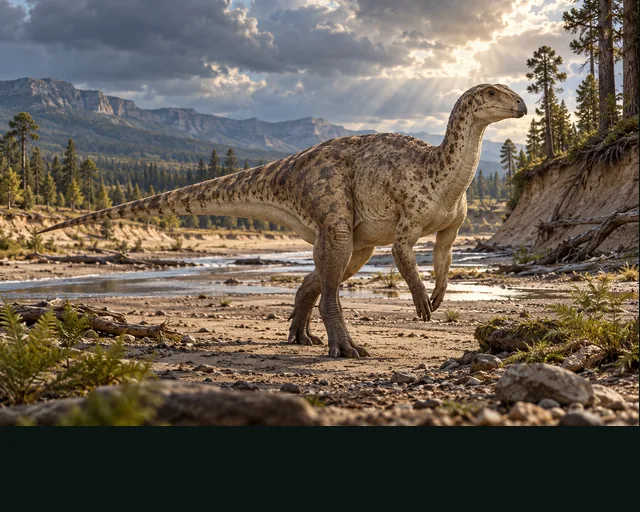
What the skeleton shows is a long neck, long slender legs, a long stiff tail and short arms with five fingers on each hand. It had a horny beak at the front of the mouth and cheek teeth with a strong ridge on the outer surface.
Is Dryosaurus an iguanodont?
Yes. Dryosaurus is an ornithopod, in the family Dryosauridae, and the museum lists it within the iguanodont branch of that group. It used to be classified as a hypsilophodont, an older label for small ornithopods. For a better-known relative from the same rocks, see Camptosaurus.
The genus has also been trimmed over time. Valdosaurus and Dysalotosaurus were once counted as species of Dryosaurus but are now regarded as separate genera. Within the Morrison fossils, a 2018 study by Carpenter and Galton named the Utah material as a separate species, D. elderae, so the single name Dryosaurus now covers more than one species in the American record.
How did Dryosaurus live?
Dryosaurus is thought to have fed mostly on low-growing plants on ancient floodplains. Its strong legs and stiff counterbalancing tail point to a quick, agile runner, and scientists think it probably relied on speed to escape meat-eaters. No one has measured a top speed from the fossils, so any number in popular books should be treated as a guess.
The hatchling from Dinosaur National Monument shows how the head changed with age: young animals had proportionally large eyes and a short muzzle, and as they grew the eyes became relatively smaller and the snout longer. The name itself, ‘oak lizard’, refers to a forest habitat as presumed by Marsh, and not to the shape of the teeth, a common misreading.
Where and when Dryosaurus lived
Dryosaurus lived in the Late Jurassic. The Morrison Formation spans roughly 156 to 147 million years ago, and the Paleobiology Database dates Dryosaurus to about 155 to 143 million years ago, while the museum gives about 155 to 140 million years. The sources therefore overlap, although they do not agree on the exact end of its range.
The Morrison landscape was semi-arid with wet and dry seasons, with floodplains, rivers, lakes and swampy lowlands. Giant sauropods such as Brontosaurus and Diplodocus lived there, along with plant-eaters like Stegosaurus and Camptosaurus. Meat-eaters included Allosaurus, which made up about 70 to 75 per cent of the theropod specimens found. The museum also lists Tanzania among places where Dryosaurus material has been reported, which may reflect material once grouped under the name but since moved to other genera.
Dryosaurus in the game
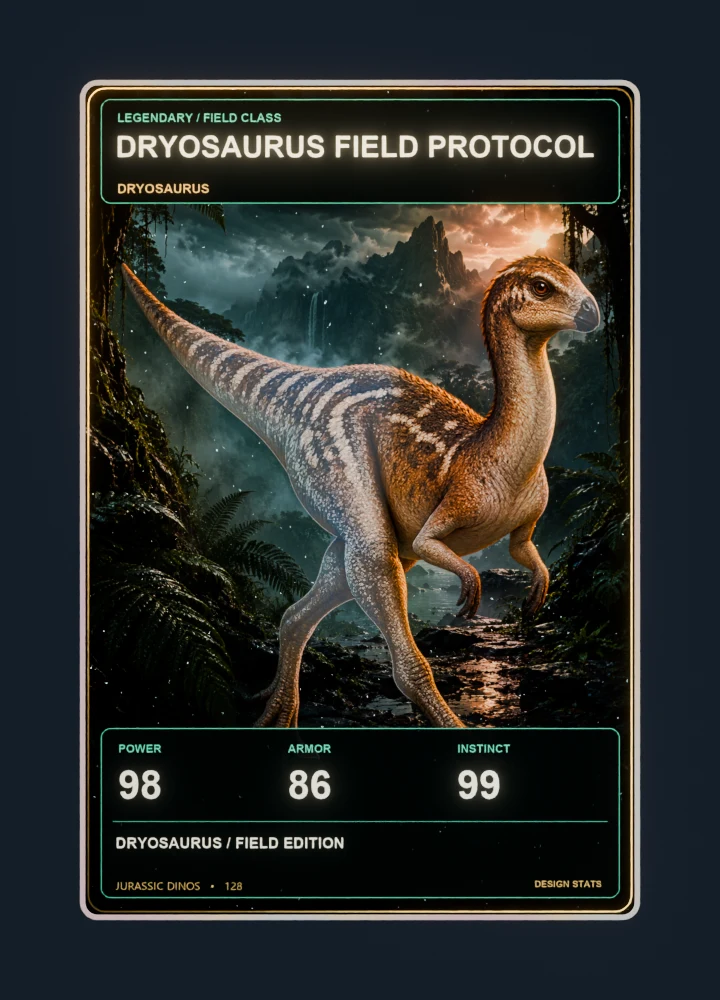
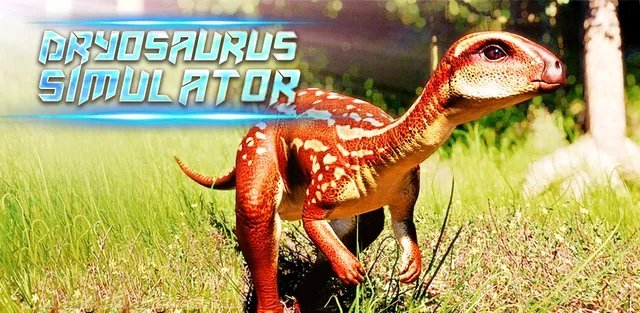
Dryosaurus: Dino Survival Sim is an Android open-world survival game. Its store listing describes managing health, hunger and energy, a day-night cycle with rain, storm, snow and fog, quests, and a roster of more than 40 playable dinosaurs. Players can also customise their dinosaur and build a family.
These features are entertainment. The game’s animations, abilities and survival rules do not show how Dryosaurus actually behaved.
Classification and fossil record
The Paleobiology Database taxonomic record catalogues Dryosaurus under Dryosauridae. This is the immediate parent in that catalogue, rather than a complete list of evolutionary relationships.
The corroborated occurrence sample includes United States; those are modern discovery locations, not a complete ancient geographic range.
Research starting point
The catalogue links Dryosaurus to Marsh, 1894, published in American Journal of Science, series 3. This identifies a research starting point; the catalogue’s citation alone does not verify every later reconstruction or species assignment.
For the meaning of taxonomic terms and how evidence is checked, see the glossary and editorial policy.
Quick answers
- Is Dryosaurus a dinosaur?
- Yes. Dryosaurus was a small plant-eating ornithopod dinosaur, an iguanodont in the family Dryosauridae, that lived in the Late Jurassic.
- When did Dryosaurus live?
- Dryosaurus lived in the Late Jurassic, roughly 155 to 143 million years ago according to the Paleobiology Database, with the museum giving about 155 to 140 million years.
- How big was Dryosaurus?
- Estimates differ: up to about 3 metres and 100 kilograms in one overview, about 4 metres at the Natural History Museum. No adult skeleton is certainly known.
- What did Dryosaurus eat?
- Dryosaurus was a herbivore. It is thought to have eaten low-growing plants, using a horny beak and ridged cheek teeth.
- Where was Dryosaurus found?
- Its fossils come from the Morrison Formation in the western United States, including Wyoming, Utah and Colorado.