Jurassic Dinos editorial · Updated · Source-based review
What was Hesperosaurus?
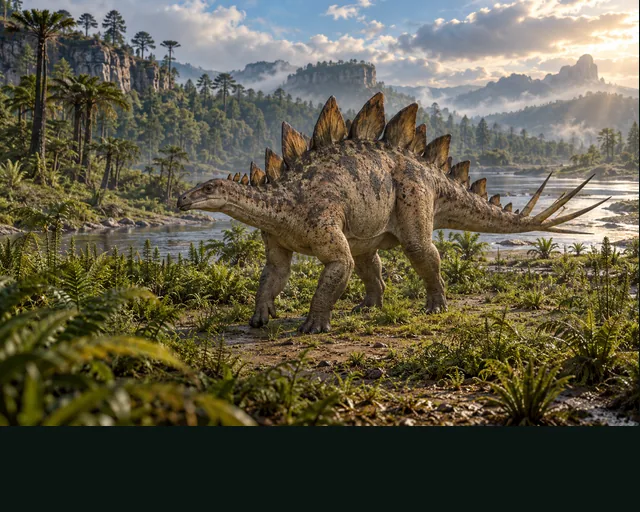
Hesperosaurus was a stegosaur from Late Jurassic North America. It carried plates along its back and spikes near the end of the tail. Its fossils reveal details of the body covering that an isolated plate cannot show.
What makes the fossil distinctive?
The back plates are generally described as relatively long and low compared with those of familiar Stegosaurus reconstructions. One specimen preserves an impression interpreted as the horny covering of a plate. The external surface of a living plate therefore need not have matched bare bone exactly.
Where was it found and how was it named?
The genus was named in 2001 after discoveries in the Morrison Formation. Relatively complete specimens from Wyoming and Montana have expanded the evidence. Its distinction from Stegosaurus has been debated, illustrating how closely related genera can be reassessed as more anatomy becomes available.
What can we infer, and what remains uncertain?
The preserved plate covering is especially useful when reading reconstructions. Bone can establish the underlying support, while soft-tissue traces constrain the outer shape. Colours and many behavioural details remain uncertain. Proposals that plates were used for display or heat exchange require evidence beyond simply noting their presence.
Were the plates exposed bare bone in life?
Evidence from Hesperosaurus supports a horny outer covering, so the living surface could differ from the fossil bone.
How can you check the evidence?
The Paleobiology Database record catalogues Hesperosaurus under Stegosaurinae. Its linked bibliography identifies this research starting point: K. Carpenter, C. A. Miles, and K. Cloward. 2001. New primitive stegosaur from the Morrison Formation, Wyoming. The Armored Dinosaurs. Indiana University Press, Bloomington. Open the bibliographic record. A catalogue entry establishes the source trail; it does not independently verify every later illustration or behavioural claim.
Use the dated genus overview to follow the references behind the discovery and anatomy discussed above. When sources disagree, compare which specimen and rock layer each author studied. A reconstructed whole animal can combine original bones with comparisons to relatives; those two kinds of evidence should not be confused. The account above explains the particular limits that matter for Hesperosaurus, rather than supplying unsupported size, speed or lifespan figures.
Read the image and keep exploring
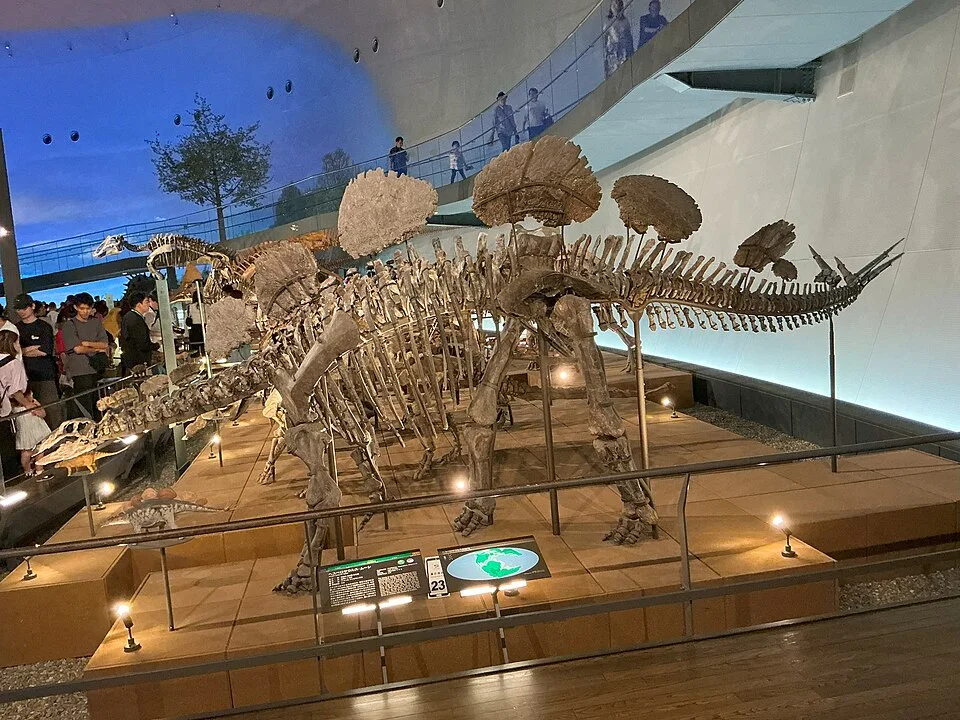
The Hesperosaurus mount displays back plates and a spiked tail; the living plate covering extended beyond bare fossil bone. A displayed specimen or skeletal mount can include restored parts. Its appearance should be read alongside the original specimen description.
Compare Stegosaurus, Huayangosaurus, Kentrosaurus. Find more names in the H index and explore ornithischian field notes. The glossary explains unfamiliar fossil terms.
Quick answers
- Where have Hesperosaurus fossils been found?
- The discoveries discussed here come from United States. Modern place names describe discovery locations, not a complete ancient geographic range.
- When did Hesperosaurus live?
- It is placed in the Jurassic period. See the discovery discussion for qualifications about the particular rock layers and dating.
- Where can I compare Hesperosaurus with related dinosaurs?
- Follow the related field notes below. Comparisons explain shared anatomy; they do not imply that all the animals lived together.