Jurassic Dinos editorial · Updated · Source-based review
What is Huayangosaurus?
Huayangosaurus was a Middle Jurassic Chinese stegosaur from the Lower Shaximiao Formation.
Distinctive features and evidence
It predates North American Stegosaurus and records an earlier stage of stegosaur diversity. Shared local deposits provide a more grounded ecological context than combining every famous plated dinosaur in one imagined landscape.
Genus overview and research references.
Huayangosaurus fossil discoveries
Huayangosaurus comes from a very rich fossil site in southwestern China. In 1979 and 1980 workers at the Dashanpu Quarry near the city of Zigong, in Sichuan Province, recovered the remains of twelve stegosaur individuals. Dong Zhiming, Tang Zilu and Zhou Shiwu named the animal in 1982. The species name, taibaii, honours the poet Li Bai, who was also known as Taibai.
The type specimen is a partial skeleton with a fairly complete skull, neck, back and tail vertebrae, a few foot bones, plates and a spike. A second specimen, ZDM T7001, is more complete and adds many more vertebrae, the shoulder girdle and eleven plates. In 2006 Susannah Maidment, Wei Guangbiao and David Norman re-examined the collection. They concluded that several specimens could not be tied to the type specimen with confidence, and that one looked different enough to be a separate animal. Mounted skeletons are displayed at the Zigong Dinosaur Museum.
How big was Huayangosaurus?
Huayangosaurus was small for a stegosaur. Reference accounts give a length of about 4 metres, and the Natural History Museum in London lists 4.5 metres, so a safe description is “around 4 to 4.5 metres” (about 13 to 15 feet). A body mass of roughly 500 kilograms is often quoted, but we found it in only one of the sources we checked, so treat it as a rough figure.
For comparison, Stegosaurus appeared in North America some 20 million years later and was a much bigger animal.
How did Huayangosaurus differ from Stegosaurus?
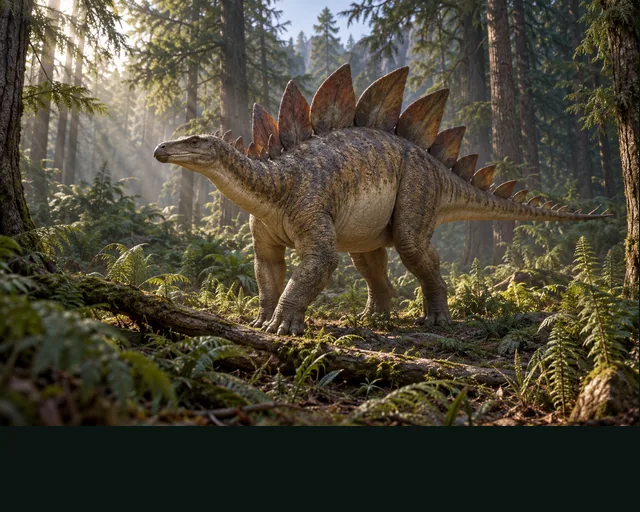
Huayangosaurus looks like an early draft of the stegosaur design. It had two rows of bony plates along its neck, back and tail, but they were narrower and more spike-like than the broad plates of Stegosaurus. A long spine curved out from each shoulder, a row of smaller bony studs ran along each flank, and the tail ended in two pairs of long spikes.
Several features were later lost. Huayangosaurus still had teeth at the very front of its upper jaw, a trait that no later stegosaur kept. Its skull was broader and its arms were relatively long and slender, while later stegosaurs had much shorter front legs.
Scientists have suggested uses for the armour, always with caution. The two big spikes above the hips might have discouraged attacks from above, and the Australian Museum notes vein-like channels in the plates that could have helped with temperature control or display. The plates were small, though, so any heat-shedding role would have been modest compared with the larger plates of Stegosaurus.
Is Huayangosaurus a stegosaur?
Yes. Huayangosaurus is a stegosaurian, a member of the armoured dinosaur group Stegosauria, and it gives its name to a small family, Huayangosauridae. That family is defined as everything closer to Huayangosaurus than to Stegosaurus, which expresses the idea that Huayangosaurus sits on an earlier branch than the famous plated dinosaurs of North America. It is among the oldest stegosaurs known from good material, so it is a useful guide to what early members of the group looked like.
Where and when Huayangosaurus lived
Huayangosaurus lived in the Middle Jurassic of what is now Sichuan, roughly 170 to 160 million years ago according to the Natural History Museum, with many accounts quoting about 165 million years. Its rocks, the Lower Shaximiao Formation, were long dated to about 168 to 161 million years ago on fossil evidence. A later radiometric date of about 160.4 million years from the lower part of the formation suggests the rocks may be somewhat younger than first thought, so the exact age is still being refined.
The formation contains petrified wood alongside the bones, and researchers suspect a forested landscape with a lake fed by a large river, into which carcasses were washed over a long time. Neighbours included the long-necked sauropods Shunosaurus, Datousaurus and Omeisaurus, the small plant-eater Xiaosaurus and the meat-eater Gasosaurus. By 1985 Dong Zhiming’s team had dug up more than 100 dinosaurs at Dashanpu.
Classification and fossil record
The Paleobiology Database taxonomic record catalogues Huayangosaurus under Huayangosauridae. This is the immediate parent in that catalogue, rather than a complete list of evolutionary relationships.
The corroborated occurrence sample includes China; those are modern discovery locations, not a complete ancient geographic range.
The sourced length estimate for Huayangosaurus is 4–4.5 metres. This is an estimate for the reconstructed animal, not a measurement shared by every individual. See the body-size discussion and linked evidence for context.
Research starting point
The catalogue links Huayangosaurus to Dong and Tang, 1982, published in Vertebrata PalAsiatica. This identifies a research starting point; the catalogue’s citation alone does not verify every later reconstruction or species assignment.
For the meaning of taxonomic terms and how evidence is checked, see the glossary and editorial policy.
Quick answers
- Is Huayangosaurus a dinosaur?
- Yes. Huayangosaurus was a plant-eating stegosaur, an armoured dinosaur from the Middle Jurassic of Sichuan Province, China.
- When did Huayangosaurus live?
- Huayangosaurus lived in the Middle Jurassic, roughly 170 to 160 million years ago, with many accounts giving about 165 million years. The exact age of its rocks is still being refined.
- How big was Huayangosaurus?
- It was small for a stegosaur, about 4 to 4.5 metres long. A weight of around 500 kilograms is often quoted, but that figure rests on limited sourcing.
- Is Huayangosaurus a stegosaur?
- Yes. It is a stegosaurian, and one of the earliest known from good fossils, with teeth in the front of the upper jaw that later stegosaurs lost.
- What did Huayangosaurus eat?
- Huayangosaurus was a plant-eater. Its small teeth and beak-like snout fit that diet, which is inferred from anatomy and from its place among the stegosaurs.
- Where was Huayangosaurus found?
- Huayangosaurus was found at the Dashanpu Quarry near Zigong in Sichuan Province, China, in the Lower Shaximiao Formation, with fossils collected in 1979 and 1980.