Jurassic Dinos editorial · Updated · Source-based review
What is Chungkingosaurus?
Chungkingosaurus was a stegosaur from the Late Jurassic Upper Shaximiao Formation of China.
Distinctive features and evidence
The type species is Chungkingosaurus jiangbeiensis. Its Chinese fossil setting broadens a comparison with North American Stegosaurus, while the short available overview does not justify detailed performance or behavioral claims.
Genus overview and research references.
Chungkingosaurus fossil discoveries
Fossils of Chungkingosaurus have been found near Chongqing in China since 1977. Dong Zhiming, Zhou Shiwu and Zhang Yihong named the genus in 1983. The holotype, catalogued as CV 00206, is a partial skeleton from the Upper Shaximiao Formation. It preserves part of the snout and lower jaws, ten vertebrae from the back, the hips, 23 tail vertebrae, some limb bones and five plates from the back. The specific name jiangbeiensis refers to the Jiangbei district.
The describers also reported three more sets of remains, left as unnamed “species” 1 to 3. One of these, a stretch of tail vertebrae with its spikes in place, is the only evidence for the shape of the tail weapon. In 2014 two of these specimens were given separate species names, but later researchers judged those names doubtful and treated the bones as the same species as the holotype.
How big was Chungkingosaurus?
Chungkingosaurus was small for a stegosaur. Dong and colleagues estimated the holotype at under four metres in length, and the ossified sacrum suggests that it was an adult. The Natural History Museum lists about four metres. The larger unnamed specimens were estimated at around five metres or more, although their identity is uncertain. Compared with Tuojiangosaurus from the same formation, it had a deeper snout and front jaw, giving a tall, narrow skull, and teeth that did not overlap and had weaker serrations.
Plates and tail spikes of Chungkingosaurus
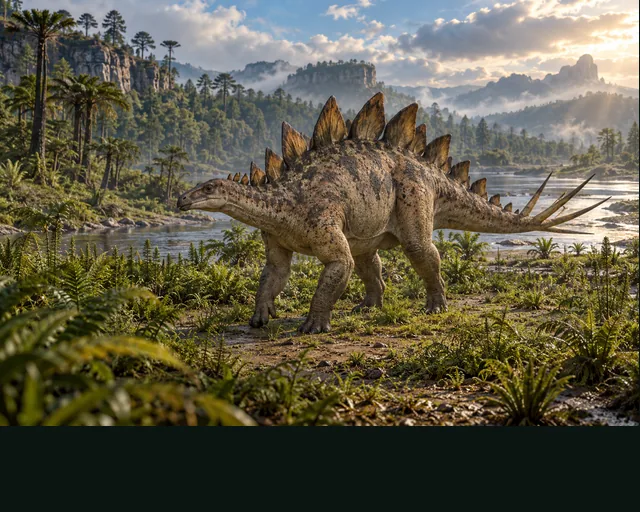
Chungkingosaurus probably had two rows of paired plates and spikes along its back, though the true number is unknown. A skeleton model in a Chongqing museum shows fourteen pairs of plates and two pairs of tail spikes. The plates had a thickened middle, as though they were modified spikes.
The tail specimen preserves two pairs of stout spikes, and the describers reported that a third pair at the front was lost during excavation. It also has an unusual extra pair of long, thin spikes at the very tip, pointing sideways and backwards. Gregory Paul compared this arrangement to a pin-cushion. A more familiar stegosaur with tail spikes is Stegosaurus.
Is Chungkingosaurus a valid stegosaur?
Chungkingosaurus is generally treated as a stegosaur, but its exact place has shifted. In 1983 it was placed in the Stegosaurinae, in 2006 Maidment and Wei called it an early member of the Stegosauria, and in 2008 Maidment and colleagues assigned it to the Huayangosauridae, the family of Huayangosaurus. In 2010 Gregory Paul suggested that it might be a juvenile of Tuojiangosaurus, though the holotype appears to be an adult. In 2006 Maidment and Wei treated it as valid, although a lot of the original material could not be traced.
Where and when Chungkingosaurus lived
Chungkingosaurus comes from the Upper Shaximiao Formation near Chongqing. The Natural History Museum lists the Late Jurassic, roughly 159 to 142 million years ago, but the Paleobiology Database gives an older range of about 168 to 161.5 million years, in the Bathonian to Callovian stages. Dates for the formation are not tightly fixed, so the exact age should be treated as uncertain.
It probably shared its landscape with other stegosaurs such as Tuojiangosaurus and Chialingosaurus, and with long-necked sauropods including Mamenchisaurus and Omeisaurus. It may have been hunted by large theropods such as Yangchuanosaurus.
Classification and fossil record
The Paleobiology Database taxonomic record catalogues Chungkingosaurus under Stegosauridae. This is the immediate parent in that catalogue, rather than a complete list of evolutionary relationships.
The corroborated occurrence sample includes China; those are modern discovery locations, not a complete ancient geographic range.
Research starting point
The catalogue links Chungkingosaurus to Dong and Zhou, 1983, published in Palaeontologica Sinica, New Series C, Whole Number. This identifies a research starting point; the catalogue’s citation alone does not verify every later reconstruction or species assignment.
For the meaning of taxonomic terms and how evidence is checked, see the glossary and editorial policy.
Quick answers
- Is Chungkingosaurus a dinosaur?
- Yes. Chungkingosaurus was a plant-eating stegosaur, an armoured dinosaur, from the Jurassic of the Chongqing region in China.
- When did Chungkingosaurus live?
- Sources differ. The Natural History Museum gives the Late Jurassic, about 159 to 142 million years ago, while the Paleobiology Database gives an older range, of about 168 to 161.5 million years.
- How big was Chungkingosaurus?
- It was small for a stegosaur: the holotype was estimated at under four metres long, with larger unnamed specimens perhaps around five metres.
- Is Chungkingosaurus a stegosaur?
- Yes. It is classed in the Stegosauria, although studies have placed it in different families and one suggested it could be a young Tuojiangosaurus.
- Where was Chungkingosaurus found?
- It was found in the Upper Shaximiao Formation near Chongqing, in China, with fossils collected from 1977 onwards.