Jurassic Dinos editorial · Updated · Source-based review
What is Mamenchisaurus?
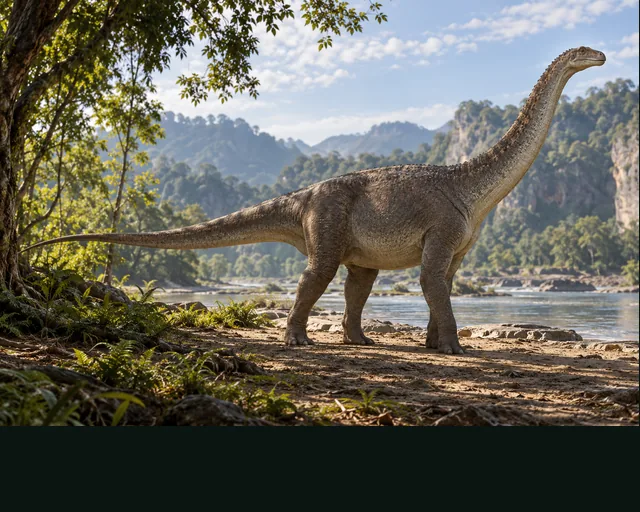
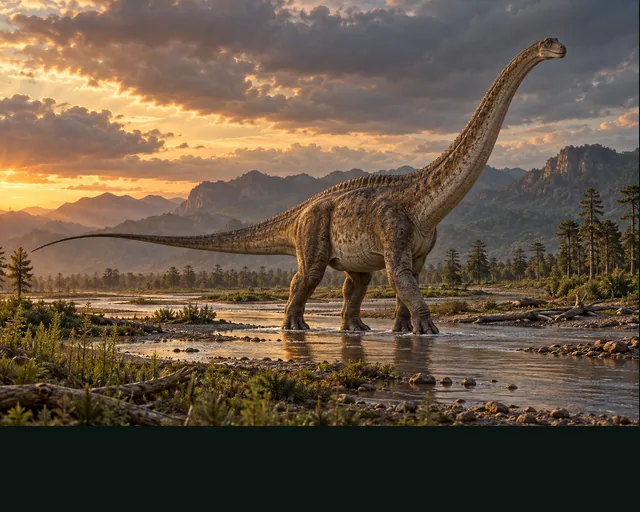
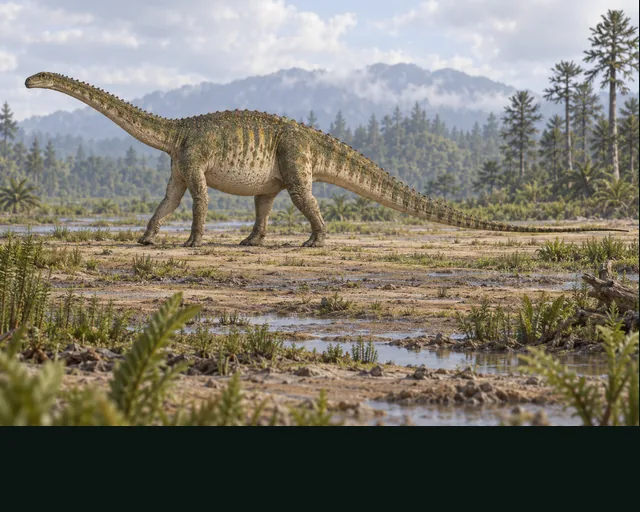
Mamenchisaurus was a Chinese sauropod genus associated with unusually elongated necks.
Distinctive features and evidence
Numerous species assignments and uncertain formation ages complicate a single reconstruction. Claims about an extreme neck length must identify the actual species and specimen rather than apply one large animal’s dimensions to the whole genus.
Genus overview and research references.
Mamenchisaurus fossil discoveries
The first Mamenchisaurus was found in 1952 by workers building the Yitang Highway in Sichuan Province, China, and the Chinese palaeontologist C. C. Young named it Mamenchisaurus constructus in 1954 (the species name nods to the road construction). That specimen was fragmentary: it included many neck, back and tail vertebrae and some leg bones but no skull, front limbs or hips. The genus name was also based on a slip, because Young confused the real place name with a similar-sounding one.
A second species, M. hochuanensis, was described in 1972 from near Hechuan. Local people had noticed its bones long before, but excavation only began in 1957. It preserved an almost complete backbone with 19 long neck vertebrae and was the largest sauropod then known from China. A skull and limbs were only found with a later specimen from Zigong, reported in 2001, though a 2020 analysis questioned whether that skeleton belongs to the same species.
How long was the neck of Mamenchisaurus?
The neck is the genus’s trademark, reaching nearly half of the animal’s total length. The neck bones were elongated, lightly built and filled with air spaces. Size, however, depends on the species. M. constructus is estimated at about 13 to 15 metres long, M. youngi about 16 metres with a neck of roughly 6.5 metres, and the M. hochuanensis skeleton about 21 to 22 metres with a 9.3-metre neck. The fragmentary M. sinocanadorum has the longest neck rib known for any described sauropod, at 4.2 metres, and its total length has been estimated at up to 26 metres. A claim of 35 metres rests on two undescribed vertebrae whose identity is disputed.
How the neck was held is also debated. A study of M. youngi suggested a mostly straight neck that could be lowered to feed at low levels, rather than a giraffe-like pose.
One specimen even has four fused tail vertebrae that may form a small tail club. Analysis suggests it was of limited use as a weapon, and it may have worked as a sensory organ. Omeisaurus and Shunosaurus, other Chinese sauropods, had tail clubs of a different shape.
How many Mamenchisaurus species are there?
Many species have been named, but scientists are not sure that all of them belong in the genus. Mamenchisaurus is sometimes described as a wastebasket taxon, a name that collects specimens that do not clearly fit elsewhere, and several family-tree analyses have failed to recover the species as a single natural group. The type species, M. constructus, is itself so incomplete that its exact relationships are unclear.
Two examples show the problem. M. anyuensis has been dated to roughly 114 million years ago, about 30 million years younger than the other species, so it is probably not a true Mamenchisaurus. In 2023, M. sinocanadorum was found to sit outside the other species, close to Xinjiangtitan. Because of this, a statement about “Mamenchisaurus” should say which species it is based on.
Where and when Mamenchisaurus lived
Most fossils come from the Sichuan Basin and Yunnan in southern China, with M. sinocanadorum from the Junggar Basin in the north-west. The Upper Shaximiao Formation, where many species were found, has no reliable direct date. Uranium-lead dating published in 2018 placed the layers beneath it at about 159 million years ago, in the Oxfordian stage of the Late Jurassic, so the Mamenchisaurus beds are probably no older than that. The Xinjiang species comes from rocks dated to about 161 to 159 million years ago.
Classification and fossil record
The Paleobiology Database taxonomic record catalogues Mamenchisaurus under Mamenchisauridae. This is the immediate parent in that catalogue, rather than a complete list of evolutionary relationships.
The corroborated occurrence sample includes China; those are modern discovery locations, not a complete ancient geographic range.
Research starting point
The catalogue links Mamenchisaurus to Young, 1954, published in Acta Paleontologica Sinica. This identifies a research starting point; the catalogue’s citation alone does not verify every later reconstruction or species assignment.
For the meaning of taxonomic terms and how evidence is checked, see the glossary and editorial policy.
Quick answers
- Is Mamenchisaurus a dinosaur?
- Yes. Mamenchisaurus was a long-necked sauropod dinosaur known from China, placed in the family Mamenchisauridae.
- How long was Mamenchisaurus?
- It depends on the species. Estimates range from about 13 to 15 metres for the type species to roughly 21 to 22 metres for M. hochuanensis, with up to 26 metres suggested for fragmentary M. sinocanadorum.
- When did Mamenchisaurus live?
- Most species lived in the Late Jurassic, probably no earlier than the Oxfordian stage, about 160 million years ago. Rocks of one disputed species are about 114 million years old.
- Why was the neck of Mamenchisaurus so long?
- The neck had many elongated, air-filled vertebrae and made up nearly half the body length. Scientists debate how it was used; one study of M. youngi suggests it often fed at low levels.
- Where was Mamenchisaurus found?
- Fossils come mainly from the Sichuan Basin and Yunnan in China, with one species from the Junggar Basin in Xinjiang.