Jurassic Dinos editorial · Updated · Source-based review
What is Shunosaurus?
Shunosaurus was a Jurassic Chinese sauropod named for Sichuan.
Distinctive features and evidence
Introductory sources disagree about the exact stage assigned to its fossil beds. The region and sauropod identity are clearer than a single precise numerical age, which should be checked against formation-level research.
Genus overview and research references.
Shunosaurus fossil discoveries
The first Shunosaurus bones were found in 1977 by a group of students who were practising fossil excavation at a road cutting at Dashanpu, near Zigong in Sichuan. That partial skeleton became the type specimen. Dong Zhiming, Zhou Shiwu and Zhang Yihong named the genus and species Shunosaurus lii in 1983. The genus name uses “Shu”, an old name for Sichuan, and the species name honours Li Bing, a governor of Sichuan in the third century BC.
The following year about twenty more specimens were reported, including several complete or nearly complete skeletons, skulls and young animals. As a result Shunosaurus has become one of the most completely known sauropods, and about 94% of its skeletal elements have been identified. A 2022 review of sauropod necks, most of which are incomplete or distorted, noted that Shunosaurus has two individuals with complete or nearly complete necks, a subadult missing only its first vertebra and an adult. The specimens are shown in museums in Zigong and Tianjin.
How big was Shunosaurus?
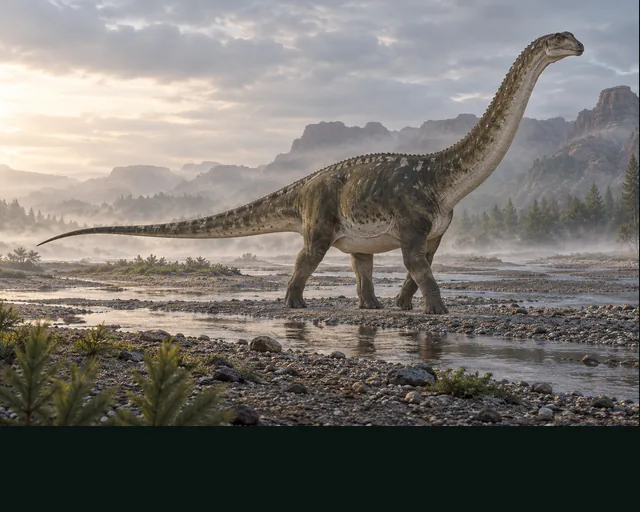
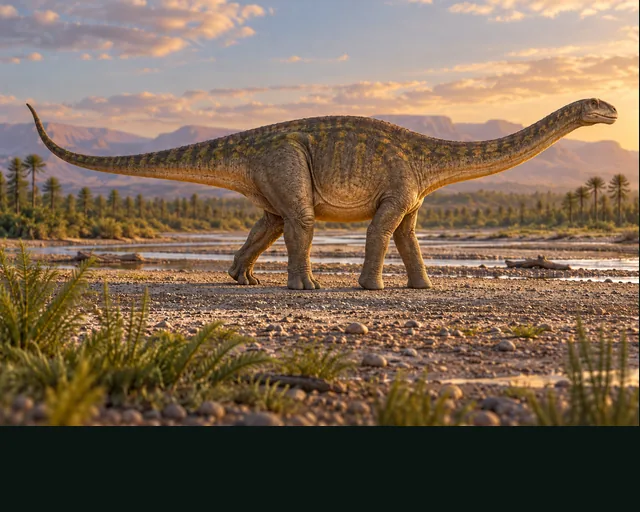
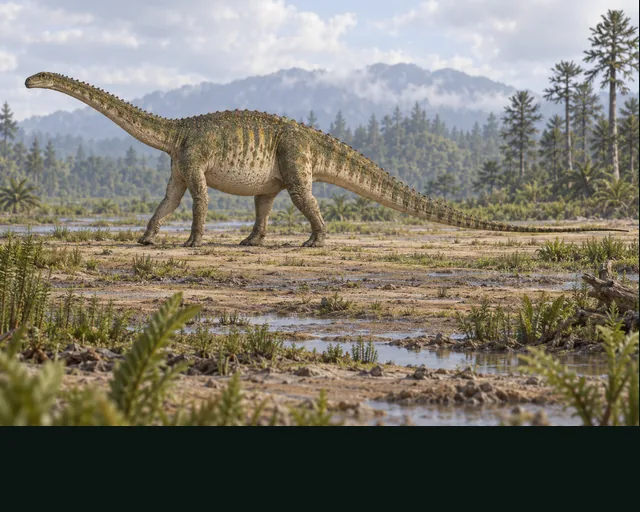
Shunosaurus was a mid-sized sauropod. It was first estimated at about 11 metres long, but later and more complete material suggested a slightly smaller animal. The Natural History Museum gives 10 metres, and Gregory Paul estimated about 9.5 metres and about 3 tonnes in 2010. Treat these as estimates rather than measurements.
Unlike most sauropods it had a very short neck, comparable to some members of the family Dicraeosauridae. The skull is the least certain part. The skulls found are mostly crushed or broken, and reconstructions of the head have varied from short, deep and broad to extremely narrow and pointed.
Did Shunosaurus have a tail club?
Yes, a bony club at the end of the tail was reported by Chinese palaeontologists in 1989, an unusual feature among sauropods. It has been interpreted as a weapon that may have been used to ward off predators, though that use is an inference and not something the fossils prove.
The jaws also stand out. Both the upper and lower jaws curved upwards, and the teeth were fairly sturdy with crowns up to 8 centimetres long, shaped like a cylinder with a spoon-like tip.
What did Shunosaurus eat?
Scientists think Shunosaurus was a plant-eater that browsed low vegetation, since its short neck would not have allowed it to reach high into trees. The shape of its jaws is described as well suited to processing large amounts of tough plant material. The exact plants are unknown, and no stomach contents have been reported.
Where and when Shunosaurus lived
Most of the best material comes from one site, the Dashanpu Quarry near Zigong, in the lower Shaximiao Formation. A partial juvenile skeleton was also reported from a different site in Yunyang County, Chongqing.
The age of the formation is disputed. It has long been treated as Middle Jurassic, and the Natural History Museum lists about 170 to 160 million years ago. However, dating of zircon crystals in the rock suggests that the formation is no older than about 159 million years, which would put it in the Oxfordian stage of the Late Jurassic. The Paleobiology Database range for the genus, roughly 175 to 155 million years ago, spans both views. Because of this disagreement this page gives only a broad Jurassic label.
Shunosaurus accounts for about 90% of the fossils collected in the Dashanpu fauna, so it was a common animal in its environment. The same fauna included other sauropods such as Omeisaurus, the early plated dinosaur Huayangosaurus, a meat-eater called Gasosaurus and a possible small ornithopod, Xiaosaurus.
Where does Shunosaurus fit among sauropods?
Shunosaurus belongs to Eusauropoda, a large group of long-necked sauropods, but where it sits within it has changed between studies. Dong placed it in Cetiosauridae in 1992. Upchurch grouped it with other Jurassic Chinese sauropods in 1995, while Wilson in 2002 found it very close to the base of Eusauropoda. A 2021 cladogram shows it as one of the earliest branches of that group, separate from the later Jobaria and Mamenchisaurus lineages.
A second species, Shunosaurus jiangyiensis, was named in 2004 from a single partial skeleton from Yuanmou County, Yunnan, mainly because its shoulder girdle differs from that of S. lii.
Classification and fossil record
The Paleobiology Database taxonomic record catalogues Shunosaurus under Eusauropoda. This is the immediate parent in that catalogue, rather than a complete list of evolutionary relationships.
The corroborated occurrence sample includes China; those are modern discovery locations, not a complete ancient geographic range.
The sourced length estimate for Shunosaurus is 9.5–10 metres. This is an estimate for the reconstructed animal, not a measurement shared by every individual. See the body-size discussion and linked evidence for context.
Research starting point
The catalogue links Shunosaurus to Dong and Zhou, 1983, published in Palaeontologica Sinica, New Series C, Whole Number. This identifies a research starting point; the catalogue’s citation alone does not verify every later reconstruction or species assignment.
For the meaning of taxonomic terms and how evidence is checked, see the glossary and editorial policy.
Quick answers
- Is Shunosaurus a dinosaur?
- Yes. Shunosaurus was a sauropod dinosaur, a plant-eating member of Eusauropoda, known from the Jurassic of Sichuan Province in China.
- When did Shunosaurus live?
- In the Jurassic, but the exact age is disputed. The Natural History Museum gives 170 to 160 million years ago, while zircon dating suggests its rock layer may be younger, about 159 million years or less.
- How big was Shunosaurus?
- About 10 metres long: the Natural History Museum gives 10 metres, and Gregory Paul estimated 9.5 metres and about 3 tonnes. It had a very short neck for a sauropod.
- Did Shunosaurus have a tail club?
- Yes. A bony tail club was reported in 1989, and it may have been used as a weapon against predators, although that is an interpretation rather than direct evidence.
- Where was Shunosaurus found?
- Mainly at the Dashanpu Quarry near Zigong in Sichuan, China, in the lower Shaximiao Formation. Students found the first skeleton in 1977, and it was named in 1983.