Jurassic Dinos editorial · Updated · Source-based review
What is Omeisaurus?
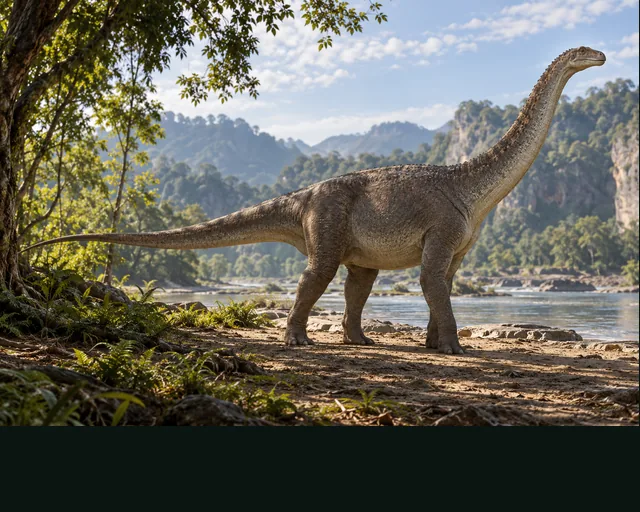
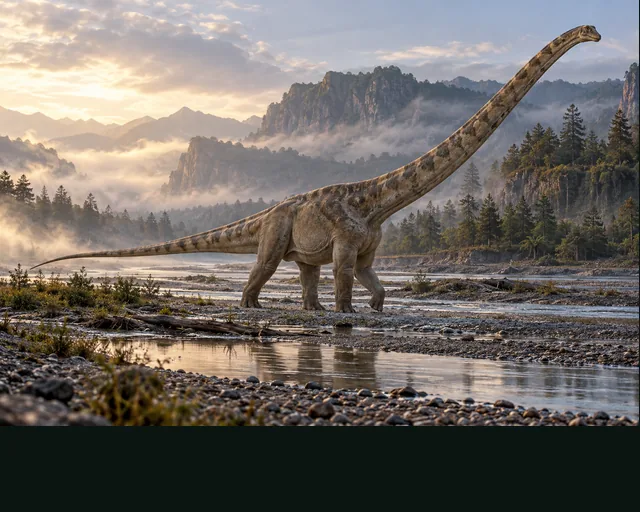
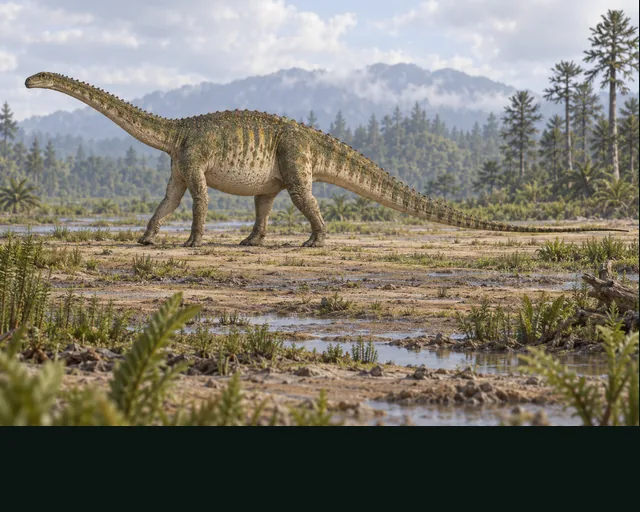
Omeisaurus was a Chinese Jurassic sauropod named for Mount Emei.
Distinctive features and evidence
Several species of different reconstructed sizes have been included in the genus. A single maximum length would obscure that variation, so species and fossil assignment should accompany any future numerical comparison.
Genus overview and research references.
Omeisaurus fossil discoveries
The first skeleton was dug up in Sichuan in 1936 by Charles Lewis Camp and Yang Zhongjian, from the Shaximiao Formation. Yang named it Omeisaurus junghsiensis in 1939. It had four neck vertebrae, and its name honours the sacred mountain Omeishan, with the species name taken from the nearby locality. That original skeleton was lost during the Second World War. In 1955 work on a reservoir at Changshou turned up more sauropod bones from the same rock, which Yang described in 1958 as a second species, O. changshouensis.
Bigger finds followed. In the 1970s construction of the Wujiaba Dam at Zigong exposed the remains of between 13 and 16 large sauropod individuals from the upper Shaximiao Formation, and two composite skeletons were later mounted. At Dashanpu, also in Zigong, a nearly complete, semi-articulated skeleton of O. tianfuensis (ZDM T5701) was described in 1984 and a skull-bearing partial skeleton (ZDM T5702) became the paratype. Later species include O. maoianus (2001), O. jiaoi (2011) and O. puxiani.
How big was Omeisaurus?
That depends on the species. The largest, O. tianfuensis, is estimated at 18 to 20.2 metres long and 8.5 to 9.8 tonnes. The type species, O. junghsiensis, is estimated at about 14 metres and 4 tonnes, and O. maoianus at about 15 metres and 5 tonnes. The Natural History Museum’s single figure of 20 metres matches only the largest species, so a single number can mislead.
Did Omeisaurus have a tail club?
One specimen of O. tianfuensis from Dashanpu showed a tail club at the end of the tail vertebrae. In the sources consulted, only O. tianfuensis is reported with this feature, so it should not be assumed for the other species.
Is Omeisaurus a mamenchisaurid?
Yes, today. Omeisaurus was once placed in Cetiosauridae, a family long used as a catch-all, and later in Euhelopodidae. It and other Jurassic Asian sauropods are now placed in the family Mamenchisauridae, the group of Mamenchisaurus, which sits lower down the sauropod tree. In 2021 John D’Angelo concluded that all species except O. maoianus are valid and probably belong in one genus, with O. junghsiensis the most primitive. Several analyses place O. maoianus closer to Mamenchisaurus and Xinjiangtitan, so its place in Omeisaurus has been questioned. Names have also been confused: O. fuxiensis shares its species name with a separate animal called Zigongosaurus, though they are based on different material.
Where and when Omeisaurus lived
Omeisaurus lived in what is now China during the Middle to Late Jurassic, from the Bathonian to the Oxfordian stage, and the Natural History Museum gives about 169 to 159 million years ago. It lived in dense forests. Species sometimes shared a habitat: O. junghsiensis and O. tianfuensis, for example. In the older Xiashaximiao layers it lived alongside the sauropods Shunosaurus and Datousaurus and the stegosaur Huayangosaurus, while Mamenchisaurus appears in the younger Shangshaximiao layers. The large predator Yangchuanosaurus is known from the upper layers and is thought likely to have preyed on sauropods.
Classification and fossil record
The Paleobiology Database taxonomic record catalogues Omeisaurus under Mamenchisauridae. This is the immediate parent in that catalogue, rather than a complete list of evolutionary relationships.
The corroborated occurrence sample includes China; those are modern discovery locations, not a complete ancient geographic range.
Research starting point
The catalogue links Omeisaurus to Young, 1939, published in Bulletin of the Geological Society of China. This identifies a research starting point; the catalogue’s citation alone does not verify every later reconstruction or species assignment.
For the meaning of taxonomic terms and how evidence is checked, see the glossary and editorial policy.
Quick answers
- Is Omeisaurus a dinosaur?
- Yes. Omeisaurus was a plant-eating sauropod dinosaur from the Middle to Late Jurassic of China, named after Mount Emei.
- When did Omeisaurus live?
- It lived from the Bathonian to the Oxfordian stages of the Middle to Late Jurassic, roughly 169 to 159 million years ago by the Natural History Museum's listing.
- How big was Omeisaurus?
- It depends on the species: about 14 metres for the type species, up to 18 to 20 metres for O. tianfuensis, the largest.
- Is Omeisaurus a mamenchisaurid?
- Yes. It is now classified in Mamenchisauridae, the family of Mamenchisaurus, after earlier placements in Cetiosauridae and Euhelopodidae.
- Where was Omeisaurus found?
- Fossils come from the Shaximiao Formation of Sichuan Province, China, including sites at Zigong, Changshou and Jingyan.