Jurassic Dinos editorial · Updated · Source-based review
What was Kulindadromeus?
Kulindadromeus was a small Jurassic ornithischian from Siberia. Fossils preserve both scales and filamentous body coverings. This combination makes it central to discussions about the early history of feather-like structures, especially because it was not a close theropod relative of birds.
What makes the fossil distinctive?
Different parts of the body carried different coverings. Some areas preserve simple filaments, while other patches show more complex grouped structures; the tail also preserves scales. An illustration that gives the whole animal one uniform covering can hide that important mosaic. These fossils challenge a simple division between “scaly dinosaurs” and “feathered dinosaurs.” A single animal could combine several surface types.
Where was it found and how was it named?
The genus was named in 2014 from material at Kulinda in Russia’s Zabaykalsky region. Numerous fossils, including different growth stages, were recovered from exceptionally preserving deposits. Such a site allows repeated observations rather than reliance on a lone impression. The exact geological placement has been discussed, with the material generally treated as Middle Jurassic.
What can we infer, and what remains uncertain?
Finding feather-like structures in an ornithischian opens more than one evolutionary question. Were some kinds of covering inherited from a distant common ancestor, or did similar structures evolve separately? The fossil demonstrates the covering itself more directly than it resolves every step of its evolutionary origin. Compare it with a feathered theropod such as Sinosauropteryx, but also compare the skeletons: similar body coverings do not make the animals the same kind of dinosaur.
Could Kulindadromeus fly?
There is no evidence that it could. A filamentous covering can serve functions other than flight, and this dinosaur lacked the wing anatomy of flying birds.
How can you check the evidence?
The Paleobiology Database record catalogues Kulindadromeus under Pyrodontia. Its linked bibliography identifies this research starting point: P. Godefroit, S. M. Sinitsa, and D. Dhouailly, Y. L. Bolotsky, A. V. Sizov, M. E. McNamara, M. J. Benton, O. Spagna. 2014. A Jurassic ornithischian dinosaur from Siberia with both feathers and scales. Science 345(6):451-455. Open the bibliographic record. A catalogue entry establishes the source trail; it does not independently verify every later illustration or behavioural claim.
Use the dated genus overview to follow the references behind the discovery and anatomy discussed above. When sources disagree, compare which specimen and rock layer each author studied. A reconstructed whole animal can combine original bones with comparisons to relatives; those two kinds of evidence should not be confused. The account above explains the particular limits that matter for Kulindadromeus, rather than supplying unsupported size, speed or lifespan figures.
Read the image and keep exploring
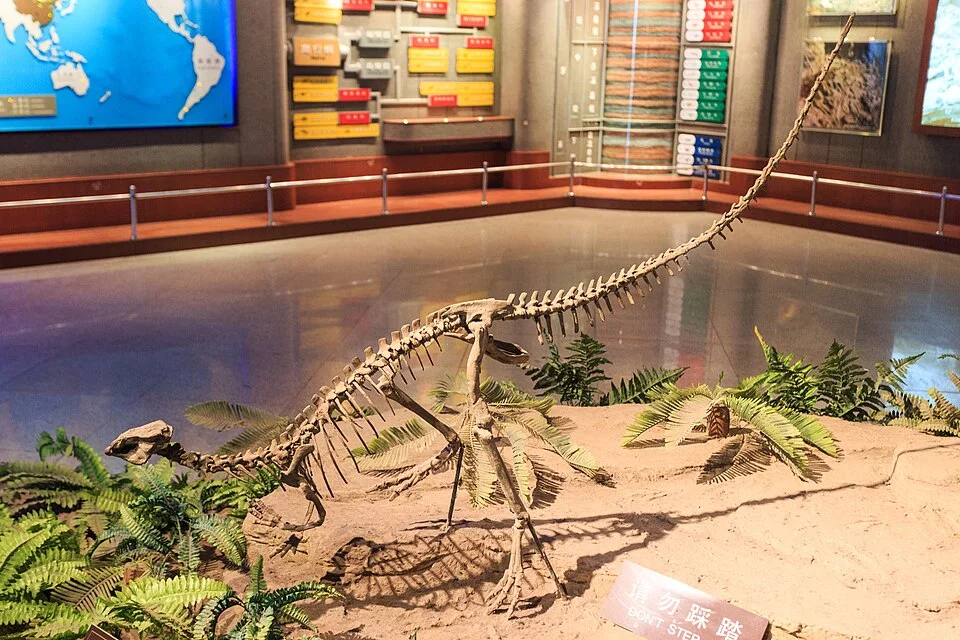
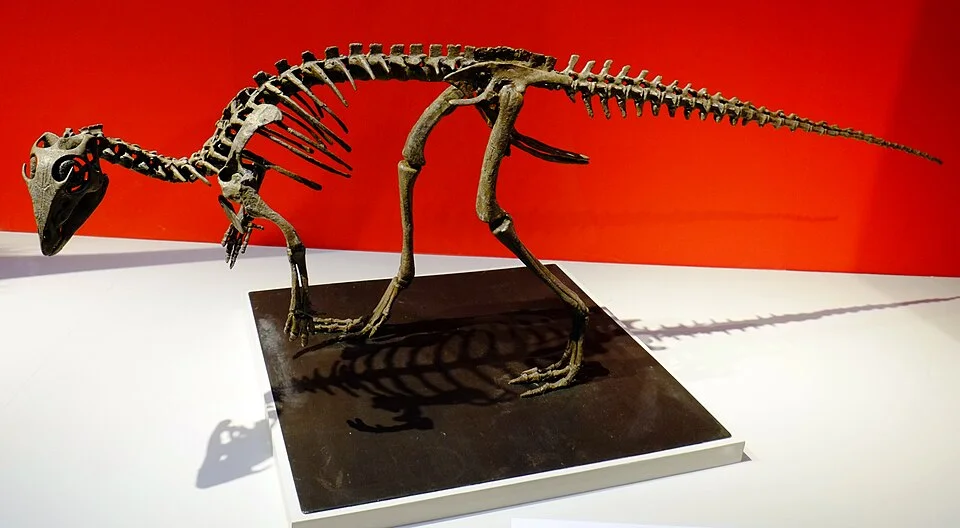
The skeletal mount shows Kulindadromeus body proportions; it does not itself display the fossil evidence for the skin covering. A displayed specimen or skeletal mount can include restored parts. Its appearance should be read alongside the original specimen description.
Compare Agilisaurus, Lesothosaurus, Scelidosaurus. Find more names in the K index and explore ornithischian field notes. The glossary explains unfamiliar fossil terms.
Quick answers
- Where have Kulindadromeus fossils been found?
- The discoveries discussed here come from Russia. Modern place names describe discovery locations, not a complete ancient geographic range.
- When did Kulindadromeus live?
- It is placed in the Jurassic period. See the discovery discussion for qualifications about the particular rock layers and dating.
- Where can I compare Kulindadromeus with related dinosaurs?
- Follow the related field notes below. Comparisons explain shared anatomy; they do not imply that all the animals lived together.