Jurassic Dinos editorial · Updated · Source-based review
What is Lesothosaurus?
Lesothosaurus was an Early Jurassic southern African ornithischian with relatively simple teeth and jaws.
Distinctive features and evidence
Numerous skull and body fossils make it important for early ornithischian anatomy. Possible seasonal omnivory is a hypothesis, and should remain separate from the directly preserved tooth structure.
Genus overview and research references.
Lesothosaurus fossil discoveries and the Fabrosaurus puzzle
The story starts with a single lower jaw fragment with three teeth, collected in 1959 by the geologist Jean Fabre in Lesotho. It was named Fabrosaurus australis in 1964, but a jaw piece is too little to identify an animal securely, so the name is now considered doubtful, even though the fragment probably came from a Lesothosaurus. Expeditions in 1963 and 1964, and a joint expedition in 1967 and 1968, then recovered scores of fossils, including skulls and partial skeletons, from the same site. Peter Galton named Lesothosaurus diagnosticus in 1978 from two of those specimens.
A second name later caused confusion. In 2005 a larger animal from South Africa was named Stormbergia, thought to be a separate, bigger relative. A 2017 study by Baron, Norman and Barrett argued that the differences simply reflect growth, so Stormbergia is probably the adult of Lesothosaurus.
How big was Lesothosaurus?
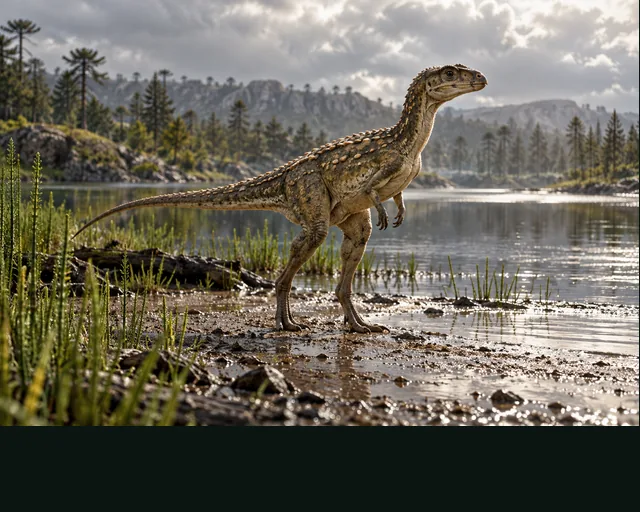
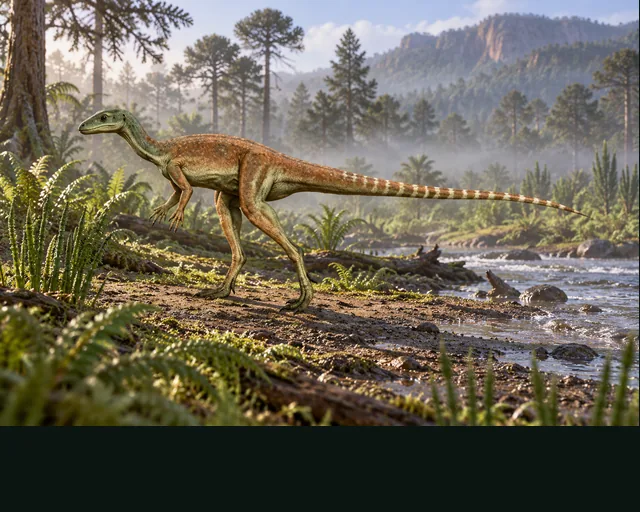
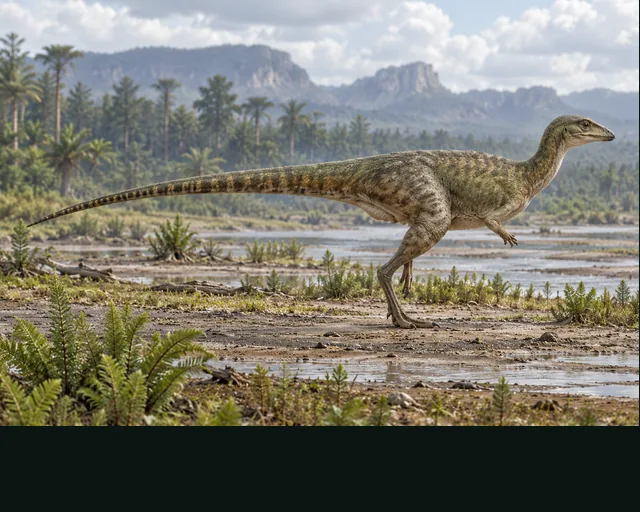
Lesothosaurus was small and lightly built, between about 1 and 2 metres long, and walked on two legs. Its long, slender legs, small arms and slender tail all point to a fast runner, while its hands were too weak to grasp properly. The Natural History Museum lists a length of 1 metre and about 10 kilograms, but because the sources checked here give only the museum’s weight, treat that figure as a rough guide. A bonebed found in 2016 included three large animals, which has led to the cautious suggestion that it may have lived in groups.
What did Lesothosaurus eat?
The front of the jaws ended in a horny beak, and behind it sat leaf-shaped teeth with coarse, edged margins. Studies of those teeth suggest Lesothosaurus sliced food rather than chewing it. They also showed less wear than expected in an animal eating only tough plants of a dry climate, so one study proposed that it was an opportunistic omnivore that ate small animals when softer plants were scarce. The museum, by contrast, lists it simply as a plant eater. The evidence for meat-eating is indirect, so this is a hypothesis rather than a finding.
What kind of ornithischian is Lesothosaurus?
Galton first placed it in a family called Fabrosauridae, which he saw as primitive members of the ornithopod line. In 1991 Paul Sereno argued that Lesothosaurus and similar animals were instead early members of the whole bird-hipped group, the ornithischians. Many later studies place Lesothosaurus at the base of the neornithischians, the group that includes ornithopods, horned dinosaurs and dome-headed dinosaurs, but another possibility is that it was an early thyreophoran, in the armoured group that led to stegosaurs and ankylosaurs. The position is unsettled, and it is best thought of as a small, early ornithischian.
Where and when Lesothosaurus lived
Lesothosaurus comes mainly from the Upper Elliot Formation of Lesotho and South Africa, with some from the Clarens Formation, rocks laid down in the Hettangian and Sinemurian stages of the Early Jurassic, roughly 200 to 190 million years ago. The museum gives an older 213 to 200 million years, and the rocks were once thought to be Late Triassic, so the exact date is uncertain. Animals of the Upper Elliot Formation appear lightly built, possibly an adaptation to a drier climate. Lesothosaurus shared its habitat with Heterodontosaurus, Massospondylus and the theropod Megapnosaurus.
Classification and fossil record
The Paleobiology Database taxonomic record catalogues Lesothosaurus under Thyreophora. This is the immediate parent in that catalogue, rather than a complete list of evolutionary relationships.
The corroborated occurrence sample includes South Africa; those are modern discovery locations, not a complete ancient geographic range.
The sourced length estimate for Lesothosaurus is 1–2 metres. This is an estimate for the reconstructed animal, not a measurement shared by every individual. See the body-size discussion and linked evidence for context.
Research starting point
The catalogue links Lesothosaurus to Galton, 1978, published in Paläontologische Zeitschrift. This identifies a research starting point; the catalogue’s citation alone does not verify every later reconstruction or species assignment.
For the meaning of taxonomic terms and how evidence is checked, see the glossary and editorial policy.
Quick answers
- Is Lesothosaurus a dinosaur?
- Yes. Lesothosaurus was a small, two-legged ornithischian dinosaur from the Early Jurassic of southern Africa, known from many skull and body fossils.
- When did Lesothosaurus live?
- Lesothosaurus lived in the Early Jurassic, roughly 200 to 190 million years ago in most accounts, though the museum gives an older range of 213 to 200 million years.
- How big was Lesothosaurus?
- Lesothosaurus was small, about 1 to 2 metres long, with long slender legs that suggest it ran quickly on two legs.
- What did Lesothosaurus eat?
- It had a horny beak and leaf-shaped teeth, so it ate plants, but tooth wear led one study to suggest it also took small animals when plants were scarce.
- Where was Lesothosaurus found?
- Lesothosaurus fossils were found in the Upper Elliot Formation of Lesotho and South Africa, in the Karoo region of southern Africa.