Jurassic Dinos editorial · Updated · Source-based review
What is Massospondylus?
Massospondylus was an Early Jurassic southern African sauropodomorph with an extensive referred fossil record.
Distinctive features and evidence
Its name originally reflected vertebrae interpreted as coming from the tail but later identified as neck bones. The original material was destroyed, so later specimens and careful identification are central to modern anatomical study.
Genus overview and research references.
Massospondylus fossil discoveries
The first Massospondylus bones were dug up around 1853 or 1854 near Harrismith, South Africa, by Joseph Millard Orpen, a surveyor, and his brothers. Richard Owen described 56 bones or fragments in London in 1854. They were found loose rather than connected, so it was hard to tell which belonged together. Owen’s name, a reference to long vertebrae, was based on what he took to be tail bones. The same bones were later shown to come from the neck.
The original collection was lost in 1941, when a bomb hit the Hunterian Museum in London during the Second World War. Only drawings and plaster casts survive. Scientists now rely on later finds, especially an almost complete skeleton nicknamed ‘Big Momma’, found in 1980 in South Africa. In 2010 Yates and Barrett proposed it as the new reference specimen, called a neotype.
Thousands of bones, including at least 13 reasonably complete skulls, have since been found, which makes it one of the best-known early sauropodomorphs.
How big was Massospondylus?
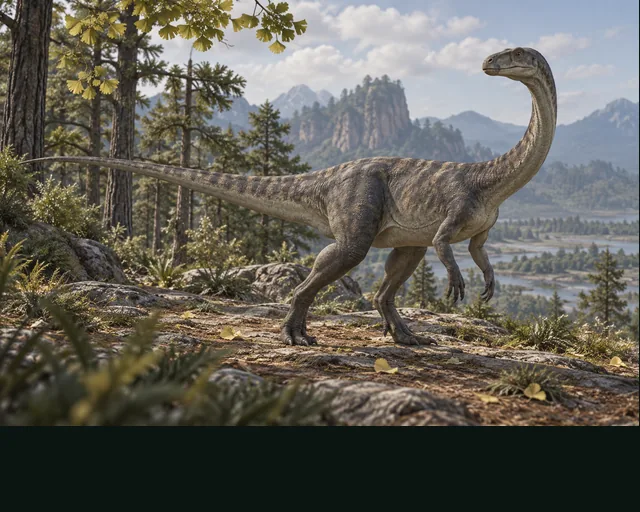
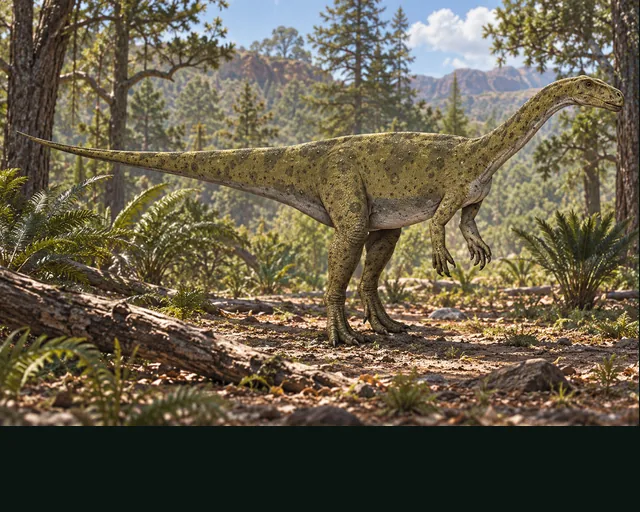
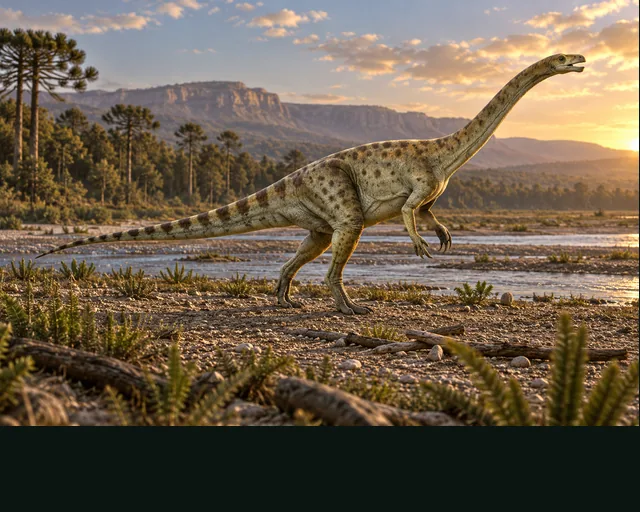
Massospondylus was a medium-sized sauropodomorph, with a long neck and tail, a very small head and a slim body. Sources give lengths from about 4 to 6 metres, and the large neotype specimen was estimated at around 5 metres by Barrett and colleagues in 2019. The Natural History Museum lists about 4 metres.
Weight estimates vary even more. The museum gives about 70 kilograms, while published estimates include roughly 137 kilograms (Frank Seebacher, 2001, for a 4-metre animal) and about 195 kilograms (Gregory Paul). Treat all of these as rough values.
Massospondylus eggs and embryos
In 1976 James Kitching found clutches of eggs at a site called Rooidraai in Golden Gate Highlands National Park, South Africa. Later work by Robert Reisz and colleagues reported ten clutches from at least four different layers, with up to 34 eggs in a clutch. They suggested that the site was used repeatedly, and that this is the oldest evidence of such nesting behaviour.
These are among the oldest known eggs and embryos of any land vertebrate with an amniotic egg. The eggshell had a very thin layer of calcite, under 0.1 millimetre thick. A study in 2020 by Chapelle and colleagues concluded that the embryos were only about 60 per cent of the way through incubation. The embryos had large heads and big eyes compared with adults. Scientists have debated whether hatchlings walked on four legs and later became two-legged, and recent studies disagree on the answer.
Did Massospondylus walk on two legs or four?
For many years it was drawn on all fours. In 2007 Matthew Bonnan and Phil Senter argued that the arm could not swing forwards properly and that the hands could not be turned to face forwards, so the animal was probably restricted to walking on two legs. Most modern accounts treat the adult as a biped.
The sickle-shaped thumb claw is thought to have been used in feeding, perhaps for pulling up plants or hooking branches when the animal reared up. It might also have been used in defence, though that is less certain.
What did Massospondylus eat?
Scientists think Massospondylus was mostly a plant-eater, though early sauropodomorphs may have been omnivores. The museum directory lists it as omnivorous. A 2004 study by Peter Galton and Paul Upchurch found that the jaws and tooth shape of early sauropodomorphs were closer to those of plant-eating reptiles than meat-eaters. In 2000 Paul Barrett suggested that they might have added small prey or carrion.
The upper parts of the tooth crowns were serrated. Teeth at the front of the snout were pointed and slightly curved, while those further back were broad and flat-tipped. A 2013 study estimated that each tooth stayed in the jaw for only about 17 to 30 days.
Is Massospondylus related to sauropods?
Massospondylus is a sauropodomorph, a group that includes the giant long-necked sauropods as well as many earlier, smaller relatives. It is usually placed in its own family, Massospondylidae. Plateosaurus is a well-known relative, though more heavily built, and Antetonitrus is another sauropodomorph from the upper Elliot Formation.
Owen did not recognise it as a dinosaur at first, and in the 1800s it was classed as a crocodilian and later as a theropod. In 1965 Alan Charig argued that these early long-necked dinosaurs were closer relatives of the sauropods. Material from the United States and Argentina once placed in Massospondylus is now assigned to the genera Sarahsaurus and Adeopapposaurus. Two species are valid: M. carinatus and M. kaalae, the latter known from one skull.
Where and when Massospondylus lived
Massospondylus lived in the Early Jurassic, about 201 to 184 million years ago according to one source, though other databases list different spans, some of them older. The bulk of the fossils are in South Africa and Lesotho, in the upper Elliot and Clarens rock units, with more in Zimbabwe. The climate was becoming drier, with rivers and lakes in the Elliot Formation and desert dunes in the Clarens Formation.
Its fossils are so common that a rock zone is named after the genus, and the fossils are used to estimate the relative age of rocks. Nearby animals included the small theropod Megapnosaurus, the larger predator Dracovenator and early ornithischians such as Lesothosaurus.
Classification and fossil record
The Paleobiology Database taxonomic record catalogues Massospondylus under Massospondylidae. This is the immediate parent in that catalogue, rather than a complete list of evolutionary relationships.
The corroborated occurrence sample includes South Africa; those are modern discovery locations, not a complete ancient geographic range.
The sourced length estimate for Massospondylus is 4–6 metres. This is an estimate for the reconstructed animal, not a measurement shared by every individual. See the body-size discussion and linked evidence for context.
Research starting point
The catalogue links Massospondylus to Owen, 1854, published in London. This identifies a research starting point; the catalogue’s citation alone does not verify every later reconstruction or species assignment.
For the meaning of taxonomic terms and how evidence is checked, see the glossary and editorial policy.
Quick answers
- Is Massospondylus a dinosaur?
- Yes. Massospondylus was a sauropodomorph dinosaur that lived in southern Africa in the Early Jurassic, and belongs to the wider group that later included the giant sauropods.
- When did Massospondylus live?
- It lived in the Early Jurassic, about 201 to 184 million years ago according to one source. Other databases give different spans, some of them older, so the exact limits are less certain.
- How big was Massospondylus?
- Estimates range from about 4 to 6 metres in length, depending on the source. Weight estimates differ more, from about 70 kilograms to roughly 195 kilograms.
- Is Massospondylus a sauropod?
- Not exactly. It is a sauropodomorph, an early relative of the sauropods, and is usually placed in the family Massospondylidae rather than within the true sauropods.
- What did Massospondylus eat?
- Scientists think it ate mainly plants, and that early sauropodomorphs may also have been omnivores. Jaw and tooth shape fit plant-eating reptiles better than meat-eaters.
- Where was Massospondylus found?
- Most fossils come from South Africa and Lesotho, with more from Zimbabwe. Material once assigned from the United States, India and Argentina is now placed elsewhere.