Jurassic Dinos editorial · Updated · Source-based review
What is Lufengosaurus?
Lufengosaurus was an Early Jurassic massospondylid dinosaur from southwestern China.
Distinctive features and evidence
Its geographic setting supplies an Asian comparison with southern African Massospondylus. The concise available overview supports group and provenance, while numerical size or feeding detail needs additional specimen-based sources.
Genus overview and research references.
Lufengosaurus fossil discoveries in Yunnan
The first bones were found in the late 1930s by the geologist Bien Meinian near Lufeng, in China’s Yunnan Province. The palaeontologist C. C. Young joined him in 1938 and named Lufengosaurus huenei in 1940, honouring his former teacher, the German scientist Friedrich von Huene. The type specimen is a nearly complete skeleton with a well-preserved skull, and Young published a full description in 1941. About thirty major specimens are known today, including juveniles.
In 1958 a Lufengosaurus became the first complete dinosaur skeleton mounted in China, and it appeared on a Chinese stamp the same year. Young also named a larger species, L. magnus, in 1940, but most researchers now see its specimens as simply bigger individuals of the main species.
How big was Lufengosaurus?
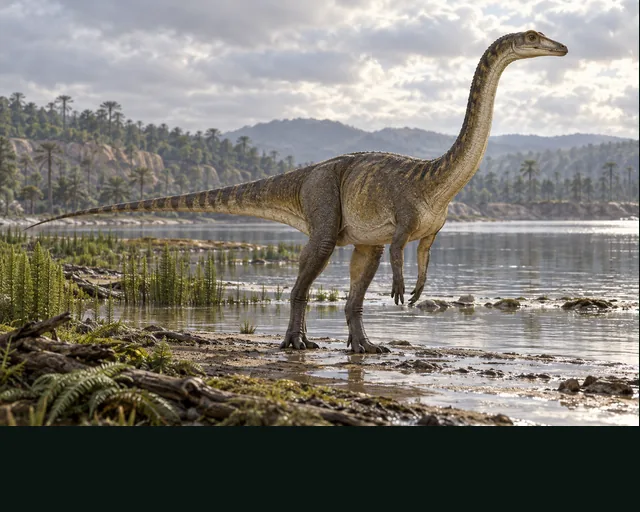
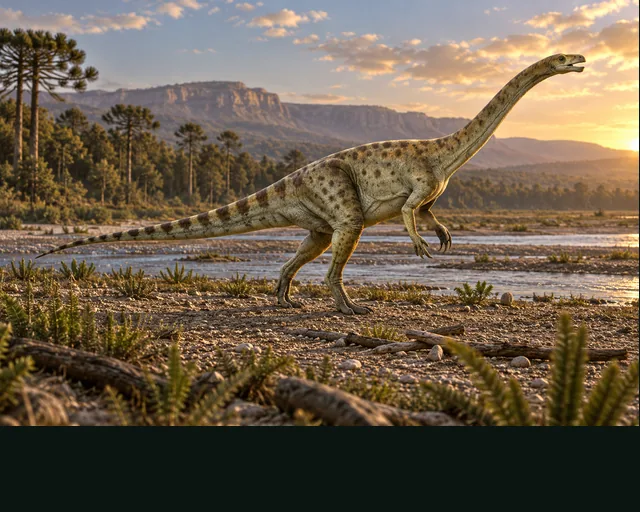
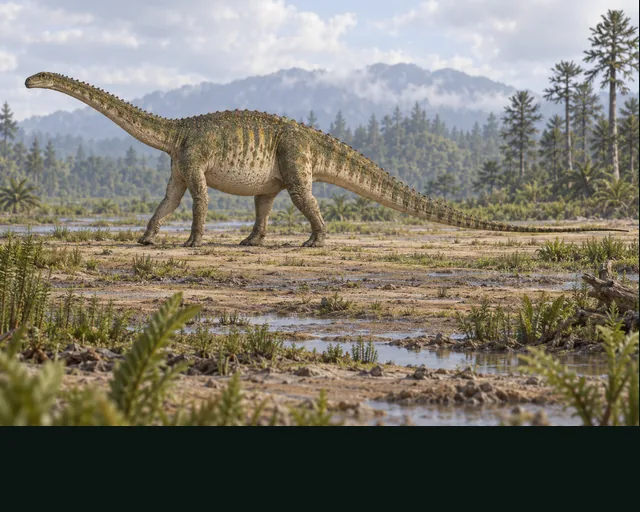
Many accounts describe Lufengosaurus as a fairly small early sauropodomorph of around 6 metres, which matches the Natural History Museum’s listing. Counting the larger specimens, Gregory Paul estimated about 9 metres and 1.7 tonnes in 2010, and Benson and colleagues estimated about 2.3 tonnes in 2014. These are scaled estimates. The skull of the type specimen is 25 centimetres long, and for an early member of its group the neck was fairly long and the forelimbs short, which led scientists to conclude it walked mainly on two legs.
What did Lufengosaurus eat?
The snout was deep and broad, and the teeth were closely spaced and serrated, a good match for leaves. Because it also had sharp claws, including a large thumb claw, Michael Cooper suggested in 1981 that it was partly omnivorous. Others reply that the teeth look like those of plant-eating iguana-type lizards and that the claws could have been used in defence or for pulling down foliage. On balance, a plant-eating diet is the better-supported interpretation.
Is Lufengosaurus a massospondylid?
Probably, though the family has shifted. Young placed it among the plateosaurids close to Plateosaurus, and it is still sometimes treated that way. More recent analyses lean towards the Massospondylidae, the group of Massospondylus, because its anatomy resembles that of Massospondylus and Coloradisaurus more than was once thought. In the 1980s Cooper even suggested Lufengosaurus was a species of Massospondylus, but a 2005 re-study of the skull showed it is a separate, valid genus. Exactly which animal is its closest relative still varies between analyses.
Where and when Lufengosaurus lived
The rocks of the Lufeng Formation were first thought to be Late Triassic, but they are now dated to the Hettangian and Sinemurian stages of the Early Jurassic, which makes Lufengosaurus younger than once believed. The Natural History Museum gives about 200 to 195 million years ago. The Paleobiology Database lists occurrences over a wider span, about 201 to 168 million years ago, so the age window differs between sources.
What has Lufengosaurus taught scientists about early dinosaur biology?
Embryos of this genus have been described as the earliest evidence of soft tissue in a fossil vertebrate. In 2017 a team led by Yao-Chang Lee reported preserved collagen protein in a Lufengosaurus fossil, which they said was over 100 million years older than any fossil protein recorded before. Its thigh-bone growth resembles that of altricial birds such as pigeons, which led to the suggestion that the young depended on adult feeding. Both findings are interpretations of unusual fossils, and further work is needed to confirm them.
Classification and fossil record
The Paleobiology Database taxonomic record catalogues Lufengosaurus under Massospondylidae. This is the immediate parent in that catalogue, rather than a complete list of evolutionary relationships.
The corroborated occurrence sample includes China; those are modern discovery locations, not a complete ancient geographic range.
The sourced length estimate for Lufengosaurus is 6–9 metres. This is an estimate for the reconstructed animal, not a measurement shared by every individual. See the body-size discussion and linked evidence for context.
Research starting point
The catalogue links Lufengosaurus to Young, 1940, published in Bulletin of the Geological Society of China. This identifies a research starting point; the catalogue’s citation alone does not verify every later reconstruction or species assignment.
For the meaning of taxonomic terms and how evidence is checked, see the glossary and editorial policy.
Quick answers
- Is Lufengosaurus a dinosaur?
- Yes. Lufengosaurus was a plant-eating sauropodomorph dinosaur from the Early Jurassic of Yunnan Province, China, closely related to Massospondylus.
- When did Lufengosaurus live?
- Lufengosaurus lived in the Early Jurassic, about 200 to 195 million years ago according to the Natural History Museum, in the Hettangian and Sinemurian ages.
- How big was Lufengosaurus?
- It is often described as about 6 metres long. Estimates including larger specimens reach about 9 metres and between 1.7 and 2.3 tonnes.
- What did Lufengosaurus eat?
- It most likely ate plants, since its teeth were serrated and suited to leaves, though sharp claws led one scientist to suggest it was partly omnivorous.
- Where was Lufengosaurus found?
- Lufengosaurus was found in the Lower Lufeng Formation near Lufeng, in Yunnan Province, southwestern China, beginning in the late 1930s.