Jurassic Dinos editorial · Updated · Source-based review
What is Plateosaurus?
Plateosaurus was a Late Triassic European sauropodomorph with a long history of taxonomic revision.
Distinctive features and evidence
The designated type species changed after the older type material was judged insufficiently diagnostic. Its abundant historical record should be read through explicit species assignments instead of a single composite reconstruction.
Genus overview and research references.
Plateosaurus fossil discoveries
A physician named Johann Friedrich Engelhardt found the first bones, a few vertebrae and leg bones, in 1834 near Nuremberg, Germany. Hermann von Meyer named the genus three years later. Today it is one of the best-known dinosaurs, with more than 100 individuals found, many of them nearly complete.
Three sites in particular have produced large numbers of skeletons: Trossingen and Halberstadt in Germany, and Frick in Switzerland. Trossingen, in the Black Forest region, yielded 35 complete or partial skeletons in the early 20th century, plus scraps of about 70 more. The abundance in Swabia earned the animal an old nickname meaning “Swabian dragon”. Much of the Trossingen and Halberstadt material was lost in the Second World War, though important parts of the Trossingen finds survive.
A drill core from an oil field beneath the North Sea also held a limb-bone fragment identified as Plateosaurus, the first dinosaur reported from Norway.
Why are there so many Plateosaurus skeletons?
Because many of them seem to have been trapped in mud. A study by Martin Sander found that the heavy animals sank into soft, wet ground and could not escape, a scenario compared with the famous La Brea Tar Pits. Lighter animals, such as juveniles, could pull free, which would explain why no young Plateosaurus are known from these sites.
This replaces an older and much-repeated story, that herds died together in a catastrophic mudflow. Sander’s analysis found no evidence of herding or of a mass burial, so the bonebeds do not show that Plateosaurus lived in herds.
How big was Plateosaurus?
Remarkably variable. Fully grown Plateosaurus ranged from about 4.8 to 10 metres long, and from about 600 to 4,000 kilograms, which is unusual because most dinosaurs reached a fairly uniform adult size. Bone studies by Martin Sander and Nicole Klein found some individuals fully grown at 12 years old and others still growing at 20. Researchers think the spread in size probably reflects conditions such as food supply.
The older species P. gracilis was smaller, at around 4 to 5 metres.
How did Plateosaurus walk?
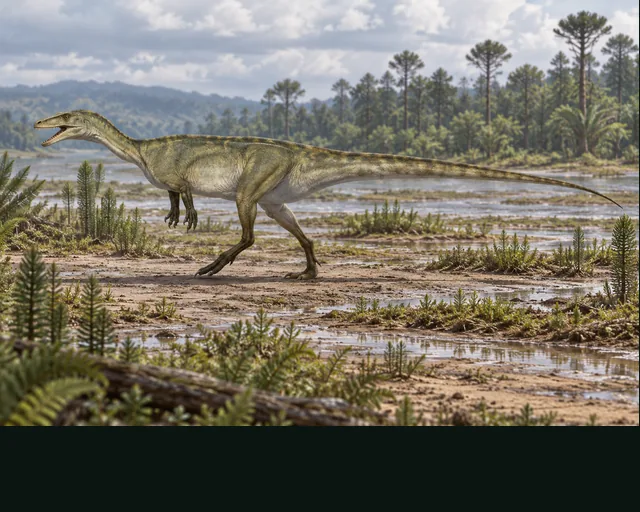
Almost every posture has been proposed for it. Early researchers argued for a lizard-like sprawl, a kangaroo-like hop, or a mixture of walking on two and four legs. A 2007 study by Bonnan and Senter showed that the forearm bones could not rotate to turn the palms downward, so Plateosaurus could not walk on its hands and was an obligate biped. The hind legs were also about twice as long as the arms.
The hands could grasp, and had large claws on three fingers, perhaps for defence or for feeding. Its long lower legs and toe-walking feet suggest it could run quickly.
Is Plateosaurus a sauropod?
No, but it belongs to the same wider group. Plateosaurus is a basal sauropodomorph, an early member of the line that later produced the giant long-necked sauropods, and it gives its name to the family Plateosauridae. The old label “prosauropod” is still used, but most researchers avoid it because it does not describe one natural group. Another Late Triassic relative on this site is Riojasaurus from Argentina.
Its naming history is tangled, and only three species are widely accepted today: P. trossingensis, P. longiceps and P. gracilis. Since 2019 the type species has been P. trossingensis, because the original type material was ruled too incomplete to identify.
Where and when Plateosaurus lived
Plateosaurus lived in central and northern Europe in the Norian stage of the Late Triassic, perhaps between about 227 and 208 million years ago, though dating varies. The older species comes from the Löwenstein Formation, and P. trossingensis and P. longiceps from the Trossingen Formation.
Classification and fossil record
The Paleobiology Database taxonomic record catalogues Plateosaurus under Plateosauridae. This is the immediate parent in that catalogue, rather than a complete list of evolutionary relationships.
Discovery and naming history
Johann Friedrich Engelhardt found the original material in 1834; Hermann von Meyer described it in 1837. The later designation of Plateosaurus trossingensis as the type species illustrates that even long-established genera can require nomenclatural revision. Historical overview.
The corroborated occurrence sample includes Germany, France; those are modern discovery locations, not a complete ancient geographic range.
The sourced length estimate for Plateosaurus is 4.8–10 metres. This is an estimate for the reconstructed animal, not a measurement shared by every individual. See the body-size discussion and linked evidence for context.
Research starting point
The catalogue links Plateosaurus to Meyer, 1837, published in Neues Jahrbuch für Mineralogie, Geognosie, Geologie und Petrefaktenkunde. This identifies a research starting point; the catalogue’s citation alone does not verify every later reconstruction or species assignment.
For the meaning of taxonomic terms and how evidence is checked, see the glossary and editorial policy.
Quick answers
- Is Plateosaurus a dinosaur?
- Yes. Plateosaurus was an early plant-eating sauropodomorph dinosaur that lived in Europe during the Late Triassic, long before the giant sauropods.
- How big was Plateosaurus?
- Adults varied a lot, from about 4.8 to 10 metres long and roughly 600 to 4,000 kilograms. Size seems to have depended on conditions, not only on age.
- Did Plateosaurus walk on two legs?
- Yes. A 2007 study found that its forearms could not rotate palm-down, so it could not walk on its hands and moved as a biped.
- Did Plateosaurus live in herds?
- Not shown. Many skeletons were found together, but a detailed study concluded they were trapped in mud over time, with no evidence for herds or a mass burial.
- Where was Plateosaurus found?
- Mainly in Germany, Switzerland and France, with a bone fragment from a drill core in the Norwegian sector of the North Sea.