Jurassic Dinos editorial · Updated · Source-based review
What is Eoraptor?
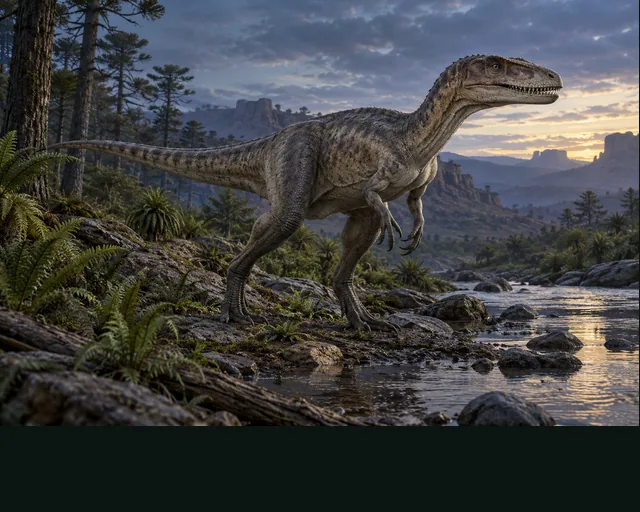
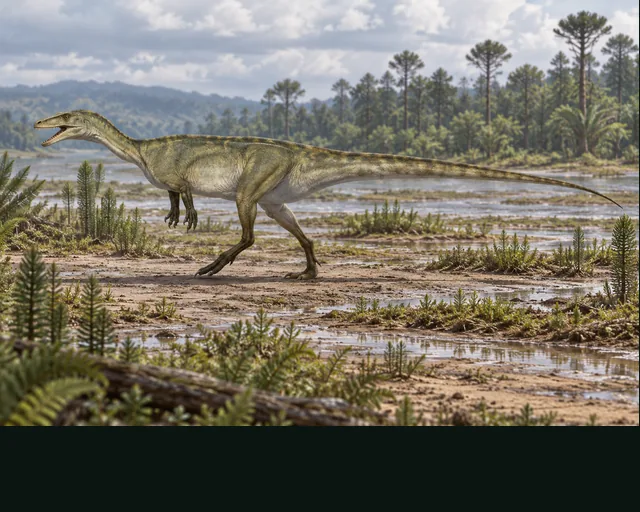
Eoraptor was a small Late Triassic dinosaur from Argentina, generally interpreted as an early sauropodomorph.
Distinctive features and evidence
A well-preserved skeleton and differing tooth shapes inform discussions of early dinosaur diversification. Suggested omnivory is a feeding interpretation, and its small body should not obscure its relevance to the sauropod evolutionary story.
Genus overview and research references.
Eoraptor fossil discoveries
The first Eoraptor bones were found in 1991 in the Valle de la Luna (Valley of the Moon) of northwestern Argentina by Ricardo Martínez and Paul Sereno, while working for two universities, Chicago and San Juan. The main specimen, PVSJ 512, came from muddy siltstone of the Ischigualasto Formation and took about a year to collect. It was prepared at the Field Museum in Chicago, shown there, and then returned to San Juan.
Sereno, Forster, Rogers and Monetta named the animal in 1993. Eoraptor is known from one almost complete, well-preserved skeleton and several fragmentary ones. The species name lunensis refers to the Valley of the Moon.
How big was Eoraptor?
Eoraptor was small and lightly built. Published sizes differ a little: the known specimens measure about 1.2 to 1.3 metres in one account, while the Natural History Museum gives 1.7 metres. Both agree it weighed around 10 kilograms, or less.
It stood upright on its hind legs and was probably a quick runner, since its lower leg bone was slightly longer than its thigh bone. The arms were only about half the length of the legs, with five fingers on each hand. The three longest had large claws, thought to have been used for handling prey, while the fourth and fifth were tiny. Many bones had hollow shafts, a lightweight design.
What did Eoraptor eat?
Scientists are not certain. Eoraptor had several tooth shapes: serrated, curved teeth in the upper jaw, like a meat-eater’s, and leaf-shaped teeth in the lower jaw, more like those of early plant-eaters. This has led to the suggestion that it was an omnivore.
It was not an obvious killer, though. It lacked the sliding lower-jaw joint of later predators that helped hold struggling prey, and its teeth were less uniformly blade-like. The close relative Buriolestes has very similar teeth but is regarded as a meat-eater, and the Natural History Museum lists Eoraptor as carnivorous. Taken together, the evidence supports a small animal that caught and tore up prey but may also have eaten other food.
Is Eoraptor a theropod or a sauropodomorph?
The answer has changed over the years. Sereno’s team treated Eoraptor as one of the earliest dinosaurs and, at first, as a theropod, the group of two-legged meat-eaters. Some later studies agreed, while others found it to be just outside either group.
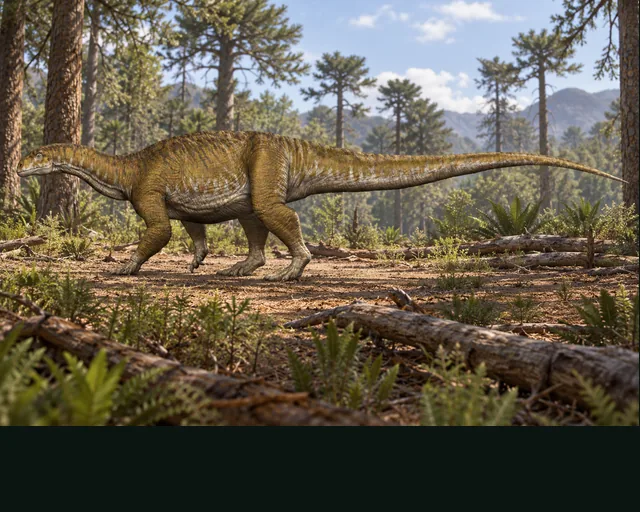
Several studies since 2012, including Sereno’s 2013 redescription of the main skeleton, have placed it among the early sauropodomorphs, the group that includes the later long-necked giants, alongside genera such as Buriolestes. Not every analysis agrees, and a large 2017 study placed it at the base of the theropods instead. This is why Eoraptor is often used as an example of how hard it is to sort the earliest dinosaurs. It lived alongside Herrerasaurus, another early dinosaur that was also hard to classify.
Where and when Eoraptor lived
Eoraptor lived in the Carnian stage of the Late Triassic, in what is now Argentina. Estimates for the age of the specimens are around 231 to 228 million years ago, and the rock formation as a whole spans about 235 to 228 million years. The Natural History Museum gives 228 million years.
The Ischigualasto Formation was a volcanically active floodplain with forests of ferns, horsetails and giant conifers, a warm, humid climate and strong seasonal rains. Early dinosaurs were not common: they account for only about 6 percent of the fossils recovered there, with many more non-dinosaur animals such as rhynchosaurs and cynodonts.
Classification and fossil record
The Paleobiology Database taxonomic record catalogues Eoraptor under Sauropodomorpha. This is the immediate parent in that catalogue, rather than a complete list of evolutionary relationships.
The corroborated occurrence sample includes Argentina; those are modern discovery locations, not a complete ancient geographic range.
Research starting point
The catalogue links Eoraptor to Sereno and Forster, 1993, published in Nature. This identifies a research starting point; the catalogue’s citation alone does not verify every later reconstruction or species assignment.
For the meaning of taxonomic terms and how evidence is checked, see the glossary and editorial policy.
Quick answers
- Is Eoraptor a dinosaur?
- Yes. Eoraptor was a small, early dinosaur from the Late Triassic of Argentina, and one of the earliest dinosaurs known.
- What does Eoraptor mean?
- It means "dawn plunderer": the Greek eos for dawn, referring to its early place in dinosaur history, and the Latin raptor, plunderer.
- Is Eoraptor a theropod?
- That is debated. It was first treated as a theropod, but several studies since 2012 place it among the early sauropodomorphs, while a 2017 analysis put it at the base of the theropods.
- How big was Eoraptor?
- It was small. Known specimens are about 1.2 to 1.7 metres long depending on the source, and it weighed around 10 kilograms or less.
- What did Eoraptor eat?
- Its varied teeth suggest an omnivore, although the Natural History Museum calls it carnivorous. No stomach contents are known, so the diet is inferred from teeth.