Jurassic Dinos editorial · Updated · Source-based review
What was Ingentia?
Ingentia was a large Late Triassic sauropodomorph from Argentina. It helps show that substantial body size appeared before the fully specialised skeletons of later giant sauropods. Its name evokes huge size, but its importance is the particular combination of features used to support a large body.
What makes the fossil distinctive?
Its neck vertebrae are robust and contain air spaces. Such pneumatic structures can reduce the mass of parts of a skeleton without requiring each bone to be solid throughout. The shoulder blade and forelimb also reveal weight-supporting adaptations, yet the limbs did not simply duplicate the straight, column-like arrangement of later sauropods.
Where was it found and how was it named?
The named material came from the Quebrada del Barro Formation in northwestern Argentina. The genus was described in 2018, and additional referred bones include tail vertebrae and limb elements. Researchers grouped it with Lessemsaurus and Antetonitrus in Lessemsauridae. Whether that group is called an early sauropod group or a very close relative depends partly on the definition of Sauropoda used in an analysis.
What can we infer, and what remains uncertain?
This is a good case for separating a biological finding from a naming boundary. The animal’s bones do not change when researchers apply different group definitions. The broader question remains how early dinosaurs achieved large size using combinations of growth, skeletal air spaces and weight-bearing anatomy. Comparing Ingentia with a much later giant such as Argentinosaurus reveals that becoming large was a long evolutionary story, rather than a single sudden change to one final body design.
Was Ingentia the largest dinosaur?
No. It is important for early large size among sauropodomorphs, not for holding an all-time size record. Later sauropods reached much greater dimensions.
How can you check the evidence?
The Paleobiology Database record catalogues Ingentia under Lessemsauridae. Its linked bibliography identifies this research starting point: C. Apaldetti, R. N. Martínez, and I. A. Cerda, D. Pol, O. Alcober. 2018. An early trend towards gigantism in Triassic sauropodomorph dinosaurs. Nature Ecology & Evolution 2:1227-1232. Open the bibliographic record. A catalogue entry establishes the source trail; it does not independently verify every later illustration or behavioural claim.
Use the dated genus overview to follow the references behind the discovery and anatomy discussed above. When sources disagree, compare which specimen and rock layer each author studied. A reconstructed whole animal can combine original bones with comparisons to relatives; those two kinds of evidence should not be confused. The account above explains the particular limits that matter for Ingentia, rather than supplying unsupported size, speed or lifespan figures.
Read the image and keep exploring
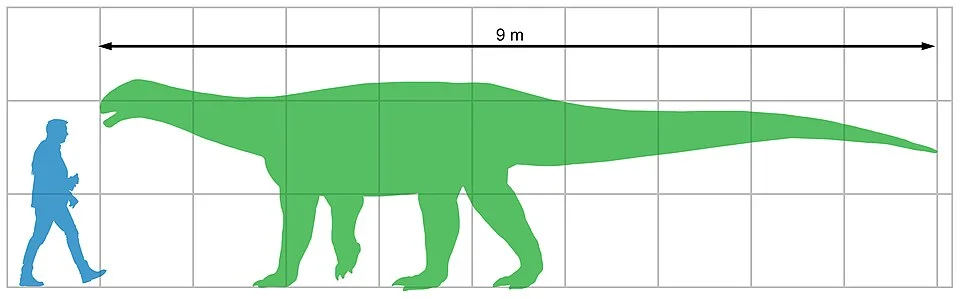
An estimated Ingentia silhouette is compared with a person. The whole-body outline and size are reconstructions, not a complete measured skeleton. This diagram explains the stated evidence; schematic elements are not additional fossil observations.
Compare Antetonitrus, Plateosaurus, Argentinosaurus. Find more names in the I index and explore sauropodomorph field notes. The glossary explains unfamiliar fossil terms.
Quick answers
- Where have Ingentia fossils been found?
- The discoveries discussed here come from Argentina. Modern place names describe discovery locations, not a complete ancient geographic range.
- When did Ingentia live?
- It is placed in the Triassic period. See the discovery discussion for qualifications about the particular rock layers and dating.
- Where can I compare Ingentia with related dinosaurs?
- Follow the related field notes below. Comparisons explain shared anatomy; they do not imply that all the animals lived together.