Jurassic Dinos editorial · Updated · Source-based review
What is Antetonitrus?
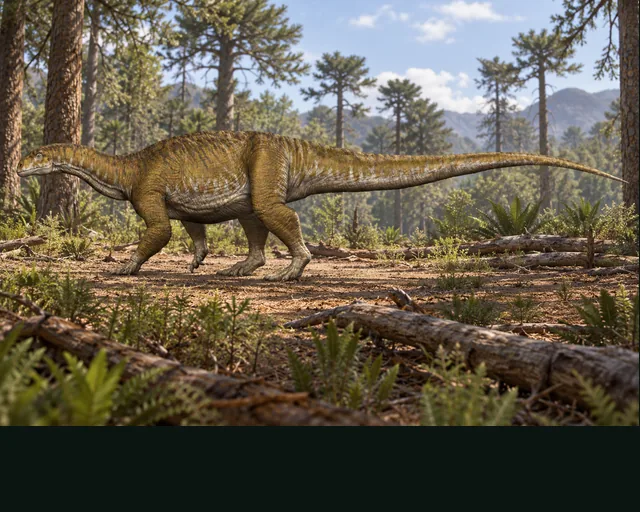
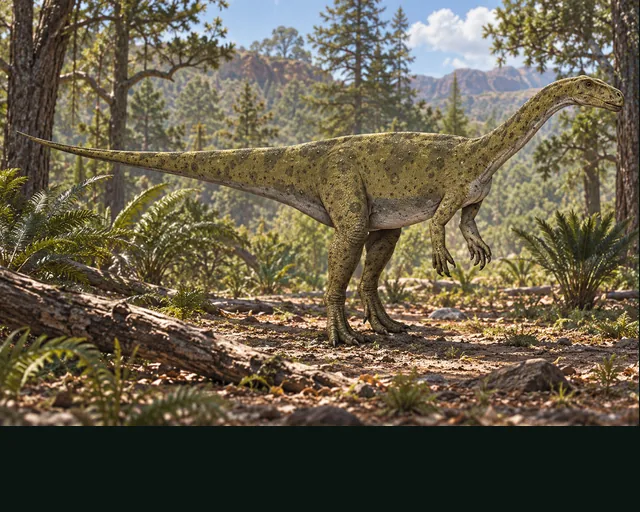
Antetonitrus was an early sauropod relative from South Africa’s Elliot Formation, combining weight-bearing and grasping forelimb features.
Distinctive features and evidence
This combination is informative about the transition toward fully quadrupedal sauropods. Its position close to the sauropod boundary matters more than assigning it the body proportions of a much later long-necked giant.
Genus overview and research references.
Antetonitrus fossil discoveries
The bones of Antetonitrus were dug up by the palaeontologist James Kitching in 1981, in South Africa’s Free State province. They were then stored at the Bernard Price Institute with a different name on the label, Euskelosaurus, a genus of early long-necked dinosaur. Decades later the Australian specialist Adam Yates re-examined them, decided they belonged to a separate animal, and named Antetonitrus with Kitching in 2003.
The main specimen is a partial skeleton: several vertebrae plus many bones of both the front and hind limbs, all thought to come from one individual. Five more limb bones from a smaller animal have also been assigned to the genus. There is no known skull, so what we know of its head and neck comes only from comparison with relatives.
How big was Antetonitrus?
One published estimate for the main specimen is a length of roughly 8 to 10 metres and a body mass of around 5.6 tonnes. Treat these as rough figures: the skeleton has no skull, and the arches of its vertebrae were not yet fused to the vertebral bodies, a sign that the animal was probably not fully grown. A fully adult Antetonitrus could therefore have been larger.
Studies of its bone structure found a mixture of old and new traits. Like later sauropods, the young animals grew with a richly supplied, fast-growing kind of bone, but the bone also shows pauses in growth, a feature seen in earlier sauropodomorphs rather than in the giants that came later.
Is Antetonitrus a sauropod?
Yates and Kitching presented it in 2003 as a very early sauropod, although it is sometimes described more cautiously as a sauropodiform, a member of the wider group of long-necked plant-eaters. It was heavily built and walked mainly on four legs. Its forelimbs were long compared with its hind legs, its wrist bones were broad, and its foot bones were shortened, all clues to bearing a lot of weight.
Yet the animal was not yet a fixed-pillar giant. Its thumb was still twisted and flexible, so the hand could probably grasp, which later sauropods could not do. That mix is why scientists find it informative about how four-legged walking evolved.
Its exact family tree is still being tested. Later studies grouped it with Lessemsaurus and Ingentia in a family called Lessemsauridae, and in 2020 it was placed within a larger group called Massopoda. The 2003 analysis put it between Isanosaurus and the earlier Melanorosaurus.
How old is Antetonitrus? A dating revision
When it was first named, the fossils were thought to come from the lower part of the Elliot Formation, which dates to the Late Triassic. On that basis Antetonitrus was announced as the oldest definite sauropod, older than Isanosaurus from Thailand. Later work indicated that the bones came from the upper Elliot Formation, which is Early Jurassic in age. The Paleobiology Database catalogue now lists it from the Hettangian to Sinemurian stages, roughly 201 to 193 million years ago.
It is still counted among the early members of its group in time, tied with a few other South African relatives from the same formation, but it is no longer called the very oldest. The revision is a useful reminder that a rock layer can be re-dated long after a fossil is named.
Classification and fossil record
The Paleobiology Database taxonomic record catalogues Antetonitrus under Lessemsauridae. This is the immediate parent in that catalogue, rather than a complete list of evolutionary relationships.
The corroborated occurrence sample includes South Africa; those are modern discovery locations, not a complete ancient geographic range.
Research starting point
The catalogue links Antetonitrus to Yates and Kitching, 2003, published in Proceedings of the Royal Society of London B. This identifies a research starting point; the catalogue’s citation alone does not verify every later reconstruction or species assignment.
For the meaning of taxonomic terms and how evidence is checked, see the glossary and editorial policy.
Quick answers
- Is Antetonitrus a dinosaur?
- Yes. Antetonitrus was a plant-eating dinosaur from South Africa, an early member of the long-necked sauropodomorph line, close to or at the beginning of the sauropods.
- What does Antetonitrus mean?
- The name means "before the thunder". It refers to the animal living earlier than the later sauropods, including Brontosaurus, whose name means "thunder lizard".
- When did Antetonitrus live?
- It was first thought to be Late Triassic, but later studies place the fossils in the Early Jurassic upper Elliot Formation, roughly 201 to 193 million years ago in the catalogue used by the Paleobiology Database.
- Is Antetonitrus a sauropod?
- Usually described as an early sauropod or a close relative. It had long forelimbs for carrying weight but a still-grasping thumb, so it sits near the beginning of the group.
- How big was Antetonitrus?
- One estimate for the main specimen is about 8 to 10 metres long, but the skeleton lacks a skull and was probably not yet fully grown, so the figure is uncertain.