Jurassic Dinos editorial · Updated · Source-based review
What was Aardonyx?
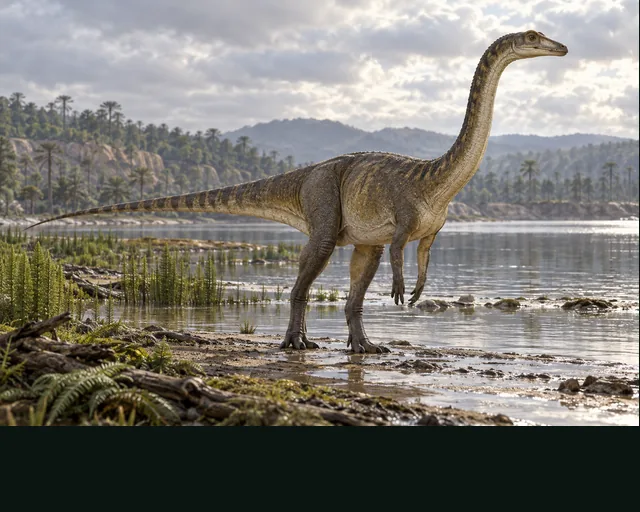
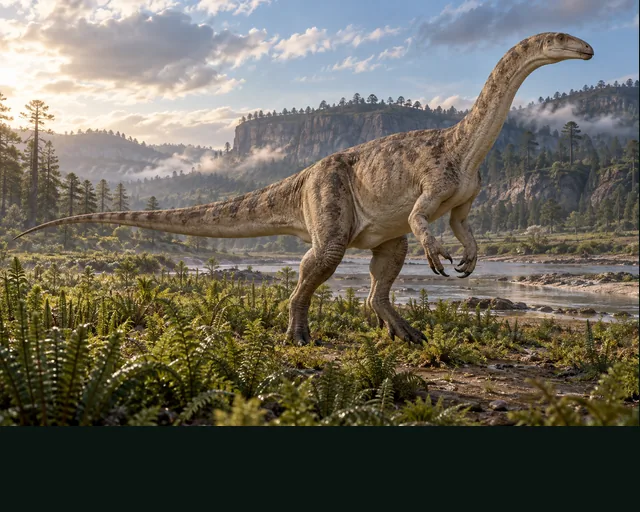
Aardonyx was an Early Jurassic sauropodomorph from South Africa. It combines features of mainly two-legged ancestors with adaptations associated with supporting more weight on the forelimbs. Rather than being a miniature version of a giant sauropod, it records a different stage in the development of that body plan.
What makes the fossil distinctive?
The known bones represent immature individuals and include parts of the jaws, limbs and trunk. The arms and hands are particularly useful for studying posture. A limb that can support weight does not necessarily prove that the animal always walked on all fours. Researchers must consider the hips, legs and range of movement as well.
Where was it found and how was it named?
The material comes from the Elliot Formation. Its scientific description appeared online in 2009 ahead of print publication. The species name celestae honours Celeste Yates, who prepared much of the material. Preparation is part of the discovery process: important joint surfaces and internal structures can remain hidden until surrounding rock is removed.
What can we infer, and what remains uncertain?
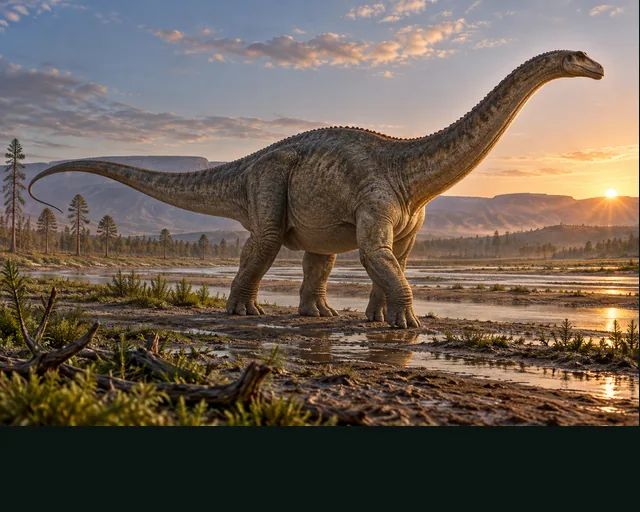
Aardonyx helps test how feeding and locomotion changed as sauropodomorphs became larger. It should not be labelled a proven direct ancestor of Apatosaurus. Evolutionary comparisons identify combinations of characters and likely relationships, not a guaranteed parent-to-child chain across millions of years. Comparing its forelimbs with those of a later sauropod makes the distinction between transitional features and a fully specialised body easier to understand.
Did Aardonyx always walk on four legs?
That is not established. Its anatomy suggests a primarily bipedal animal with some adaptations relevant to supporting weight on the forelimbs.
How can you check the evidence?
The Paleobiology Database record catalogues Aardonyx under Sauropodiformes. Its linked bibliography identifies this research starting point: A. M. Yates, M. F. Bonnan, and J. Neveling, A. Chinsamy, M. G. Blackbeard. 2010. A new transitional sauropodomorph dinosaur from the Early Jurassic of South Africa and the evolution of sauropod feeding and quadrupedalism. Proceedings of The Royal Society B 277(1682):787-794. Open the bibliographic record. A catalogue entry establishes the source trail; it does not independently verify every later illustration or behavioural claim.
Use the dated genus overview to follow the references behind the discovery and anatomy discussed above. When sources disagree, compare which specimen and rock layer each author studied. A reconstructed whole animal can combine original bones with comparisons to relatives; those two kinds of evidence should not be confused. The account above explains the particular limits that matter for Aardonyx, rather than supplying unsupported size, speed or lifespan figures.
Read the image and keep exploring
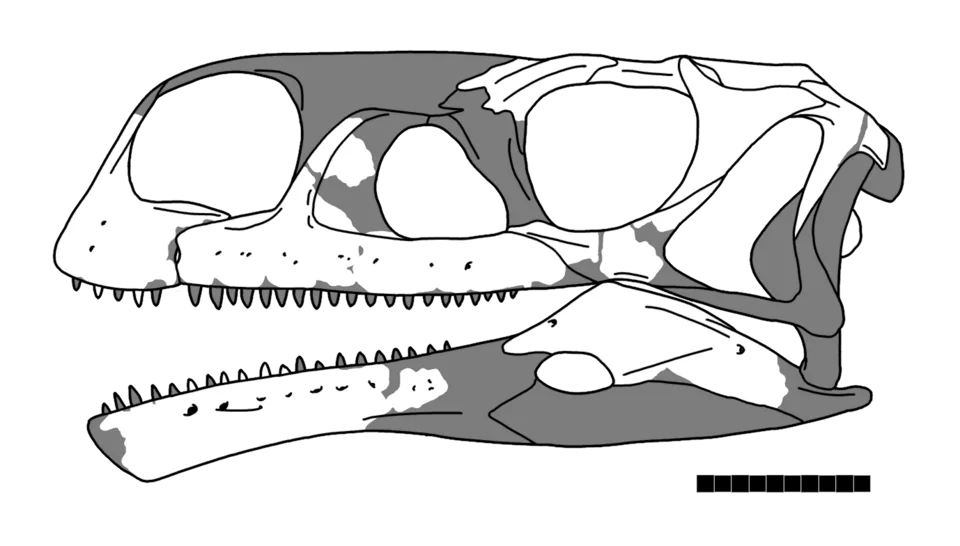
The Aardonyx skull diagram distinguishes reconstructed outlines from illustrated bone regions and includes a scale bar. This diagram explains the stated evidence; schematic elements are not additional fossil observations.
Compare Massospondylus, Plateosaurus, Apatosaurus. Find more names in the A index and explore sauropodomorph field notes. The glossary explains unfamiliar fossil terms.
Quick answers
- Where have Aardonyx fossils been found?
- The discoveries discussed here come from South Africa. Modern place names describe discovery locations, not a complete ancient geographic range.
- When did Aardonyx live?
- It is placed in the Jurassic period. See the discovery discussion for qualifications about the particular rock layers and dating.
- Where can I compare Aardonyx with related dinosaurs?
- Follow the related field notes below. Comparisons explain shared anatomy; they do not imply that all the animals lived together.