Jurassic Dinos editorial · Updated · Source-based review
What is Argentinosaurus?
Argentinosaurus was a giant Argentine titanosaur known from incomplete vertebral and limb material.
Distinctive features and evidence
Its great size is reconstructed from a limited set of bones, so competing mass estimates require attention to the reconstruction method. The cached overview contains an age inconsistency; formation age and exact numerical estimates require primary-source confirmation.
Genus overview and research references.
Argentinosaurus fossil discoveries
The first bone was found in 1987 by a farmer, Guillermo Heredia, on his land near Plaza Huincul in Neuquén Province, Argentina. He thought he had found petrified logs and told the local museum, the Museo Carmen Funes. Digging led by the palaeontologist José Bonaparte began in 1989 and recovered more bones from the same individual, including seven back vertebrae and the underside of the sacrum, the fused vertebrae in the hip region, and part of a rib. The bones were set in very hard rock and had to be freed with pneumatic hammers. Bonaparte and Rodolfo Coria named the animal in 1993.
A complete thigh bone about 2.5 metres long was assigned to the genus in 1996, and a second femur shaft is held in another museum. As of 2019, it was still uncertain whether either femur belongs to Argentinosaurus. Even the first bone was misunderstood. It was described as a shin bone but was reidentified in 2004 as a calf bone, the fibula.
Because so little of the skeleton is known, researchers have disagreed over where each preserved vertebra sat in the spine, and about whether certain extra joints between vertebrae were really there. Any complete picture of the animal is therefore a reconstruction.
How big was Argentinosaurus?
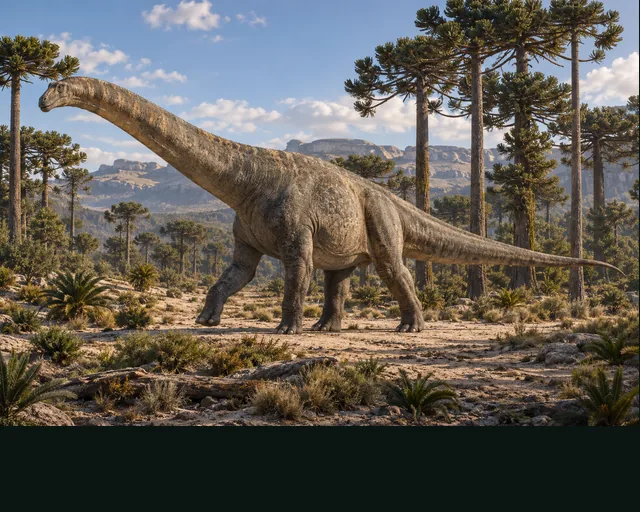
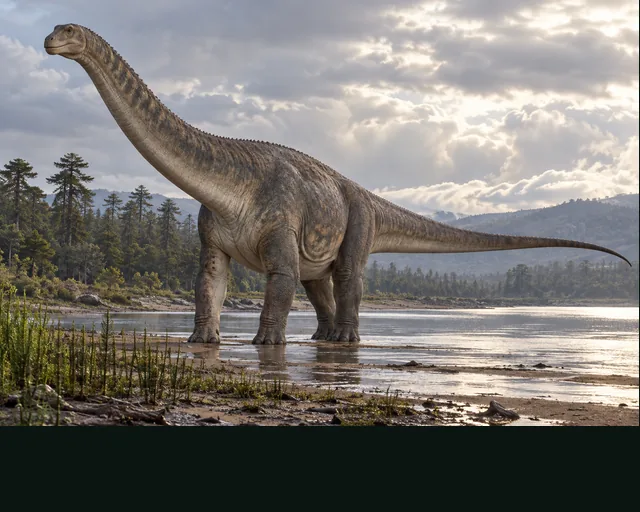
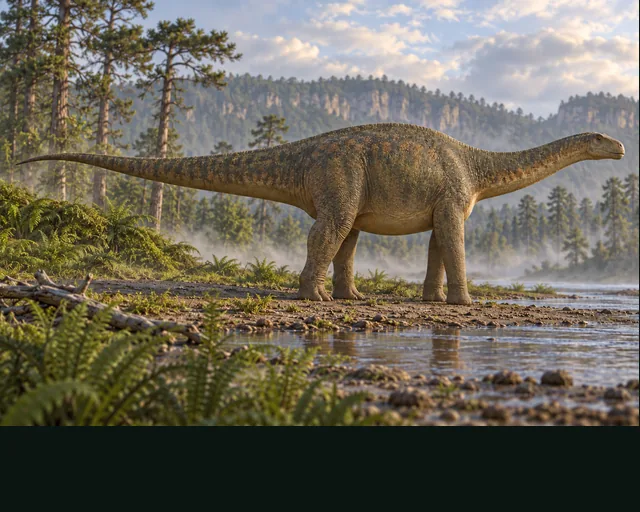
Argentinosaurus is among the largest land animals known, but its precise size is uncertain. To estimate it, researchers scale up from better-known relatives such as Saltasaurus and Futalognkosaurus, or build volume models. Length estimates have included about 30 metres, less than 33 metres, 30 to 35 metres, and one estimate of 39.7 metres from a scan of the mounted skeleton in the Museo Carmen Funes. Mass estimates range even more widely, from about 50 or 60 tonnes to over 90 tonnes. Recent figures cluster around 65 to 80 tonnes. The Natural History Museum gives 35 metres and about 70 tonnes.
The size ranking among giant titanosaurs also depends on the study. Some have found Patagotitan larger, while another concluded Argentinosaurus was bigger. Some other long sauropods may have been longer but lighter. The blue whale can still be heavier than any known sauropod.
How did Argentinosaurus grow and move?
For an animal this large, the start of life was small. Researchers estimated that the eggs held about one litre and that a hatchling was no longer than a metre and no heavier than about 5 kilograms, with sexual maturity at 8 to 10 years, physical maturity at about 20 and a life of around 30 years. These are estimates based on comparisons with other animals, not directly preserved evidence. The Natural History Museum describes a growth to adulthood of about 15 years.
A 2013 computer model of the skeleton and muscles produced a walking speed of just over 2 metres per second, around 7 kilometres per hour, using a pacing gait where the legs on the same side move together. A 2025 study estimated about 5.7 kilometres per hour. The authors of the 2013 study cautioned that their model was simplified, so these figures show roughly how fast it could move and are not measurements.
What did Argentinosaurus eat and what ate it?
Argentinosaurus was a plant-eater. The Natural History Museum notes that its teeth were suited to stripping vegetation from branches and suggests that its long neck could sweep the ground or reach high into trees. Researchers also suggest that giant sauropods did not chew their food, which let them feed quickly and keep food in the gut for a long time to extract energy.
Hatchlings would have been very vulnerable while they grew, and the Natural History Museum names Giganotosaurus as one possible predator of the young. Another giant meat-eater, Mapusaurus, lived in the same formation and might have preyed on Argentinosaurus. At least seven Mapusaurus individuals were found together, which has led some researchers to ask whether it hunted in groups, though that is only a possibility.
Where and when Argentinosaurus lived
Argentinosaurus comes from the Huincul Formation in the Neuquén Basin of Patagonia. The rocks formed in a braided river system, and fossil pollen shows a rich plant community of ferns, conifers, flowering plants and others. The same formation holds fish, turtles, crocodile relatives and many dinosaurs, including other titanosaurs and the long-necked rebbachisaurids, giant carnivores such as the abelisaurids and Mapusaurus, and iguanodonts.
The age needs care because sources disagree. The Natural History Museum places the animal in the Late Cretaceous about 90 million years ago. Other accounts describe the formation as Albian, which is Early Cretaceous, and the Paleobiology Database’s earliest record falls around 110 to 106 million years ago. Earlier work suggested a Cenomanian to Turonian age. Because the dating of the Huincul Formation has been revised more than once, this account does not give a single figure.
Is Argentinosaurus a titanosaur?
Yes. Argentinosaurus is a titanosaur, a branch of long-necked sauropods that was widespread in the Cretaceous. Exactly where it sits within the group is unsettled. Several studies place it in a group called Lognkosauria, together with Patagotitan and Futalognkosaurus, but a 2018 analysis found it either near the base of the titanosaurs or close to Epachthosaurus. The relationships of titanosaurs are among the least understood in dinosaur research.
Giant relatives include Patagotitan and Dreadnoughtus. Another giant of the era, Puertasaurus, was estimated at about 27 metres by one researcher, which would be smaller.
Argentinosaurus in the game
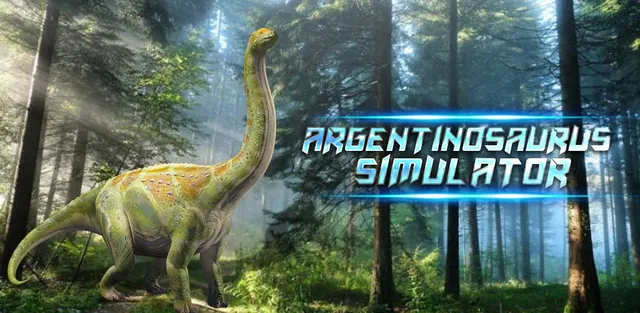
Argentinosaurus Simulator lets you play as an Argentinosaurus on a Jurassic island. The store listing describes health and energy management by eating and drinking, an open world with a day-night cycle and weather, unlockable skills and other dinosaurs to meet.
The game is entertainment. Its setting, abilities and the fighting it describes are not scientific evidence, and the real animal was a plant-eater from Cretaceous South America, not a Jurassic one.
Classification and fossil record
The Paleobiology Database taxonomic record catalogues Argentinosaurus under Eutitanosauria. This is the immediate parent in that catalogue, rather than a complete list of evolutionary relationships.
Discovery and naming history
A farm discovery near Plaza Huincul in 1987 led to a scientific excavation in 1989. Bonaparte and Rodolfo Coria named Argentinosaurus in 1993; the resulting vertebral material is substantial evidence, but still an incomplete basis for reconstructing an entire giant. Historical overview.
The corroborated occurrence sample includes Argentina; those are modern discovery locations, not a complete ancient geographic range.
The sourced length estimate for Argentinosaurus is 30–35 metres. This is an estimate for the reconstructed animal, not a measurement shared by every individual. See the body-size discussion and linked evidence for context.
Research starting point
The catalogue links Argentinosaurus to Bonaparte and Coria, 1993, published in Ameghiniana. This identifies a research starting point; the catalogue’s citation alone does not verify every later reconstruction or species assignment.
For the meaning of taxonomic terms and how evidence is checked, see the glossary and editorial policy.
Geological age clarification
Museum and formation studies place Argentinosaurus in the Late Cretaceous. Older overview and catalogue age assignments differ; exact numerical ages are omitted here.
Quick answers
- Is Argentinosaurus a dinosaur?
- Yes. Argentinosaurus was a giant sauropod dinosaur, a titanosaur, known from fossils found in Neuquén Province in Argentina.
- How big was Argentinosaurus?
- Estimates are roughly 30 to 35 metres long and 65 to 80 tonnes, though they vary widely because only a few bones were found.
- When did Argentinosaurus live?
- It lived in the Cretaceous, but sources disagree on the exact age: the Natural History Museum says about 90 million years ago, while other sources give an older Albian age.
- What did Argentinosaurus eat?
- It was a plant-eater. Its teeth were suited to stripping vegetation and its long neck may have reached ground-level plants or high branches.
- Where was Argentinosaurus found?
- Near Plaza Huincul in Neuquén Province, Argentina, in the Huincul Formation. A farmer found the first bone in 1987.