Jurassic Dinos editorial · Updated · Source-based review
What is Patagotitan?
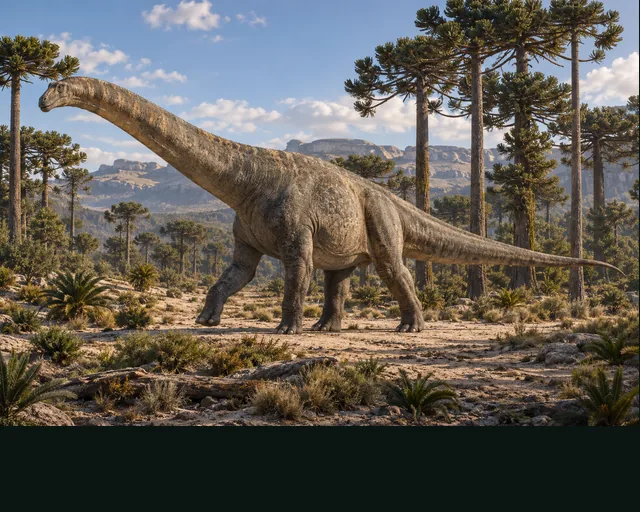
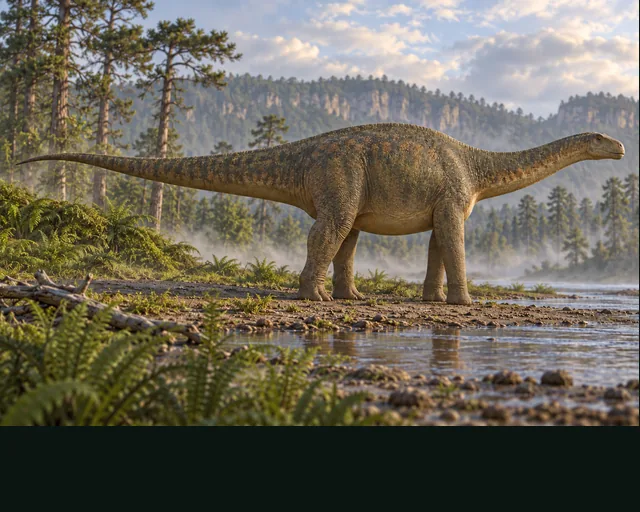
Patagotitan was a giant Argentine titanosaur represented by several individuals from the Cerro Barcino Formation.
Distinctive features and evidence
The species Patagotitan mayorum was named in 2017 after earlier announcements. Published size estimates have changed as methods developed, so an early press-release figure should not become an unqualified largest-animal record.
Genus overview and research references.
Patagotitan fossil discoveries
In 2010 a farm worker, Aurelio Hernández, noticed part of a huge thigh bone in the desert near La Flecha in Chubut Province, Argentina. Scientists from the Museum of Paleontology Egidio Feruglio in Trelew began digging in late 2012 and returned several times until 2015, led by José Luis Carballido and Diego Pol. They recovered more than 200 fossils, including about 130 sauropod bones and 57 theropod teeth.
The sauropod bones belong to at least six partial skeletons of similar size. They lay in three closely spaced layers of rock, which means the animals did not all die at the same moment but were buried in separate flood events. The type specimen has no skull, but includes neck, back and tail vertebrae, ribs, hip bones and both thigh bones. Carballido and colleagues named the species Patagotitan mayorum in 2017, honouring the Mayo family who own the ranch.
How big was Patagotitan?
Patagotitan is among the biggest dinosaurs known, but its exact size depends on who is measuring. Press reports in 2014 gave 40 metres and 77 tonnes. The 2017 description estimated 37 metres and about 69 tonnes, with a second weight method giving 44 to 78 tonnes. Gregory Paul later argued for about 31 metres and 50 to 55 tonnes, and in 2020 Otero and Carballido estimated 57 tonnes, with a margin of error of roughly 42 to 71 tonnes. The Natural History Museum lists 37.5 metres and 57 tonnes, and notes that its thigh bone alone is 2.38 metres long.
Bone studies of the thigh and upper arm bones suggest that the animals were young adults, still growing slowly, so older individuals may have been larger.
Is Patagotitan the biggest dinosaur?
That is not settled. The describing team claimed in 2017 that it was the largest known land animal, and called it about 10 per cent larger than Argentinosaurus. Other specialists, including Matt Wedel and Gregory Paul, pointed out that almost every bone that can be compared is bigger in Argentinosaurus. Paul’s estimates make Patagotitan smaller.
The real difference is the quality of the evidence. Argentinosaurus and Puertasaurus are known from fragmentary bones, whereas Patagotitan is represented by several partial skeletons, so its size is the one scientists can estimate with the most confidence.
Is Patagotitan related to Argentinosaurus?
Yes. Patagotitan is a titanosaur, and analyses have often found it grouped with Argentinosaurus and Puertasaurus, with either one coming out as its closest relative. Because Patagotitan is so well preserved, it is one of the more stable titanosaurs in family trees, even though the wider titanosaur tree has been revised many times.
The skeleton also has odd features. For example, the extra joints that stiffened the back vertebrae appear between only one pair, at the level of the shoulder blade, which may have helped carry weight.
Where and when Patagotitan lived
Patagotitan lived about 101.6 million years ago, in the latest part of the Albian stage of the Early Cretaceous. Nearby plant fossils show a forested floodplain dominated by conifers, with ferns and flowering plants present. The fine-grained sediments suggest that sheet floods were too weak to move the huge bones, so the animals were probably buried near where they died. Other animals from the same rock unit include the theropods Tyrannotitan and Genyodectes.
Casts of the skeleton have been mounted in museums in Argentina, New York and Chicago, and in London in 2023 and 2024.
Classification and fossil record
The Paleobiology Database taxonomic record catalogues Patagotitan under Eutitanosauria. This is the immediate parent in that catalogue, rather than a complete list of evolutionary relationships.
Discovery and naming history
The discovery was announced in 2014, and José Carballido and colleagues formally named Patagotitan mayorum in 2017. Multiple young adult individuals provide more evidence than a lone bone, though estimated maximum size still depends on reconstruction. Historical overview.
The corroborated occurrence sample includes Argentina; those are modern discovery locations, not a complete ancient geographic range.
The sourced length estimate for Patagotitan is 31–37.5 metres. This is an estimate for the reconstructed animal, not a measurement shared by every individual. See the body-size discussion and linked evidence for context.
Research starting point
The catalogue links Patagotitan to Carballido and Pol, 2017, published in Proceedings of the Royal Society of London B. This identifies a research starting point; the catalogue’s citation alone does not verify every later reconstruction or species assignment.
For the meaning of taxonomic terms and how evidence is checked, see the glossary and editorial policy.
Quick answers
- Is Patagotitan a dinosaur?
- Yes. Patagotitan was a titanosaur, a type of long-necked sauropod dinosaur that lived in Patagonia, Argentina, in the Early Cretaceous.
- How big was Patagotitan?
- Estimates range from about 31 metres and 50 tonnes to 37 metres and 69 tonnes or more. Different methods and measurements give different answers, so the exact size is still debated.
- Is Patagotitan the biggest dinosaur?
- It is one of the largest known, but not certainly the biggest. Argentinosaurus may have been as large or larger, though it is known only from far less complete fossils.
- When did Patagotitan live?
- About 101.6 million years ago, in the latest Albian stage of the Early Cretaceous, according to the dating of the rock layer where the fossils were found.
- Where was Patagotitan found?
- At La Flecha ranch in Chubut Province, Patagonia, Argentina, in the Cerro Barcino Formation. It is still the only place where Patagotitan fossils are known.