Jurassic Dinos editorial · Updated · Source-based review
What is Puertasaurus?
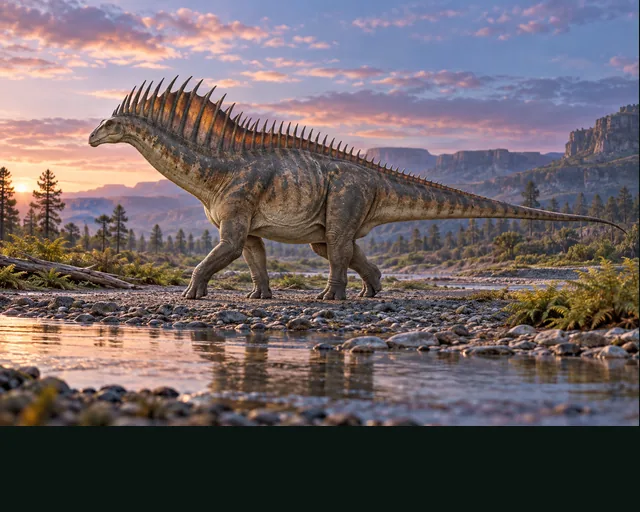
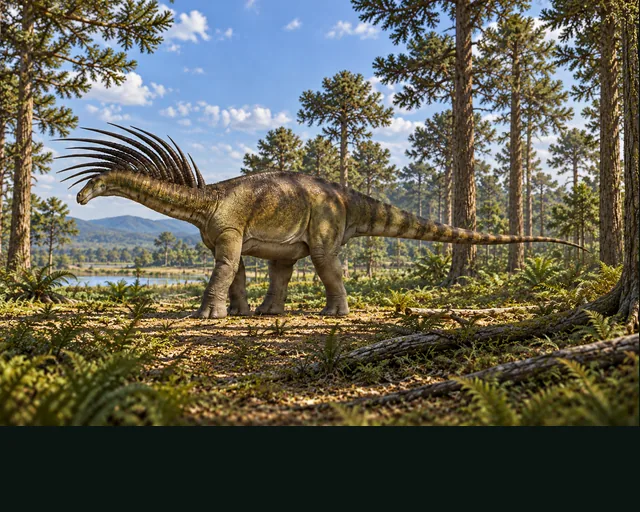
Puertasaurus was a giant Late Cretaceous Argentine titanosaur described from four vertebrae.
Distinctive features and evidence
The surviving neck, back and tail bones are informative but leave much of the skeleton unknown. Very large body reconstructions therefore depend on scaling and comparisons rather than a nearly complete individual.
Genus overview and research references.
Puertasaurus fossil discoveries
Puertasaurus is known from a single specimen: four separate vertebrae, which together make up only about 3 percent of the skeleton. They are one neck vertebra, one from the back and two from the middle of the tail. Only the back vertebra is complete. The neck bone is mostly intact, and for the tail bones just the main bodies, the centra, survive.
Fossil hunters Pablo Puerta and Santiago Reuil found the bones in January 2001 in Santa Cruz Province, southern Patagonia, near the La Leona River. They were lying in a grey sandstone lens that also held carbonised remains of cycads and conifers. Fernando Novas and colleagues described the animal in 2005, and the find was announced in Buenos Aires in 2006. It was the first giant titanosaur found with neck vertebrae preserved.
How big was Puertasaurus?
Nobody can measure Puertasaurus directly, so every size is a scaled estimate. Novas first suggested 35 to 40 metres and 80 to 100 tonnes. After the more complete Futalognkosaurus was found, scientists concluded such giants were probably under 33 metres long. Later estimates run from about 27 metres to about 30 metres, with masses of roughly 45 to 80 tonnes, depending on the author. The Natural History Museum lists 30 metres.
The best-preserved back vertebra is the clearest sign of its bulk. It is about 1.06 metres tall and 1.68 metres wide, which makes it the broadest vertebra known from any sauropod. About two-thirds of that width comes from enormous side projections that form wing-like structures when seen from the front.
Is Puertasaurus a titanosaur?
Yes. Puertasaurus is a titanosaur, and it is usually grouped in the lognkosaurs, a set of very large titanosaurs that also includes Argentinosaurus, Futalognkosaurus and Patagotitan. Its place in that group is generally stable, though one 2017 study found it, along with Quetecsaurus, to be among the least secure members.
The bones are distinctive in several ways: the neck vertebra has a widely spread neural spine, the vertebrae at the front of the back have little length from front to back, and the animal itself was enormous. These features separate it from other sauropods, even though so little is known.
Where and when Puertasaurus lived
The rock that yielded Puertasaurus was first reported as the Pari Aike Formation and thought to be Maastrichtian. It was later reassigned to the Mata Amarilla Formation and judged much older, and more recent work places it in the Cerro Fortaleza Formation, which is put in the Campanian or Maastrichtian, a span of roughly 76 to 70 million years ago. The Paleobiology Database lists the genus within the Campanian. In short, the Late Cretaceous is certain, but the exact age is debated.
The formation records a humid, low-lying forested landscape with poor drainage. Its other dinosaurs include Dreadnoughtus, the ornithopod Talenkauen and the theropods Orkoraptor and Austrocheirus, together with crocodile relatives, turtles, fish and sharks. Fossil tree trunks near the bones also hint at a forest habitat.
Classification and fossil record
The Paleobiology Database taxonomic record catalogues Puertasaurus under Colossosauria. This is the immediate parent in that catalogue, rather than a complete list of evolutionary relationships.
Discovery and naming history
Fernando Novas and colleagues described Puertasaurus in 2005. Its name honors Pablo Puerta and Santiago Reuil, who discovered and prepared the specimen; the limited vertebral material does not preserve a full giant skeleton. Historical overview.
The corroborated occurrence sample includes Argentina; those are modern discovery locations, not a complete ancient geographic range.
Research starting point
The catalogue links Puertasaurus to Novas and Salgado, 2005, published in Revista del Museo Argentino de Ciencias Naturales, nuevo serie. This identifies a research starting point; the catalogue’s citation alone does not verify every later reconstruction or species assignment.
For the meaning of taxonomic terms and how evidence is checked, see the glossary and editorial policy.
Quick answers
- Is Puertasaurus a dinosaur?
- Yes. Puertasaurus was a giant sauropod dinosaur, a plant-eating titanosaur known from just four vertebrae found in Patagonia, Argentina.
- When did Puertasaurus live?
- It lived in the Late Cretaceous. The most recent work dates the rock to the Campanian or Maastrichtian, around 76 to 70 million years ago, though the exact age has been disputed.
- How big was Puertasaurus?
- Estimates mostly fall around 27 to 30 metres and 45 to 80 tonnes. Because only four bones are known, these are scaled guesses rather than measurements.
- Is Puertasaurus a titanosaur?
- Yes. It is a titanosaur, usually placed in the lognkosaurs, a group of very large titanosaurs that includes Argentinosaurus and Patagotitan.
- Where was Puertasaurus found?
- It was found in Santa Cruz Province, southern Patagonia, Argentina, near the La Leona River, in what is now called the Cerro Fortaleza Formation.