Jurassic Dinos editorial · Updated · Source-based review
What is Amargasaurus?
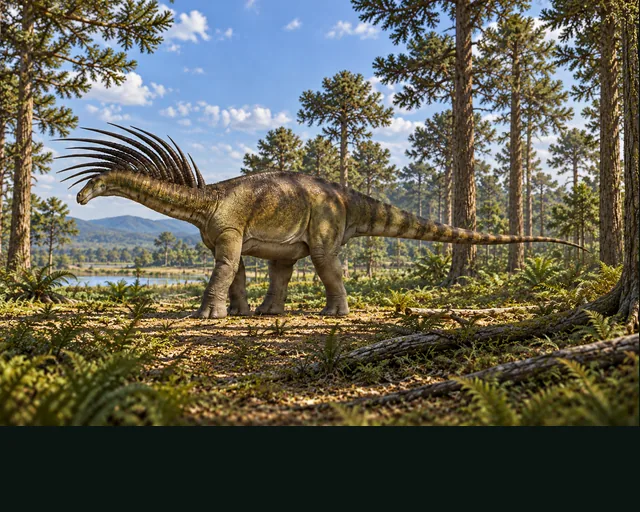
Amargasaurus was an Early Cretaceous Argentine sauropod with paired tall spines along its neck and back.
Distinctive features and evidence
A comparatively complete skeleton anchors its unusual silhouette. Whether the spines supported separate coverings or a connected soft-tissue structure remains an interpretive question, so competing reconstructions should retain that uncertainty.
Genus overview and research references.
Amargasaurus fossil discovery
Amargasaurus is known from one skeleton, found in February 1984 by Guillermo Rougier on an expedition led by José Bonaparte in Neuquén Province, Patagonia. The same trip uncovered a nearly complete skeleton of the horned predator Carnotaurus. A geologist, Luis Cazau, had alerted the team to the importance of the rocks, and the species name honours him.
The skeleton is unusually complete for a sauropod. The neck and back were found still connected to the rear of the skull and the sacrum, the hip bones. The skull is only partial, with the braincase and temple region, and the tail, hands and feet are largely missing. It is held at the Bernardino Rivadavia Museum in Buenos Aires. Leonardo Salgado and Bonaparte described it in 1991.
How big was Amargasaurus?
Amargasaurus was small for a sauropod, with estimates of about 9 to 13 metres in length. Weight estimates differ between sources: about 2.5 to 4 tonnes in one, and 9 tonnes in the Natural History Museum’s directory. Its neck was shorter than in most sauropods, which is typical of its family, and held thirteen vertebrae.
The skeleton is known to have belonged to an animal at least ten years old, based on growth lines in a rib. It may not have been fully grown, because the layer of closely packed growth lines that appears in adults is missing, though it may have eroded away.
What were the spines of Amargasaurus for?
The most striking feature is a double row of tall spines on the neck and front of the back, with the tallest, on the eighth neck vertebra, reaching about 60 centimetres. The spines are forked along their length, and the hips and base of the tail carry shorter, paddle-shaped ones. How they looked in life has been debated for decades.
Suggestions include a pair of skin sails, a single sail, horn-covered spikes, or a defensive and display structure. A 2022 study of the bone structure found marks of ligaments between the spines and no sign of a horn sheath, which fits a neck sail. Defensive roles, such as stabbing a predator when the neck was pulled back, have also been proposed. The function is not settled.
Is Amargasaurus a diplodocid?
No, but it is a distant cousin. Amargasaurus belongs to Dicraeosauridae, a family within Diplodocoidea, the same larger group as Diplodocus. Dicraeosaurids generally had shorter necks and smaller bodies than other sauropods. Dicraeosaurus from Tanzania is a better-known relative.
It was the earliest member of its family recorded from the Cretaceous, and Bajadasaurus, described in 2019 from Argentina, has similar neck spines. Compare these sizes with giants such as Argentinosaurus, which belongs to a completely different group.
When and where did Amargasaurus live?
Amargasaurus lived in the Early Cretaceous, in the Barremian to early Aptian stages, roughly 130 to 120 million years ago. It shared its environment, a coastal region of forests with a short dry season, with at least three other sauropod groups, and scientists think they ate at different heights to avoid competing. Amargasaurus probably fed close to the ground, with a maximum reach of about 2.7 metres.
Classification and fossil record
The Paleobiology Database taxonomic record catalogues Amargasaurus under Dicraeosaurinae. This is the immediate parent in that catalogue, rather than a complete list of evolutionary relationships.
Discovery and naming history
The principal skeleton was found in 1984 and formally described in 1991 as Amargasaurus cazaui. Its unusual completeness, including part of the skull, makes its preserved neck and back more informative than an isolated bone. Historical overview.
The corroborated occurrence sample includes Argentina; those are modern discovery locations, not a complete ancient geographic range.
The sourced length estimate for Amargasaurus is 9–13 metres. This is an estimate for the reconstructed animal, not a measurement shared by every individual. See the body-size discussion and linked evidence for context.
Research starting point
The catalogue links Amargasaurus to Bonaparte, 1984, published in Sulle Orme dei Dinosauri. This identifies a research starting point; the catalogue’s citation alone does not verify every later reconstruction or species assignment.
For the meaning of taxonomic terms and how evidence is checked, see the glossary and editorial policy.
Quick answers
- Is Amargasaurus a dinosaur?
- Yes. Amargasaurus was a plant-eating sauropod dinosaur from the Early Cretaceous of Argentina, known for the double row of tall spines on its neck and back.
- How big was Amargasaurus?
- About 9 to 13 metres long, which is small for a sauropod. Weight estimates differ between sources, from roughly 2.5 to 9 tonnes.
- When did Amargasaurus live?
- In the Early Cretaceous, roughly 130 to 120 million years ago according to the age of the La Amarga Formation, in the Barremian and early Aptian stages.
- What were the spines on Amargasaurus for?
- Nobody is sure. Scientists have suggested display, defence, or a neck sail. A 2022 study found signs of ligaments between the spines, consistent with a sail.
- Where was Amargasaurus found?
- In the La Amarga Formation near the La Amarga stream in Neuquén Province, northern Patagonia, Argentina, by an expedition led by José Bonaparte in 1984.