Jurassic Dinos editorial · Updated · Source-based review
What is Herrerasaurus?
Herrerasaurus was an early Late Triassic carnivorous dinosaur from Argentina’s Ischigualasto Formation.
Distinctive features and evidence
Its early classification was difficult because the available remains were incomplete. It offers a comparison with Eoraptor for early dinosaur diversification, while disagreements about deep relationships should remain explicit.
Genus overview and research references.
Herrerasaurus fossil discoveries
The first fossils were noticed by a local man, Victorino Herrera, in outcrops of the Ischigualasto Formation near San Juan in north-western Argentina, and Osvaldo Reig named the animal in 1963. Reig also named a second dinosaur, Ischisaurus, from the same rocks. Both it and another early name, Frenguellisaurus, are now regarded as the same animal, with Ischisaurus being a young one. The early finds were incomplete, which is one reason why classification was so uncertain for decades.
That changed in 1988, when a team led by Paul Sereno found a complete skull and a nearly complete skeleton. The new bones allowed a detailed study and gave Herrerasaurus a central role in debates about what the earliest dinosaurs looked like. A young Herrerasaurus pelvis later showed that the smaller Staurikosaurus was not simply a juvenile of this genus.
How big was Herrerasaurus?
Sources disagree. One account gives up to about 6 metres in length and roughly 350 kilograms for the biggest adults, with smaller specimens about 4.5 metres and 200 kilograms, and skulls up to 56 centimetres long. The Natural History Museum lists about 3 metres. Because the genus is known from several individuals of different sizes, the different figures probably describe different animals, but that is not certain, so a single size is not given here.
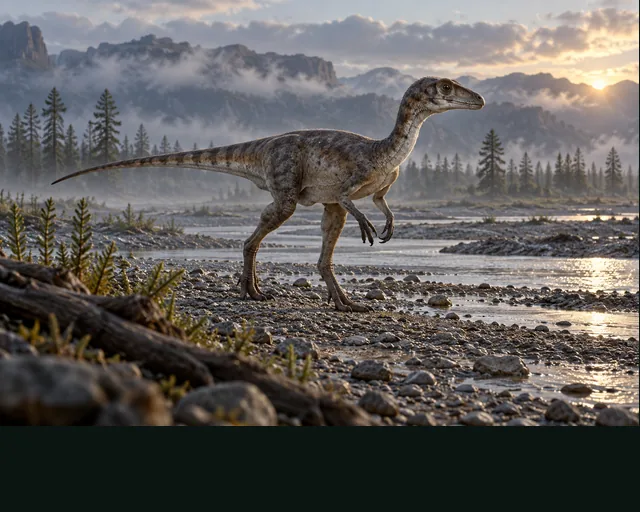
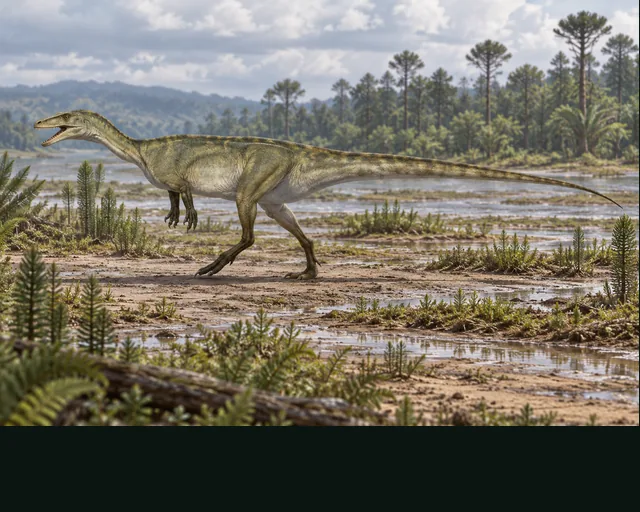
The animal was slim and walked on two legs. It balanced its body with a long tail and carried a head that was modest in size. The hind legs had short thighs and long feet, which suggests it ran quickly, and only the middle three toes bore the weight. The hands were long, and several fingers ended in curved, sharp claws. The jaws held large serrated teeth, and a flexible joint in the lower jaw may have allowed a sliding grasping bite.
Is Herrerasaurus a theropod?
Nobody has fully settled this, and it is one of the best-known disputes in early dinosaur research. Herrerasaurus has some dinosaur features, such as parts of the hip, but others, such as a partly closed hip socket and a skull that resembles more primitive archosaurs, look older. Over the decades it has been called a carnosaur, a prosauropod, a close relative of the ancestors of all dinosaurs, a saurischian of uncertain position, and even a non-dinosaur.
After the 1988 skeleton, most analyses treated it as an early saurischian. Two main ideas then dominated: that it was a very early theropod, or that it branched off before the theropod and long-necked sauropodomorph lines separated. Later studies have supported each in turn, and a 2014 analysis left Herrerasauridae, Theropoda and Sauropodomorpha as an unresolved three-way split. Its close relatives in the family Herrerasauridae include Staurikosaurus and Sanjuansaurus; for a comparison with another early South American form, see Eoraptor.
What did Herrerasaurus eat?
Herrerasaurus is thought to have preyed on small and medium-sized plant-eaters, which might have included early dinosaurs such as Pisanosaurus as well as the abundant rhynchosaurs and relatives of mammals. Dental microwear, the tiny wear patterns on teeth, resembles that of crocodilians that swallow small prey nearly whole, although the authors warned that the sample was small. Fossil dung with small bones and no plant remains in the same rocks has been tentatively linked to Herrerasaurus on the basis of how common the animal was, and if that link is right, the animal could digest bone.
It was not at the top of its world either. Puncture wounds in one skull may have come from a large predator such as the rauisuchian Saurosuchus, while a Herrerasaurus skull with healed bite pits is thought to show a fight with another Herrerasaurus.
Where and when Herrerasaurus lived
Herrerasaurus fossils all come from the Ischigualasto Formation of north-western Argentina, which is Carnian in age, early in the Late Triassic. Estimates of age vary between sources, from about 237 to 227 million years ago in the Paleobiology Database to a single date near 231 million years ago in another, so this page gives no single figure.
The formation records a warm, moist, volcanically active floodplain with forests of conifers, ferns and horsetails and strong seasonal rains. Dinosaurs made up only about a tenth of the fossils. Most animals were other reptile groups and relatives of mammals, so Herrerasaurus lived in a world that was not yet dominated by dinosaurs, alongside early dinosaurs such as Eoraptor and Sanjuansaurus. Its remains appear to be the most common among the carnivores there.
Classification and fossil record
The Paleobiology Database taxonomic record catalogues Herrerasaurus under Herrerasauridae. This is the immediate parent in that catalogue, rather than a complete list of evolutionary relationships.
The corroborated occurrence sample includes Argentina; those are modern discovery locations, not a complete ancient geographic range.
Research starting point
The catalogue links Herrerasaurus to Reig, 1963, published in Ameghiniana. This identifies a research starting point; the catalogue’s citation alone does not verify every later reconstruction or species assignment.
For the meaning of taxonomic terms and how evidence is checked, see the glossary and editorial policy.
Quick answers
- Is Herrerasaurus a dinosaur?
- Yes, in most analyses. Herrerasaurus is treated as one of the earliest saurischian dinosaurs, though its exact position and even its status were debated for decades.
- Is Herrerasaurus a theropod?
- Possibly. Some studies call it an early theropod and others place it before the split of theropods and long-necked dinosaurs. A 2014 analysis left the relationship unresolved.
- How big was Herrerasaurus?
- Estimates range from about 3 metres to up to 6 metres long. One account suggests 200 to 350 kilograms, depending on the size of the individual.
- What did Herrerasaurus eat?
- It was a meat-eater with serrated teeth and clawed hands, probably hunting small and medium-sized plant-eating animals of its time. Details of its menu are inferred, not observed.
- Where was Herrerasaurus found?
- All known fossils come from the Ischigualasto Formation in San Juan province, north-western Argentina.