Jurassic Dinos editorial · Updated · Source-based review
What is Heterodontosaurus?
Heterodontosaurus was a small Early Jurassic South African dinosaur with several distinct tooth types.
Distinctive features and evidence
Its name refers to this unusual dentition, supported by skulls and a nearly complete skeleton. Contrasting teeth provide evidence for feeding anatomy, but do not automatically settle all dietary interpretations.
Genus overview and research references.
Heterodontosaurus fossil discoveries
Heterodontosaurus was named in 1962 by Alfred Crompton and Alan Charig from a crushed but nearly complete skull collected on a British-South African expedition at Tyinindini in the Transkei region of South Africa. The rock around the bones was covered in a hard iron-rich crust, and removing it with a diamond saw damaged the specimen. Only the front of the skull and lower jaw were described at first.
The key find came in 1966, when a nearly complete skeleton with skull was discovered at the Voyizane locality. It is still the most complete skeleton of any heterodontosaurid, and it helped researchers working in the 1970s argue that dinosaurs form one natural group. A full description of the skull only appeared in 2011, and a very complete specimen found near Grahamstown in 2005 was scanned at a European synchrotron in 2016 because the rock was too hard to remove. Some of the results were published in 2021.
Why did Heterodontosaurus have three kinds of teeth?
Most reptiles have one kind of tooth along their jaws, but Heterodontosaurus had three: small cone-shaped teeth at the front of the upper jaw, a pair of long tusks, and a row of chisel-shaped cheek teeth set behind a gap. The tip of the snout was covered by a horny beak. The tusks had fine serrations at the rear, and the lower ones were also serrated at the front.
What the tusks did is debated. Richard Thulborn proposed in 1974 that they were for display or fighting, but a 2008 study showed that they were already present in a juvenile, which makes a sex-linked weapon less likely. Others have suggested that the tusks, together with the clawed hands and long legs, hint at occasional meat-eating, while Paul Sereno argued in 2012 that the beak, cheek teeth and jaw mechanics point to a mostly plant-eating animal. Most accounts therefore describe it as a herbivore or an omnivore, and we cannot say which with certainty.
How big was Heterodontosaurus?
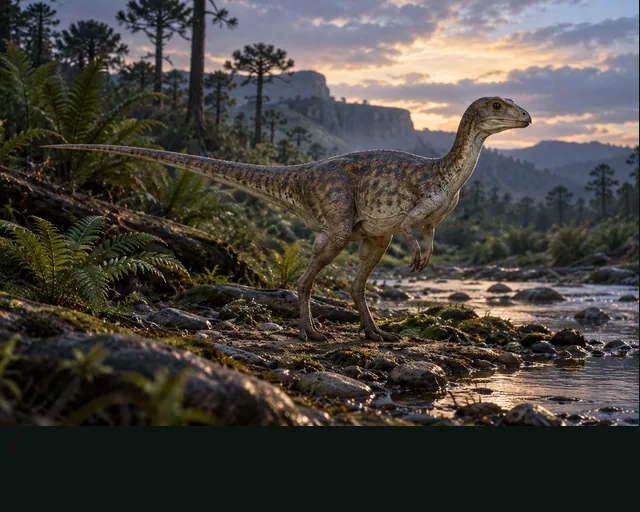
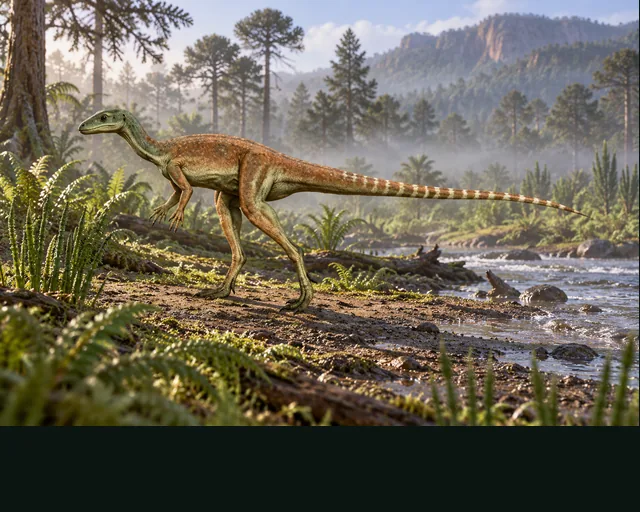
Heterodontosaurus was small, about the size of a turkey. The most complete skeleton measured around 1.18 metres, with weight estimates of roughly 1.8 to 3.4 kilograms in different studies. A larger skull suggests that some individuals could reach about 1.75 metres and nearly 10 kilograms. The reason for the size gap is unclear and could reflect variation within one species, differences between the sexes, or even two species.
The skeleton shows a short body, a long tail and long, slender hindlimbs with four toes. The arms were long and strong, with five fingers and large claws on the first three. Early studies suggested it might also have walked on all fours, but most researchers now treat it as a two-legged runner. Some reconstructions show a coat of bristle-like filaments because its relative Tianyulong preserved them, though none have been found with Heterodontosaurus itself.
Did Heterodontosaurus replace its teeth?
This was a long-running puzzle. Early skulls showed teeth worn to the same level and no replacements, so Thulborn suggested that all teeth might be replaced at once during a resting period. Later work disproved that idea. CT scans of a juvenile skull and later specimens revealed unerupted replacement teeth, and researchers now think that tooth replacement was occasional rather than continuous. The chisel-like shape of the cheek teeth is thought to have been shaped by wear from the upper and lower teeth meeting.
Where and when Heterodontosaurus lived, and who its relatives were
Heterodontosaurus fossils come from the Upper Elliot and Clarens formations of the Karoo region of southern Africa, dated to the Hettangian and Sinemurian ages of the Early Jurassic, around 200 to 190 million years ago. The sources used here give slightly different ranges, so this page gives only an approximate span. The Upper Elliot Formation was a drier world of red mudstones and sandstones with turtles, early crocodile relatives and mammal relatives. Other dinosaurs there included Lesothosaurus and Massospondylus.
Heterodontosaurus belongs to the family Heterodontosauridae, an early ornithischian group. Its place within ornithischians is debated: the family has been linked to ceratopsians and pachycephalosaurs, and a 2020 study even suggested that it is not a natural group but a series of early branches leading to the pachycephalosaurs.
Classification and fossil record
The Paleobiology Database taxonomic record catalogues Heterodontosaurus under Heterodontosaurinae. This is the immediate parent in that catalogue, rather than a complete list of evolutionary relationships.
The corroborated occurrence sample includes South Africa; those are modern discovery locations, not a complete ancient geographic range.
The sourced length estimate for Heterodontosaurus is 1.18–1.75 metres. This is an estimate for the reconstructed animal, not a measurement shared by every individual. See the body-size discussion and linked evidence for context.
Research starting point
The catalogue links Heterodontosaurus to Crompton and Charig, 1962, published in Nature. This identifies a research starting point; the catalogue’s citation alone does not verify every later reconstruction or species assignment.
For the meaning of taxonomic terms and how evidence is checked, see the glossary and editorial policy.
Quick answers
- Is Heterodontosaurus a dinosaur?
- Yes. Heterodontosaurus was a small ornithischian dinosaur from the Early Jurassic of southern Africa, best known for its three kinds of teeth.
- How big was Heterodontosaurus?
- Small: the most complete skeleton is about 1.2 metres long, and a larger skull suggests up to about 1.75 metres. Weight estimates run from about 2 to 10 kilograms.
- What did Heterodontosaurus eat?
- Probably mostly plants, using its beak and cheek teeth, although its tusks and clawed hands have led some scientists to suggest it was an omnivore. The question is debated.
- What were the tusks of Heterodontosaurus for?
- Uncertain. Suggestions include display, defence or feeding. A 2008 study found tusks in a juvenile, which argues against them being a male-only fighting feature.
- Where was Heterodontosaurus found?
- In the Karoo region of southern Africa, including sites in South Africa's Eastern Cape and the Transkei, in the Elliot and Clarens formations.