Jurassic Dinos editorial · Updated · Source-based review
What is Kentrosaurus?
Kentrosaurus was a Late Jurassic Tanzanian stegosaur from the Tendaguru Formation.
Distinctive features and evidence
The species Kentrosaurus aethiopicus supplies an African comparison with Stegosaurus. Describing it as primitive is less useful than identifying particular anatomical features and the analysis supporting a proposed relationship.
Genus overview and research references.
Kentrosaurus fossil discoveries
Kentrosaurus is one of the better-represented stegosaurs, although no single complete skeleton exists. German expeditions to what was then German East Africa dug at the Tendaguru site in present-day Tanzania from 1909 to 1912. Over four field seasons they recovered more than 1,200 Kentrosaurus bones, from roughly fifty individuals. Expedition leader Werner Janensch recognised them as belonging to a stegosaur in July 1910, and Edwin Hennig described and named the animal in 1915.
The best associated material, from one individual, includes a nearly complete tail, the hip, several back vertebrae and some limb bones. Hennig picked it as the type specimen in 1925, and it forms the core of the mounted skeleton in the Museum für Naturkunde in Berlin. Around 350 specimens remain in Berlin, because many bones were destroyed in the Second World War. A braincase and other skull parts once thought lost turned out to be sitting in a drawer in a basement cupboard.
The name has a tangled history. It looked too much like the horned dinosaur Centrosaurus, so Hennig offered Kentrurosaurus in 1916, and Franz Nopcsa suggested Doryphorosaurus. Neither replacement was needed because the spelling was different enough, so Kentrosaurus is still the valid name.
How big was Kentrosaurus and what did its armour look like?
Adult Kentrosaurus measured about 4 to 5 metres long. Published mass estimates run from about 700 to 1,600 kilograms, a wide range that reflects how weight is calculated from incomplete skeletons. It was a small animal compared with the North American Stegosaurus.
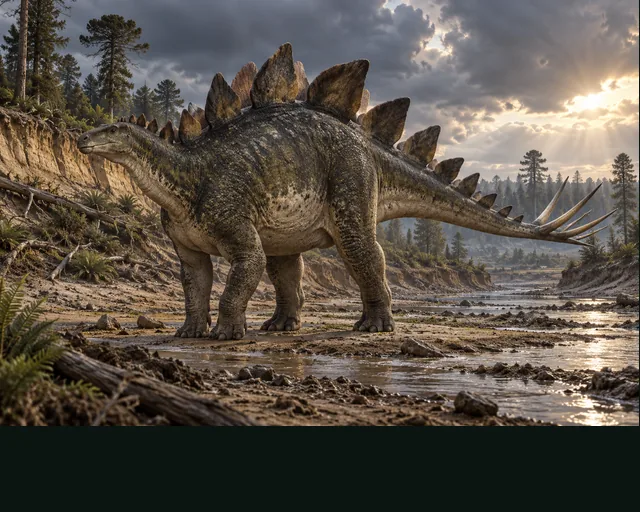
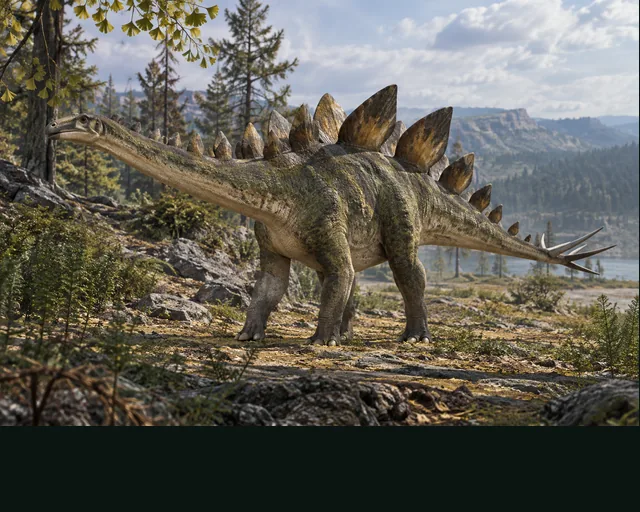
It walked on four legs, with short forelimbs and longer hind legs, and had a long, narrow head ending in a beak. Along the neck and front of the back there were small plates. These changed gradually into longer, pointed spikes toward the hips and tail, and the longest spikes sat at the tail end. Hennig and Janensch counted fifteen pairs in total. A large spike was probably positioned at each shoulder, although older reconstructions put it on the hip, and later ones moved it based on the Chinese stegosaurs Huayangosaurus and Gigantspinosaurus.
The armour is a weak point of the evidence. Most plates and spikes were found away from other bones, so their exact positions are uncertain. The animal also seems to have had two rows of them down its back, unlike the single row of plates in Stegosaurus. Their horny coverings are not preserved but are assumed from the bone surface.
What did Kentrosaurus eat?
Kentrosaurus was a plant eater. Its skull sat low, it lacked teeth at the front of the upper jaw and probably had a horny beak there, and its cheek teeth were small, with wear that shows some grinding. These features suggest a browser of low-growing non-flowering plants, although fossil evidence for its exact menu is lacking. Food was probably swallowed in big pieces and digested in a large gut.
On all fours it could reach vegetation up to about 1.7 metres high. Its centre of mass lay close to the hips, so researchers think it could rear up on its hind legs, with the tail perhaps giving some support, and reach roughly 3.3 metres. That is a mechanical estimate rather than an observed behaviour.
Behaviour and defence: what the evidence allows
The tail spikes are the best clue to defence. The tail had many vertebrae and was very flexible, and a mechanical study suggested it could be swung across a wide arc. Researchers have proposed that the spikes could have caused painful wounds, but this is a model, not a record of a real fight, and it is not known how often a predator tried.
Femur shape hints at differences between the sexes. Holly Barden and Susannah Maidment found two thigh-bone types, one stouter than the other, in a ratio of about two to one. This led to speculation about how the animals lived, but the bones came from several deposits that do not represent a single herd, so the ratio may be biased. Bone structure studied in 2013 by Ragna Redelstorff and colleagues indicates that Kentrosaurus grew relatively fast for a stegosaur.
Where and when Kentrosaurus lived
All Kentrosaurus fossils come from the Tendaguru Formation of Tanzania, from the Late Jurassic, about 152 million years ago, spanning the late Kimmeridgian and early Tithonian ages. The Natural History Museum gives 155 to 150 million years. The area was subtropical to tropical, with seasonal rain and dry periods, lagoons and coastal flats, and inland forests dominated by conifers.
Its neighbours included the giant sauropods Giraffatitan and Tornieria, the small plant eater Dysalotosaurus and meat-eaters such as Elaphrosaurus and Veterupristisaurus. Sharks, bony fish, crocodilians and invertebrates also come from the same unit.
Within the family, Kentrosaurus is placed among the Stegosauridae, close to Stegosaurus. It was once viewed as an early stegosaur, but several modern analyses find it more advanced than that, and a 2025 analysis grouped it with Dacentrurus. Scientists do not all agree on where it sits. A Late Jurassic humerus from Argentina resembles that of Kentrosaurus, and a fossil called Alcovasaurus from Wyoming was once assigned to Kentrosaurus but is now given a separate name.
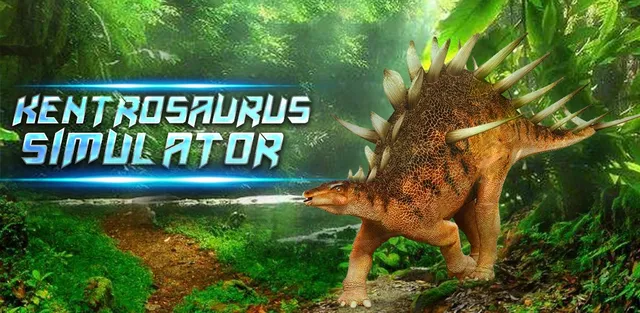
Kentrosaurus in the game
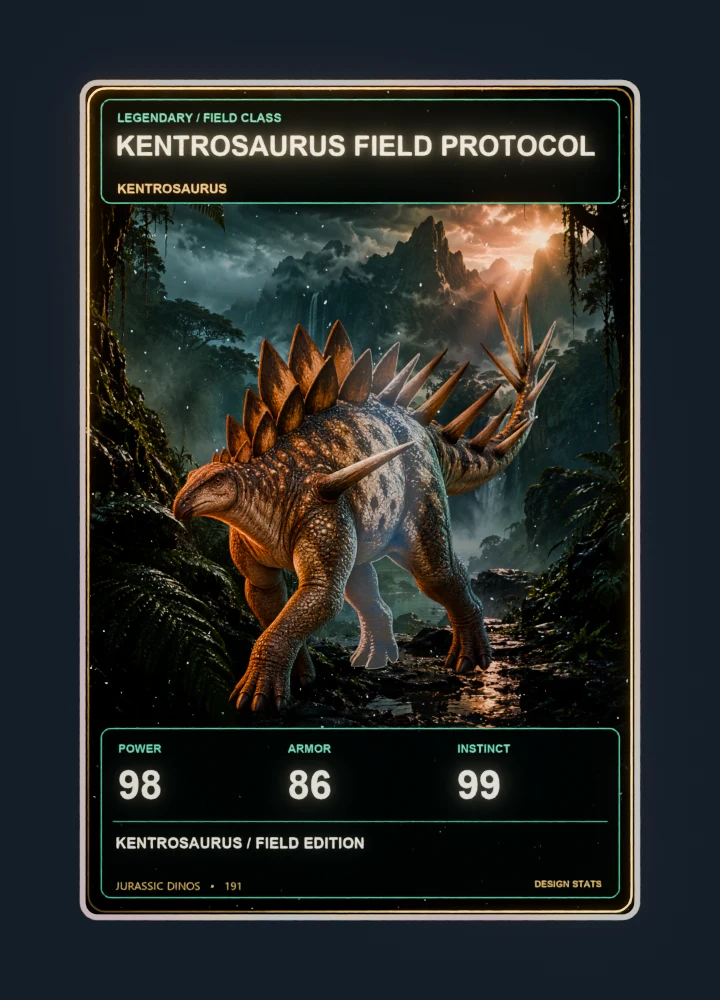
Kentrosaurus: Spike Dino Sim is an Android game that puts you in control of a spiky stegosaur. Its listing describes tail swipes, a shoulder charge and a defensive stance, along with exploring African-inspired landscapes with weather and a day-night cycle, levelling up and building a family.
The attacks and enemies belong to the game. The listed opponents include animals such as Tyrannosaurus, which lived in a different place and time from the real Tendaguru animals, so the game is not a record of the actual Jurassic ecosystem. Treat its abilities as entertainment rather than scientific evidence.
Classification and fossil record
The Paleobiology Database taxonomic record catalogues Kentrosaurus under Dacentrurinae. This is the immediate parent in that catalogue, rather than a complete list of evolutionary relationships.
The corroborated occurrence sample includes Tanzania; those are modern discovery locations, not a complete ancient geographic range.
The sourced length estimate for Kentrosaurus is 4–5 metres. This is an estimate for the reconstructed animal, not a measurement shared by every individual. See the body-size discussion and linked evidence for context.
Research starting point
The catalogue links Kentrosaurus to Hennig, 1915, published in Sitzungsberichte der Gesellschaft Naturforschender Freunde zu Berlin. This identifies a research starting point; the catalogue’s citation alone does not verify every later reconstruction or species assignment.
For the meaning of taxonomic terms and how evidence is checked, see the glossary and editorial policy.
Quick answers
- Is Kentrosaurus a dinosaur?
- Yes. Kentrosaurus was a stegosaurian ornithischian dinosaur, a plant-eating armoured animal that lived in what is now Tanzania during the Late Jurassic.
- When did Kentrosaurus live?
- It lived in the Late Jurassic, about 152 million years ago according to the dating of the Tendaguru rocks. The Natural History Museum gives 155 to 150 million years.
- How big was Kentrosaurus?
- Adults were about 4 to 5 metres long, and mass estimates run from roughly 700 to 1,600 kilograms. These are estimates because no complete skeleton has been found.
- What did Kentrosaurus eat?
- It ate plants. Its low skull, beak and small grinding teeth suggest browsing on low-growing vegetation, and it may have reared up on its hind legs to reach higher food.
- Where was Kentrosaurus found?
- Kentrosaurus fossils come only from the Tendaguru Formation in southern Tanzania, mainly from German excavations between 1909 and 1912.