Jurassic Dinos editorial · Updated · Source-based review
What is Miragaia?
Miragaia is a long-necked Late Jurassic stegosaur name based on Portuguese fossils.
Distinctive features and evidence
Its unusually numerous neck vertebrae distinguish the described material. Some authors include it within Dacentrurus, so the entry preserves that taxonomic question rather than counting both names as settled, unrelated genera.
Genus overview and research references.
Miragaia fossil discoveries
Miragaia was found when a road was built between the Portuguese villages of Miragaia and Sobral. The excavation took place in August 1999 and August 2001. The main specimen, ML 433, is the nearly complete front half of a skeleton, with part of the skull, 15 neck vertebrae, shoulder and forelimb bones, 13 bony plates and a spike. The back half was probably destroyed by the road cut. The skull remains were the only ones known from any European stegosaur at the time.
The animal was formally named in 2009 by a team led by Octávio Mateus, with Susannah Maidment and Nicolai Christiansen. A second, more complete skeleton (MG 4863), excavated in 1959 but only prepared between 2015 and 2017, includes tail bones and has been described as the most complete dinosaur found in Portugal.
Why did Miragaia have such a long neck?
Most stegosaurs had short necks, but Miragaia had at least 17 neck vertebrae, which is eight more than the ancestral condition and more than most long-necked sauropods. Stegosaurus had 12 or 13. The describing team concluded that the extra neck bones came mainly from back vertebrae that became part of the neck, rather than from brand-new bones. This is why the paper called it a ‘sauropod-mimic’.
The reason is not settled. The authors suggested that the neck allowed it to feed at heights other plant-eaters did not use, or that it evolved through sexual selection. They noted problems with both ideas, because other Iberian stegosaurs, referred to Dacentrurus and Stegosaurus, would have fed at overlapping heights.
How big was Miragaia?
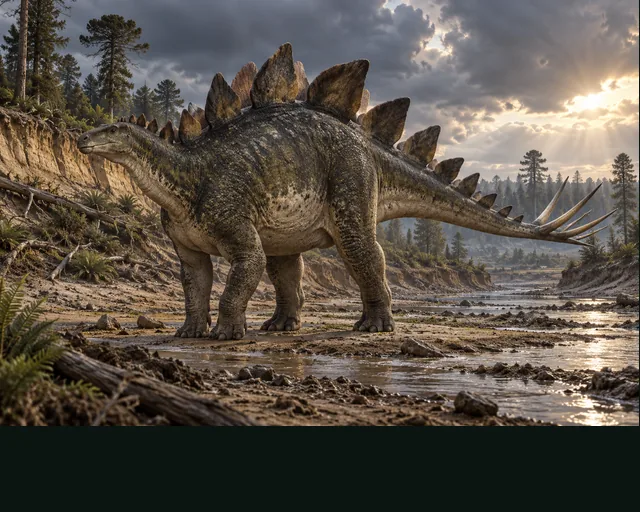
Miragaia was long but lightly built compared with other stegosaurs, with estimates of 6 to 6.5 metres and about 2 tonnes. Growth rings in the bone suggest the main specimen was sexually mature at 14 to 15 years and fully grown at 21 to 25. Neck plates were triangular and paired, reconstructed as eight pairs, and a long, straight spike was found, originally thought to be a shoulder spine but later reinterpreted as part of the tail arrangement.
Is Miragaia the same animal as Dacentrurus?
This is the main scientific debate about Miragaia, and it is not settled. In 2009 the describing team placed Miragaia with Dacentrurus in a group called Dacentrurinae, close to Stegosaurus. In 2010 Alberto Cobos and colleagues pointed out that Miragaia’s defining traits are all on bones missing from the English Dacentrurus type specimen, so the two could not be told apart and Miragaia might be a junior synonym.
In 2019 Costa and Mateus defended it as valid after studying MG 4863. A 2024 study of a new Dacentrurus specimen from the Villar del Arzobispo Formation again favoured synonymy, while a 2025 redescription of MG 4863 argued that the two are different. The Paleobiology Database currently lists Miragaia as a subjective synonym of Dacentrurus. Until the Dacentrurus fossils are better known, both views remain possible.
Where and when Miragaia lived
Miragaia is known from the Sobral Unit of the Lourinhã Formation in Portugal, rocks from the late Kimmeridgian to early Tithonian of the Late Jurassic, around 150 million years ago. Some stegosaur fossils from the Morrison Formation of Utah and Wyoming in the United States have been compared with Miragaia, and a 2026 study suggested four may be referable to it or comparable, but this is not confirmed.
Classification and fossil record
The Paleobiology Database taxonomic record catalogues Miragaia under Dacentrurinae. This is the immediate parent in that catalogue, rather than a complete list of evolutionary relationships.
The corroborated occurrence sample includes United States, Portugal; those are modern discovery locations, not a complete ancient geographic range.
Research starting point
The catalogue links Miragaia to Mateus and Maidment, 2009, published in Proceedings of the Royal Society B: Biological Sciences. This identifies a research starting point; the catalogue’s citation alone does not verify every later reconstruction or species assignment.
For the meaning of taxonomic terms and how evidence is checked, see the glossary and editorial policy.
Quick answers
- Is Miragaia a dinosaur?
- Yes. Miragaia was a long-necked stegosaur, an armoured plant-eating dinosaur from the Late Jurassic of Portugal.
- How long was the neck of Miragaia?
- It had at least 17 neck vertebrae, more than most sauropods and more than other stegosaurs, which had about 12 or 13.
- Is Miragaia the same as Dacentrurus?
- That is disputed. Some researchers think Miragaia is a junior synonym of Dacentrurus, while others argue the two are separate genera. The type specimens do not overlap enough to settle it.
- When did Miragaia live?
- Miragaia lived in the Late Jurassic, around 150 million years ago, in what is now Portugal.
- How big was Miragaia?
- Estimates are about 6 to 6.5 metres in length and around 2 tonnes, which is light and long compared with other stegosaurs.