Jurassic Dinos editorial · Updated · Source-based review
What is Dacentrurus?
Dacentrurus was a European stegosaur first named from a skeleton found in the Kimmeridge Clay of England.
Distinctive features and evidence
The original name Omosaurus was replaced because it was already in use. Fossil completeness limits the reconstruction, and the broad set of historical species assignments should not all be treated as valid members of the genus.
Genus overview and research references.
Dacentrurus fossil discoveries
The story begins in May 1874, when a worker at the Swindon Brick and Tyle Company reported that a clay pit in Wiltshire had again produced a fossil skeleton. The bones lay inside a huge hard clay nodule that crumbled when workers tried to lift it, and the pieces were sent to London in crates weighing about three tonnes.
Richard Owen described the find in 1875. The holotype, the specimen that anchors the name, has no skull. It includes the hips, several back and tail vertebrae, a thigh bone, an almost complete left forelimb, a neck plate and a tail spike. The pits were soon abandoned, so the exact spot and age of the find can no longer be pinned down beyond the Kimmeridge Clay.
How big was Dacentrurus?
Size estimates for Dacentrurus vary. The Natural History Museum lists a length of about 6 metres, while other published estimates reach roughly 8 to 9 metres, a hip height near 1.8 metres and a body mass of about 5 to 7.4 tonnes. That would place it among the larger stegosaurs, alongside Stegosaurus, but the figures come from incomplete skeletons and should be read as rough guides.
The bones show a heavily built animal. The neck and back vertebrae are unusually wide and robust, the gut seems to have been broad for a stegosaur, and the forelimb was relatively long because of a long upper arm bone.
What armour did Dacentrurus have?
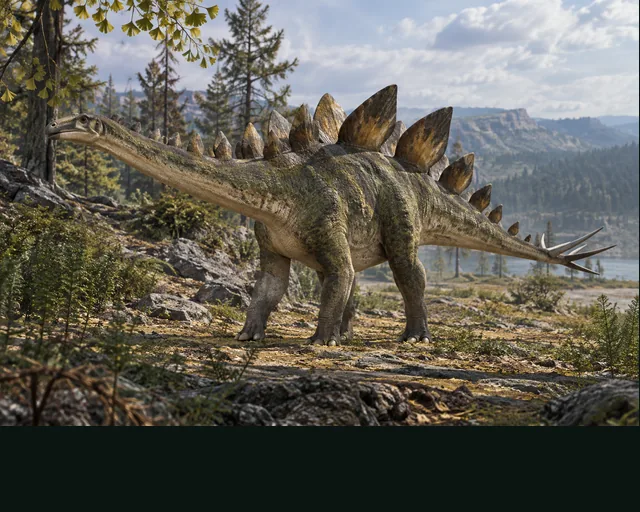
Dacentrurus carried bony armour, but its layout is not like the familiar big back plates of Stegosaurus. The neck plate in the holotype is small and blunt, and researchers think the animal probably had two rows of small plates on the neck and two rows of longer spikes along the tail. The preserved tail spike is at least 456 millimetres long and is wide and gently rounded rather than flattened like a blade.
Some older artwork shows a spike near the shoulder, as in Kentrosaurus. Whether that is correct has not been settled. Palaeontologists have suggested that strong forelimb muscles and a tail swung from side to side could have helped with defence against large predators, but that is an interpretation of the anatomy, not direct evidence of any fight.
What happened to the other Omosaurus species?
Several more Omosaurus species were named after 1875. Some were later moved to other genera, such as Lexovisaurus, and in 2008 one study limited the confirmed material of Dacentrurus armatus to its holotype. Most European stegosaur finds of the period had once been assigned to Dacentrurus, but many are fragmentary, which is why the exact range of the genus is still discussed.
Where and when Dacentrurus lived
Dacentrurus is known from the Late Jurassic of Europe, with fossils reported from England, France, Portugal and Spain. Dates are given as about 154 to 150 million years ago by the Natural History Museum and 154 to 140 million years ago in another account, because some remains from the Jurassic-Cretaceous boundary and the earliest Cretaceous, including a 2021 report from France, have also been linked to it.
The relationship with Miragaia is debated. A 2024 study assigned the Miragaia material to Dacentrurus, but a 2025 re-description argued that the two are separate. A 125-millimetre egg from Portugal has been attributed to Dacentrurus, which would make it the first egg linked to any stegosaur.
Classification and fossil record
The Paleobiology Database taxonomic record catalogues Dacentrurus under Dacentrurinae. This is the immediate parent in that catalogue, rather than a complete list of evolutionary relationships.
Discovery and naming history
The original skeleton was named Omosaurus armatus in 1875 from Swindon, England. The replacement name Dacentrurus followed in 1902 because Omosaurus was already occupied; this is a nomenclatural change, not evidence for two separate animals. Historical overview.
The corroborated occurrence sample includes France, Portugal, Spain; those are modern discovery locations, not a complete ancient geographic range.
Research starting point
The catalogue links Dacentrurus to Lucas, 1902, published in Science, new series. This identifies a research starting point; the catalogue’s citation alone does not verify every later reconstruction or species assignment.
For the meaning of taxonomic terms and how evidence is checked, see the glossary and editorial policy.
Quick answers
- Is Dacentrurus a dinosaur?
- Yes. Dacentrurus was a plant-eating stegosaur, an armoured ornithischian dinosaur, known mainly from the Late Jurassic of western Europe.
- How big was Dacentrurus?
- Estimates differ: the Natural History Museum lists about 6 metres, while other published estimates reach roughly 8 to 9 metres and 5 to 7.4 tonnes, based on incomplete skeletons.
- Why was Omosaurus renamed Dacentrurus?
- The name Omosaurus had already been used in 1856 for a phytosaur, so Frederick Augustus Lucas proposed Dacentrurus in 1902 for the same stegosaur.
- Where was Dacentrurus found?
- The type skeleton came from a clay pit at Swindon, England. Other remains attributed to the genus come from France, Portugal and Spain, though many are fragmentary.