Jurassic Dinos editorial · Updated · Source-based review
What is Giraffatitan?
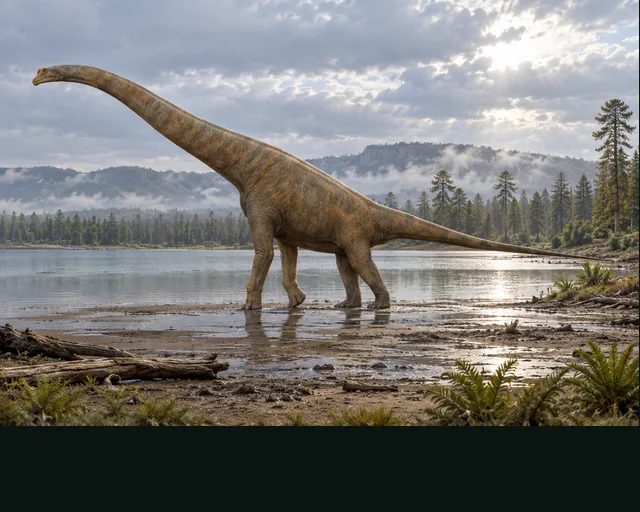
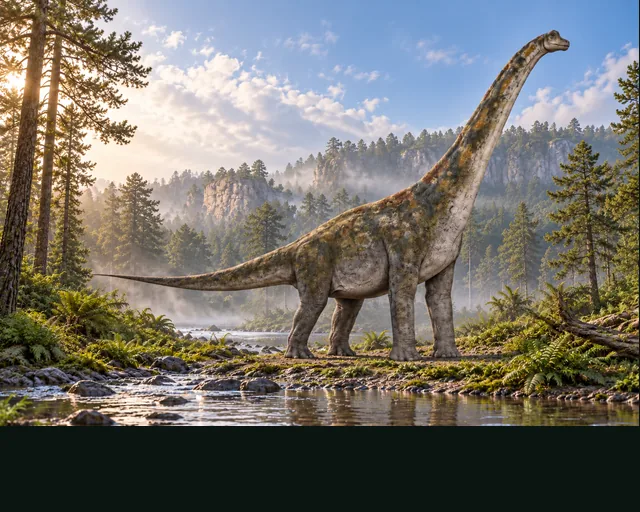
Giraffatitan was a Late Jurassic Tanzanian sauropod formerly called Brachiosaurus brancai.
Distinctive features and evidence
Separating the Tendaguru fossils from North American Brachiosaurus changes how famous museum mounts are labeled. The distinction is anatomical and taxonomic, rather than evidence that the African material has disappeared from the fossil record.
Genus overview and research references.
Giraffatitan fossil discoveries at Tendaguru
Giraffatitan comes from Tendaguru, a hill in southern Tanzania, then part of German East Africa. A mining engineer, Bernhard Sattler, noticed an enormous bone sticking out of the ground there in 1906, and the German palaeontologist Eberhard Fraas confirmed the bones in 1907. A large expedition from the Berlin museum, led by Werner Janensch and Edwin Hennig, worked there over four field seasons from 1909 to 1912, opening about a hundred quarries and relying on porters because the tsetse fly made pack animals unusable.
The richest quarry for this dinosaur was Site S. Janensch first thought it held one skeleton, but later realised it held two. The better one, Skelett SII, was still a subadult, and the animals were found upright with their limbs vertical, which has been explained by their becoming stuck in mud. Overall the species is known from several partial skeletons, including skulls, so that most of the skeleton is understood, though many expedition records were lost, partly through a bombing raid in 1943.
How big was Giraffatitan?
The Berlin mount of Giraffatitan is mostly based on the subadult SII and measures roughly 21.8 to 22.5 metres in length and about 12 metres in height. Janensch’s 22.46 metre figure appears to contain an adding error, and the correct number would be about 22.16 metres. A larger individual, known mainly from a fibula about 13 per cent bigger, has been estimated at 23 to 26 metres, so full-grown animals may have been bigger than the mount. The Natural History Museum lists 23 metres.
Weight is far less certain. Estimates made since 1914 have ranged from about 15 tonnes to 78 tonnes, depending on the method, and modern volume models that allow for air sacs in the body fall in a range of roughly 23 to 40 tonnes. The older extremes are now considered unlikely.
Giraffatitan was long considered the largest dinosaur known, until larger giants, especially titanosaurs, were found. It is still among the largest sauropods known from fairly complete skeletons.
Is Giraffatitan the same as Brachiosaurus?
For most of the twentieth century, Giraffatitan was called Brachiosaurus brancai, a second species of the North American Brachiosaurus. Janensch gave it that name in 1914. Gregory Paul pointed out differences in body proportions in 1988, and George Olshevsky made Giraffatitan a separate genus in 1991, but the name was widely ignored for years.
In 2009 Michael Taylor compared all the bones and counted twenty-six differences between the African and American animals, more than separate Diplodocus from Barosaurus. For example, Brachiosaurus had a longer series of back vertebrae and a longer, taller tail. Most studies after 2012 accept Giraffatitan as its own genus, although not every researcher agrees, and recent analyses disagree about whether the two are each other’s closest relatives.
What did Giraffatitan eat, and how did it live?
Giraffatitan was a plant-eater with chisel-shaped teeth, and wear on them suggests it bit and tore off foliage rather than just grinding it. The shape of the back of its skull and the limited sideways movement of the neck have been interpreted as signs of a high browser that fed from tree tops.
Old pictures showed sauropods like this in deep water with the nostrils on top of the head as snorkels. Studies since then, including work by Lawrence Witmer in 2001, show that water pressure would have made breathing hard and that the feet were too narrow for a watery life, and that the fleshy nostrils were probably near the snout tip. Its brain was small, about 300 cubic centimetres.
The animal’s growth rate is uncertain. If it was warm-blooded, it may have taken about ten years to reach full size; if cold-blooded, over a hundred.
Where and when Giraffatitan lived
Giraffatitan lived in the Tendaguru Formation, in the Late Jurassic, in the Kimmeridgian to Tithonian ages. Published date ranges vary, so this page gives no single figure: the Natural History Museum lists roughly 154 to 142 million years ago, while the Paleobiology Database range starts earlier, in the Oxfordian. It was a landscape of lagoons, tidal flats and coastal lakes, with forests of conifers inland, under a subtropical to tropical climate with seasonal rains and pronounced dry periods.
Neighbours included other sauropods such as Dicraeosaurus, the plated Kentrosaurus, several theropods and pterosaurs. The Tendaguru beds resemble the Morrison Formation of North America, apart from marine layers.
Classification and fossil record
The Paleobiology Database taxonomic record catalogues Giraffatitan under Brachiosauridae. This is the immediate parent in that catalogue, rather than a complete list of evolutionary relationships.
The corroborated occurrence sample includes Tanzania; those are modern discovery locations, not a complete ancient geographic range.
The sourced length estimate for Giraffatitan is 21.8–23 metres. This is an estimate for the reconstructed animal, not a measurement shared by every individual. See the body-size discussion and linked evidence for context.
Research starting point
The catalogue links Giraffatitan to Paul, 1988, published in Hunteria. This identifies a research starting point; the catalogue’s citation alone does not verify every later reconstruction or species assignment.
For the meaning of taxonomic terms and how evidence is checked, see the glossary and editorial policy.
Quick answers
- Is Giraffatitan a dinosaur?
- Yes. Giraffatitan was a long-necked sauropod dinosaur that lived in what is now Tanzania during the Late Jurassic.
- Is Giraffatitan the same as Brachiosaurus?
- Not according to most recent studies. It was named as a second Brachiosaurus species in 1914, but a 2009 comparison found 26 bone differences and later work usually treats it as its own genus.
- How big was Giraffatitan?
- The Berlin skeleton is roughly 22 metres long and 12 metres tall, but it is a subadult. Larger individuals may have reached 23 to 26 metres. Weight estimates vary widely.
- What did Giraffatitan eat?
- It ate plants. Its chisel-shaped teeth and skull shape suggest it browsed foliage from high in the trees, but this is inferred from anatomy.
- Where was Giraffatitan found?
- All the known material comes from the Tendaguru Formation of Lindi Region in southern Tanzania, excavated mainly by German expeditions between 1909 and 1912.