Jurassic Dinos editorial · Updated · Source-based review
What is Scutellosaurus?
Scutellosaurus was a small Early Jurassic armored dinosaur from Arizona.
Distinctive features and evidence
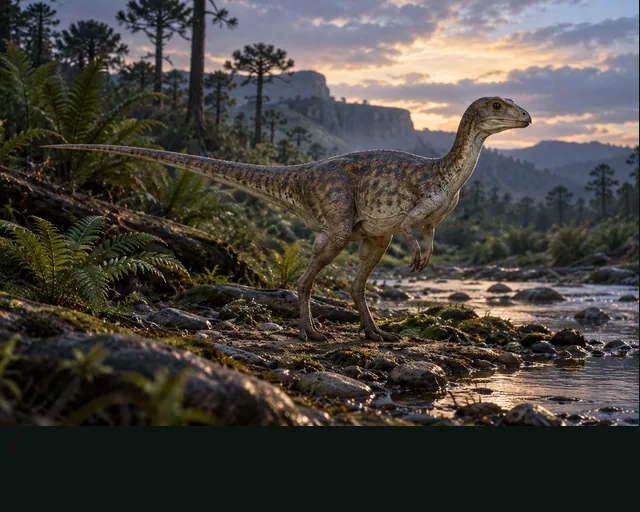
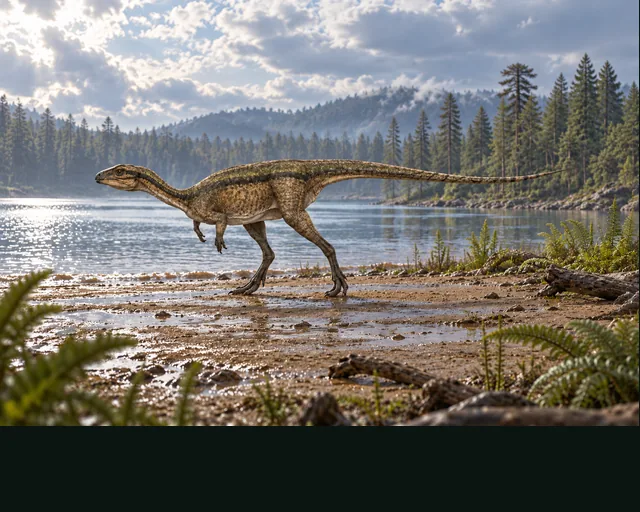
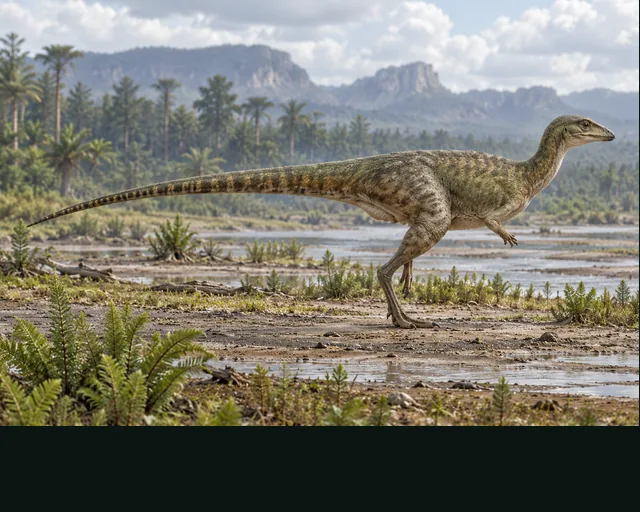
Its lightly built, mainly bipedal body contrasts with the larger quadrupedal armor-bearers familiar from later periods. Early Thyreophora included varied body plans rather than one standard tank-like silhouette.
Genus overview and research references.
Scutellosaurus fossil discoveries
The first Scutellosaurus skeleton was found in June 1971 by David Lawler, then an intern at the Museum of Northern Arizona. It lay in the Kayenta Formation on Navajo Nation land in northern Arizona. A second, larger and less complete skeleton followed in 1977. The palaeontologist Edwin Colbert described both in 1981 and named the species Scutellosaurus lawleri in honour of Lawler.
Later expeditions by several museums and universities, up to the year 2000, added many more. A 2021 anatomical study counts roughly 70 to 80 specimens, which makes Scutellosaurus the most commonly found dinosaur in the Kayenta Formation. It is unusual for such a small, early dinosaur to be known from so much material, although the skull is still poorly known.
How big was Scutellosaurus?
Scutellosaurus was small. Museum and reference summaries give a length of about 1.2 to 1.3 metres, and the body-mass figure usually quoted is about 3 kilograms, which is a single published estimate from Gregory Paul’s field guide rather than a measured value.
Much of that length was tail. The holotype preserves 58 tail vertebrae, which the 2021 study thinks represents nearly the whole tail. That long tail may have helped balance the body, a suggestion made in older reference summaries.
What armour did Scutellosaurus have?
The name refers to its armour. Hundreds of small bony plates, called osteoderms, grew in the skin along its back and tail. Colbert’s holotype was reported to include more than 300 of them. The 2021 study sorted them into several shapes, including plates with flat bases, plates with hollow bases and two-keeled plates.
How the plates were laid out on the living animal is not certain. Published reconstructions, including the one in the 2021 study, show the arrangement as speculative. Some popular accounts describe neat parallel rows of plates, but the plates are often found shifted from their original positions, so any pattern is an interpretation.
The front of the snout had a rough, pitted tip, which suggests it was covered by a horny beak, as in other early ornithischians. That is a clue to a plant-eating lifestyle, not direct evidence of what it ate.
Did Scutellosaurus walk on two legs or four?
This is one of the main questions about the animal. Colbert noted its relatively large hands and its limb proportions and suggested that Scutellosaurus might have walked on all fours at least some of the time, though he treated that as uncertain. A later test of bone features linked to quadrupedal walking in ornithischians scored Scutellosaurus as an obligate biped, meaning it habitually walked on its hind legs. The 2021 study accepts that view and calls it the only definite two-legged armoured dinosaur.
The authors also tested whether adding armour would have tipped the balance forward and forced it onto four legs. In their calculation the centre of mass shifted slightly backwards instead. The hand bones are too poorly known to settle the matter completely.
How old is Scutellosaurus?
Sources do not agree on a single age. The Natural History Museum lists 205 to 202 million years ago, while other summaries use about 196 million years ago. A 2021 study points to a preliminary uranium-lead date of about 183.7 million years from the same part of the Kayenta Formation, which would place the fossils in the Pliensbachian and Toarcian stages of the Early Jurassic. The authors say this is much younger than older ideas of a Triassic age.
For that reason this page gives only the broad Early Jurassic label. Treat any single number as approximate until the dating of the Kayenta Formation is settled.
Scutellosaurus and the armoured dinosaurs
Scutellosaurus is placed in Thyreophora, the armoured dinosaurs, and recent analyses place it very close to the base of the group. Colbert first compared it with the small ornithischian Lesothosaurus from South Africa. Later armoured dinosaurs became much larger, such as Scelidosaurus from England, which is usually seen as mainly four-legged, and the plated Stegosaurus and the club-tailed Ankylosaurus.
Scutellosaurus shows that the earliest armoured dinosaurs were small and light. It did not yet have the heavy build of its descendants.
The world of Scutellosaurus: the Kayenta Formation
The Kayenta Formation belongs to a thick series of sandstones that built up in the early Mesozoic. The wider region was largely dry, with huge dune fields, but there were wetter spells that left river and lake deposits, and Scutellosaurus fossils come from those. Other animals found in the formation include the meat-eating Dilophosaurus, an early sauropodomorph called Sarahsaurus, and tritylodontids, a group of synapsids (relatives of mammals).
The 2021 study notes that Scutellosaurus remains are far more common than those of the formation’s meat-eaters or sauropodomorphs, which is different from other well-sampled Early Jurassic sites such as the upper Elliot Formation of South Africa.
Classification and fossil record
The Paleobiology Database taxonomic record catalogues Scutellosaurus under Thyreophora. This is the immediate parent in that catalogue, rather than a complete list of evolutionary relationships.
The sourced length estimate for Scutellosaurus is 1.2–1.3 metres. This is an estimate for the reconstructed animal, not a measurement shared by every individual. See the body-size discussion and linked evidence for context.
Research starting point
The catalogue links Scutellosaurus to Colbert, 1981, published in Museum of Northern Arizona Bulletin. This identifies a research starting point; the catalogue’s citation alone does not verify every later reconstruction or species assignment.
For the meaning of taxonomic terms and how evidence is checked, see the glossary and editorial policy.
Quick answers
- Is Scutellosaurus a dinosaur?
- Yes. Scutellosaurus was a small ornithischian dinosaur, one of the earliest known armoured dinosaurs (thyreophorans), from the Early Jurassic of Arizona in the United States.
- When did Scutellosaurus live?
- It lived in the Early Jurassic, but sources disagree on the exact age. Estimates range from about 205 million years ago to a preliminary date of about 183.7 million years ago for its rock layer.
- How big was Scutellosaurus?
- About 1.2 to 1.3 metres long, much of it tail. The commonly quoted body mass of around 3 kilograms is a single published estimate, so treat it as approximate.
- Did Scutellosaurus walk on two legs?
- Most likely. A bone-feature analysis and the 2021 anatomical study treat it as an obligate biped, although Colbert originally suggested it might sometimes walk on four legs.
- What did Scutellosaurus eat?
- Scientists think it ate plants. The inference comes from its beaked snout, small teeth and its place among early plant-eating ornithischians, not from preserved stomach contents.
- Where was Scutellosaurus found?
- In the Kayenta Formation on Navajo Nation land in northern Arizona, USA. Colbert described the first two skeletons in 1981, and many more have been collected since.