Jurassic Dinos editorial · Updated · Source-based review
What is Dilophosaurus?
Dilophosaurus was an Early Jurassic North American theropod with two skull crests.
Distinctive features and evidence
Arizona skeletons were initially assigned to Megalosaurus before the distinct crest anatomy prompted a new genus. The fossil record supports the crests; popular depictions of venom and a neck frill require evidence that the cited sources do not provide.
Genus overview and research references.
Dilophosaurus fossil discoveries in Arizona
The story begins with a Navajo man, Jesse Williams, who found fossil bones on the Navajo Indian Reservation in northern Arizona in 1940. In 1942 he guided members of a University of California expedition led by Charles Camp to the site, near Tuba City. There they found three skeletons lying in a rough triangle: one nearly complete, one badly weathered but with the front of the skull, and one reduced to a few vertebrae.
The best skeleton was wrapped in plaster, taken to Berkeley and mounted over two years. In 1954 Samuel Welles, who had been part of the team, described it as a new species of Megalosaurus, a catch-all genus for theropods at the time. In 1964 Welles found a larger skeleton nearby and, as it was prepared, the skull crests became clear. They had been mistaken earlier for a misplaced cheek bone. Welles created the name Dilophosaurus in 1970 and later admitted the crests had come as a complete surprise to him.
A full re-description by Adam Marsh and Timothy Rowe followed in 2020. They sorted out which parts of the old mounts were real bone and which were plaster reconstruction, removed some fragmentary material from the genus, and relocated the original quarry. Marsh called it the best worst-known dinosaur, because it was famous but poorly understood.
How big was Dilophosaurus?
Dilophosaurus was a slender, lightly built predator. The largest specimen is estimated at about 7 metres long and about 400 kilograms, and its skull was about 59 centimetres long. The holotype, the original named skeleton, was a younger animal, estimated at about 6 metres long and 283 kilograms. The two 1942 skeletons are interpreted as juveniles and the 1964 skeleton as an adult about a third bigger, so the growth stage matters when comparing figures. Tissue studies suggested rapid growth early in life, of about 30 to 35 kilograms a year.
The neck bones were hollowed out and very light, and the jaw bones and vertebrae had air spaces, which kept the body strong without making it heavy. The hand had four fingers, but the fourth was vestigial, meaning it was still present but had lost its function. It was one of the largest land animals in North America in its time.
What were the crests of Dilophosaurus for?
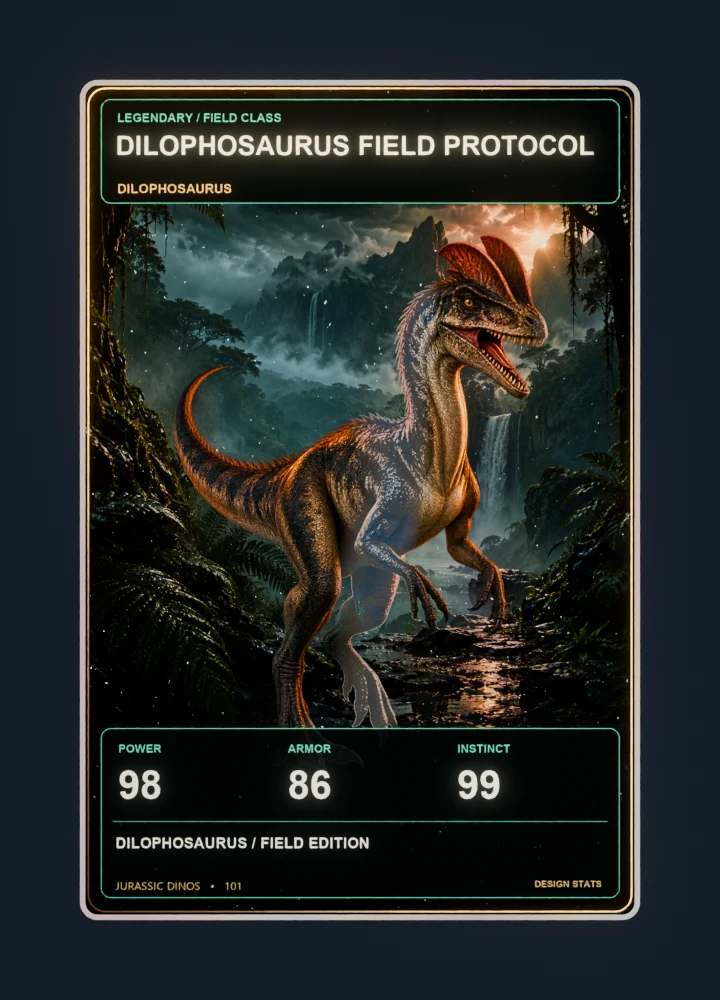
The two thin, arched crests on top of the skull are the animal’s most famous feature. Only one specimen preserves much of them, so their full shape is unknown. They were probably covered in keratin, the material of fingernails, which could have made them larger than the bone alone shows.
The crests were too delicate for fighting. Scientists most often suggest that they were used for display, such as recognising other members of the species or attracting mates, but this is an interpretation, not something the fossils prove. Air sacs in the skull bones seem to have extended into the crests, but it is not known whether that mattered for display.
What did Dilophosaurus eat?
Early studies saw a weak biter. Welles thought the notch in the upper jaw, below the nostril, made the snout weak and that the animal was more likely a scavenger. Later work disagreed. A 2005 jaw-strength study suggested the front of the lower jaw was used to catch and handle smaller prey. Other researchers pointed out that the tooth-filled jaw tip resembles that of fish-eating crocodilians, and suggested fish may have been on the menu.
In 2018 Marsh and Rowe reported possible tooth marks on a skeleton of the early long-necked dinosaur Sarahsaurus, and a young Dilophosaurus was found in the same quarry. They suggested that Dilophosaurus could feed on large prey as well as small animals and fish. Most researchers today think it was an active hunter rather than just a scavenger, although the evidence for what it usually ate is limited.
Dilophosaurus footprints and Jurassic Park
Several kinds of three-toed footprints have been attributed to Dilophosaurus or similar theropods, including a Utah trackway with resting marks showing hand prints, but such matches are hard to prove because no skeleton is found alongside them. Some researchers also suggested that marks around a resting trace might be feather impressions, while others view them as an effect of the sediment, so Dilophosaurus feathers remain unproven.
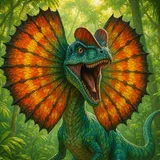
In the 1990 novel Jurassic Park and the 1993 film, the dinosaur spits venom and flares a neck frill. Both were invented. There is no fossil evidence for either, and the film also shrank it to about 1.2 metres tall compared with an estimated height of about 3 metres. The real Dilophosaurus was much larger than the film version and had two crests, not a frill.
Where and when Dilophosaurus lived
Dilophosaurus is known from the Kayenta Formation of northern Arizona, which dates to the Early Jurassic. Its age is complex: one estimate puts the formation at roughly 196 to 186 million years ago, and the Natural History Museum gives about 184 million years. The landscape was seasonally dry, with sand dunes moving in and out of wetter river areas lined with conifers, which has been compared to a river oasis.
Its neighbours included the small theropod Megapnosaurus (once called Syntarsus), the early long-necked Sarahsaurus, the armoured Scutellosaurus, and early crocodile relatives, turtles, lungfish and early mammal relatives.
Is Dilophosaurus related to Allosaurus?
Not closely. Dilophosaurus is a theropod from near the base of the family tree, living tens of millions of years before Allosaurus and from a different branch. Researchers do not agree on exactly where it fits. Some have placed it in the family Dilophosauridae with Dracovenator, while Marsh and Rowe in 2020 did not find support for that group and placed Dilophosaurus as the sister of the group containing later theropods such as Ceratosaurus and the tetanurans. A Chinese crested theropod once named Dilophosaurus sinensis is now placed in the genus Sinosaurus.
Dilophosaurus in the game
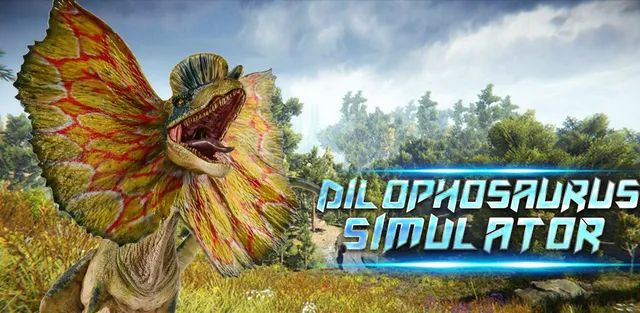
Dilophosaurus Dino Simulator is an Android game in which you play a Dilophosaurus. Its store listing emphasises stealth, ambushing prey, survival resources such as health, energy and water, open-world exploration, quests and unlockable abilities.
The game is entertainment and not scientific evidence. Its abilities and encounters, including how the animal fights, are game design and not findings about the real animal.
Classification and fossil record
The Paleobiology Database taxonomic record catalogues Dilophosaurus under Neotheropoda. This is the immediate parent in that catalogue, rather than a complete list of evolutionary relationships.
Discovery and naming history
Skeletons found in Arizona in 1940 and collected in 1942 underlie its research history. The animal was initially assigned to Megalosaurus before receiving its own genus, while a Chinese species once called Dilophosaurus was reassigned to Sinosaurus. Historical overview.
The corroborated occurrence sample includes United States; those are modern discovery locations, not a complete ancient geographic range.
The sourced length estimate for Dilophosaurus is 6–7 metres. This is an estimate for the reconstructed animal, not a measurement shared by every individual. See the body-size discussion and linked evidence for context.
Research starting point
The catalogue links Dilophosaurus to Welles, 1970, published in Journal of Paleontology. This identifies a research starting point; the catalogue’s citation alone does not verify every later reconstruction or species assignment.
For the meaning of taxonomic terms and how evidence is checked, see the glossary and editorial policy.
Quick answers
- Is Dilophosaurus a dinosaur?
- Yes. Dilophosaurus was a theropod dinosaur from Early Jurassic North America, known from fossils found in Arizona.
- When did Dilophosaurus live?
- Dilophosaurus lived in the Early Jurassic, with the Kayenta Formation dated to roughly 196 to 186 million years ago, though the dating is complex and other estimates exist.
- How big was Dilophosaurus?
- The largest specimen is estimated at about 7 metres long and about 400 kilograms, while the smaller holotype was about 6 metres and 283 kilograms.
- Could Dilophosaurus spit venom?
- There is no fossil evidence of venom or a neck frill. Both were invented for the novel and film Jurassic Park, and the real animal had two bony crests on its skull.
- What did Dilophosaurus eat?
- It was a meat-eater. Researchers suggest small animals, fish and possibly larger prey, and tooth marks on a Sarahsaurus skeleton may be from Dilophosaurus.
- Where was Dilophosaurus found?
- The main skeletons came from the Kayenta Formation on the Navajo Nation near Tuba City in northern Arizona, found in 1940 and collected in 1942.