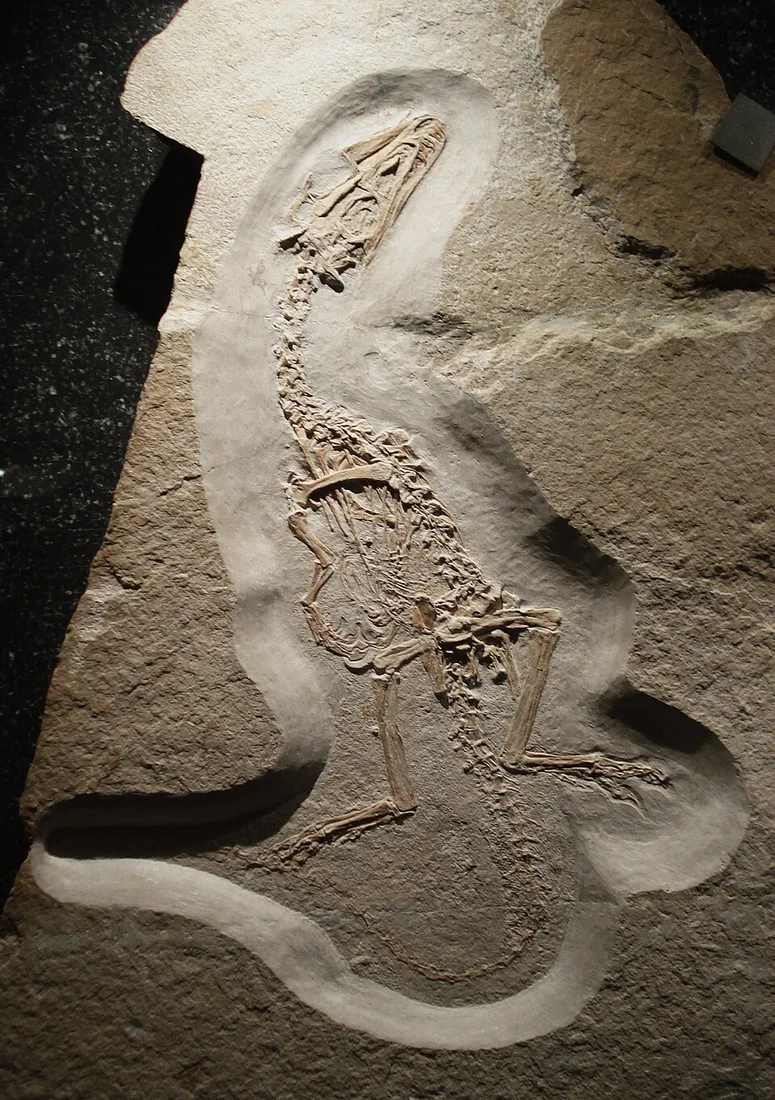
Jurassic Dinos editorial · Updated · Source-based review
What was Coelurus?
Coelurus was a small, lightly built predatory dinosaur from Late Jurassic North America. It lived during the time represented by the Morrison Formation, alongside a much more famous assortment of giant sauropods and large theropods. Small predators were part of those ecosystems too.
What makes the fossil distinctive?
The name means hollow tail and refers to the thin-walled construction of its tail vertebrae. Hollow spaces can reduce skeletal mass, but their presence alone does not prove that an animal flew. Different parts of the skeleton provide different clues to movement and physiology.
Where was it found and how was it named?
Othniel Charles Marsh named Coelurus in 1879 from material in Wyoming. Its history includes species later reassigned elsewhere and confusion with Ornitholestes. The currently recognised genus should be distinguished from the broader group Coelurosauria, whose name is related but whose membership is much wider.
What can we infer, and what remains uncertain?
Coelurus is known from a partial skeleton rather than a complete skull-to-tail fossil. Long legs support discussion of a mobile two-legged animal, but a precise running speed would require additional assumptions. Compare it with other small theropods to explore body proportions, while remembering that a shared formation covers many places and a long span of time.
Does Coelurus mean the same thing as Coelurosauria?
No. Coelurus is one genus; Coelurosauria is a much larger evolutionary group containing many different dinosaurs.
How can you check the evidence?
The Paleobiology Database record catalogues Coelurus under Coelurosauria. Its linked bibliography identifies this research starting point: O. C. Marsh. 1879. Notice of new Jurassic reptiles. The American Journal of Science and Arts, series 3 18:501–505. Open the bibliographic record. A catalogue entry establishes the source trail; it does not independently verify every later illustration or behavioural claim.
Use the dated genus overview to follow the references behind the discovery and anatomy discussed above. When sources disagree, compare which specimen and rock layer each author studied. A reconstructed whole animal can combine original bones with comparisons to relatives; those two kinds of evidence should not be confused. The account above explains the particular limits that matter for Coelurus, rather than supplying unsupported size, speed or lifespan figures.
Read the image and keep exploring
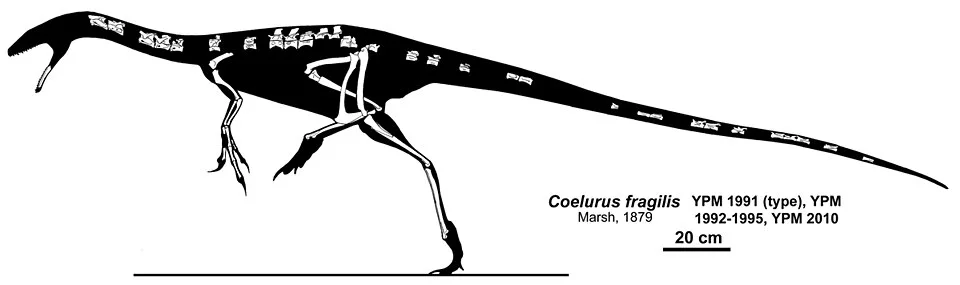
A Coelurus skeletal diagram shows known bones inside a slender theropod outline, leaving the distinction between fossil and reconstruction visible. This diagram explains the stated evidence; schematic elements are not additional fossil observations.
Compare Compsognathus, Juravenator. Find more names in the C index and explore theropod field notes. The glossary explains unfamiliar fossil terms.
Quick answers
- Where have Coelurus fossils been found?
- The discoveries discussed here come from United States. Modern place names describe discovery locations, not a complete ancient geographic range.
- When did Coelurus live?
- It is placed in the Jurassic period. See the discovery discussion for qualifications about the particular rock layers and dating.
- Where can I compare Coelurus with related dinosaurs?
- Follow the related field notes below. Comparisons explain shared anatomy; they do not imply that all the animals lived together.