Jurassic Dinos editorial · Updated · Source-based review
What is Compsognathus?
Compsognathus was a small Late Jurassic European theropod known from informative German and French specimens.
Distinctive features and evidence
Preserved prey remains supply direct evidence about feeding. The smaller German skeleton is interpreted as immature, so the popular chicken-sized comparison should not be generalized to every adult of the genus.
Genus overview and research references.
Compsognathus fossils: two skeletons, two countries
Compsognathus is known mainly from two almost complete skeletons, which is rare for a small dinosaur. The first came from the Solnhofen region of Bavaria, Germany. It belonged to a physician and collector named Joseph Oberndorfer, who lent it to the palaeontologist Johann Wagner. Wagner named it in 1859 and gave a fuller description in 1861. The exact year and quarry are unknown, but it was probably found in the 1850s on a heap of waste rock from limestone quarrying.
The second skeleton was found around 1971 in lithographic limestone at Canjuers, near Nice in southern France, and was bought by the Paris natural history museum in 1983. It was first announced as a second species, Compsognathus corallestris, because it was larger and its hand looked different. Later researchers decided it was just a bigger individual of the same species, Compsognathus longipes, and in 1984 the German skeleton was identified as a juvenile.
Some other material has been linked to the genus but is less certain. A set of 49 isolated teeth from a coal mine in Portugal was assigned to Compsognathus in 1998, though they differ from those of C. longipes and are labelled only as an unknown species of the genus.
How big was Compsognathus?
Compsognathus is often called chicken-sized, and that comparison comes from the German skeleton. Estimates for that animal range from about 70 to 89 centimetres long and from roughly 0.3 to 0.6 kilograms in weight. Because the same skeleton is thought to be a young animal, it is not a good guide to adult size.
The larger French skeleton was estimated at about 1.25 to 1.4 metres in length and about 2.5 to 3.5 kilograms. The Natural History Museum’s summary lists a length of 0.7 metres and a weight of 3 kilograms, so published figures vary depending on which specimen and which method are used. For decades Compsognathus was the smallest known non-bird dinosaur, but later finds such as Microraptor turned out to be smaller still.
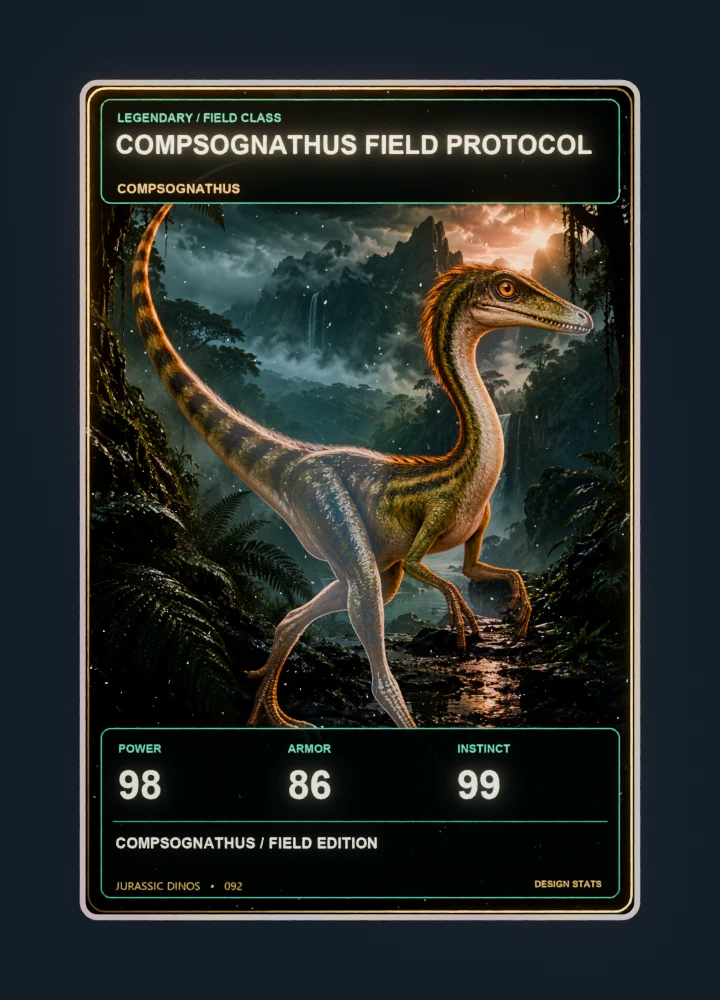
The animal had long legs and an even longer tail, which probably helped with balance on two legs. The arms were short, and the hand had two large clawed fingers plus a smaller third finger that may not have worked. The skull was long and narrow with a tapering snout and relatively large eye sockets.
What did Compsognathus eat?
Compsognathus is one of the few dinosaurs where the last meal is actually preserved. Inside the rib cage of the German skeleton lie the bones of a small lizard. The palaeontologist John Ostrom identified it as a lizard of the genus Bavarisaurus, which had a long tail and limbs built for quick running. The lizard bones are broken into several pieces, which has been taken to mean the dinosaur tore its prey apart before swallowing it. The French skeleton also contains remains of small lizard-like reptiles.
The small, pointed teeth fit this diet of small backboned animals, and some researchers suggest insects may also have been eaten, though no fossil shows that directly. Quick prey would have called for good eyesight and fast starts, which is Ostrom’s reasoning, not a measured fact.
A few older ideas have not held up. A 1972 claim that the French skeleton had webbed, flipper-like hands, suggesting a swimming lifestyle, was rejected because the marks sit beyond the bones and look like features of the rock. Round marks near the German skeleton were once read as eggs, but they lie outside the body and are now doubted.
Did Compsognathus have feathers?
Nobody knows. Close relatives from China, such as Sinosauropteryx and Sinocalliopteryx, were preserved with simple, hair-like feathers, so many illustrations give Compsognathus a fuzzy coat. However, no feathers or feather-like covering have been found with either Compsognathus skeleton, even though Archaeopteryx feathers do survive in the same kind of rock.
In 2006 a researcher reported bumpy skin impressions on the tail. A 2022 review reinterpreted these as odd bone growths rather than scales. A skin patch of another possible relative, Juravenator, shows mostly scales with possible hints of simple feathers, which suggests that this group may not have been uniformly feathered. A reconstruction of Compsognathus with or without fuzz is therefore an informed guess.
Where and when Compsognathus lived
Compsognathus lived about 150 million years ago in the Late Jurassic, during the Kimmeridgian and Tithonian ages. Europe at that time was a warm, dry archipelago of islands on the edge of the Tethys Sea. Both skeletons come from fine-grained limestone formed in lagoons between island beaches and coral reefs. The same rocks contain fish, crustaceans, sea urchins and shellfish, and they also hold the flying reptiles Rhamphorhynchus and Pterodactylus and the early bird relative Archaeopteryx.
No other dinosaur has been found in these beds, so some researchers suggest Compsognathus may have been a top land predator on these islands. That is an inference from a small set of fossils. For the German skeleton, researchers have suggested the body was swept or carried into the lagoon from surrounding land, since the animal itself lived on the islands and not in the water.
Is Compsognathus related to birds and Archaeopteryx?
Compsognathus is a theropod, the group of mostly meat-eating dinosaurs that also includes Allosaurus and, within it, the ancestors of birds. It is the namesake of the family Compsognathidae, which also includes Sinosauropteryx, Huaxiagnathus, Mirischia and possibly Juravenator and Scipionyx. Experts disagree on how basal the family is within the coelurosaurs, the group that includes tyrannosaurs and bird relatives.
In 1868 and 1870 Thomas Huxley compared it to Archaeopteryx and described it as a bird-like reptile, an argument that helped establish that birds evolved from dinosaurs. For a long time it was the only well-known small theropod, so it seemed closest to birds; today many other theropods, especially the maniraptorans, are known to be more closely related to them.
Compsognathus in the game
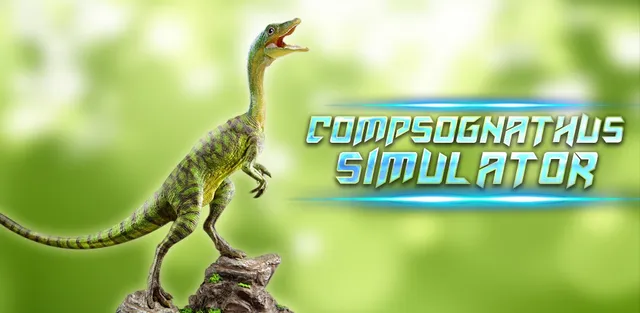
Compsognathus Dino Simulator is an Android game in which you play a small theropod on a Jurassic island. According to its store listing, it includes survival management of health, energy and water, an open world with a weather system, quests, unlockable skills and a customisable character.
The game is entertainment and not a scientific reconstruction. Its abilities, behaviour and the encounters it describes should not be read as evidence about how the real animal lived.
Classification and fossil record
The Paleobiology Database taxonomic record catalogues Compsognathus under Compsognathidae. This is the immediate parent in that catalogue, rather than a complete list of evolutionary relationships.
The corroborated occurrence sample includes France, Portugal, Germany; those are modern discovery locations, not a complete ancient geographic range.
Research starting point
The catalogue links Compsognathus to Wagner, 1861, published in Abhandlungen der königlichen bayerische Akademie der Wissenschaft, II Classe. This identifies a research starting point; the catalogue’s citation alone does not verify every later reconstruction or species assignment.
For the meaning of taxonomic terms and how evidence is checked, see the glossary and editorial policy.
Quick answers
- Is Compsognathus a dinosaur?
- Yes. Compsognathus was a small, two-legged, meat-eating theropod dinosaur that lived in Late Jurassic Europe, in what are now Germany and France.
- When did Compsognathus live?
- Compsognathus lived in the Late Jurassic, about 150 million years ago, in the Tithonian age, with the fossil beds spanning the late Kimmeridgian to Tithonian.
- How big was Compsognathus?
- The juvenile German skeleton was estimated at roughly 70 to 89 centimetres long, while the larger French skeleton was estimated at about 1.25 to 1.4 metres.
- What did Compsognathus eat?
- It ate small animals. Lizard remains are preserved in the bodies of both skeletons, and the German one contained a small, fast lizard called Bavarisaurus.
- Did Compsognathus have feathers?
- It is unknown. Relatives such as Sinosauropteryx had simple feathers, but no feathers have been found with Compsognathus fossils, so feathers are an inference, not a fact.